
The impact of artificial intelligence on our society
Key takeaways:
Artificial intelligence acts as a powerful statistical engine, transforming our society in much the same way as electricity did. Understanding how it works allows us to delegate repetitive tasks to machines so that we can better invest in purely human skills such as empathy and ethical judgment.
This human-machine synergy could, for example, reduce industrial breakdowns by 30%.
Faced with the rapid acceleration of technology, you may be wondering whether algorithms will eventually dictate your decisions or render your skills obsolete.
To shed light on this gray area, we break down the impact of artificial intelligence by exploring its underlying mechanisms, from the transformation of your work environment to changes in education.
This reading will equip you with a precise understanding and a sharp critical mind, transforming a vague threat into a tangible opportunity to regain control over your digital future.
Understanding how artificial intelligence works without jargon
Concrete differences between Generative AI and General AI
The distinction between Generative AI and General AI is fundamental. Generative AI, while impressive in its ability to create text or images, remains “weak AI.” It merely predicts content statistically from existing data, without any understanding of the world. It is a massive production tool, but without consciousness.
In contrast, Artificial General Intelligence (AGI) represents the stage at which machines would be equal to human intelligence in all its versatility. Unlike generative AI, which requires instructions, general AI would possess autonomous reasoning and its own consciousness. Today, we are surrounded by powerful generators, but general AI remains a distant theoretical and scientific horizon.
Comparatif : IA Générative vs IA Générale
| Feature | Generative AI (What we have) | General Artificial Intelligence / AGI (The theoretical future) |
| Nature | A statistical prediction engine. | A universal reasoning system. |
| Operation | Assemble data (words, pixels) according to probabilities. | Understanding concepts, causes, and effects. |
| Objective | Create content from a prompt. | Solve any problem like a human. |
| Consciousness | None. It is an algorithm without a “self.” | Theoretically conscientious or endowed with subjectivity. |
| Adaptability | Limited to its training domain. | Able to learn a new task without assistance. |
Algorithms and data: the engine under the hood
Forget magic, AI is based on pure mathematics and statistics. Far from intuition, the machine processes massive volumes of information to identify correlations and recurring patterns, often too complex for the human mind. This ability to recognize patterns on a large scale is at the very heart of its power.
Thanks to machine learning, computers no longer simply follow fixed rules; they refine their own logic through experience. By “devouring” data, the system adjusts its internal parameters to increase accuracy, transforming the accumulation of examples into predictive capabilities. It is through this cycle of continuous learning that artificial intelligence is able to differentiate between a cat and a dog with surgical precision, achieving a level of reliability that now exceeds the capabilities of the human eye in image analysis.
Parallel with the steam engine and electricity
The impact of artificial intelligence is often compared to the advent of electricity. Like electricity, this technology will permeate all professions without exception. It does not replace everything, but it radically transforms the tools we use.
However, the speed of diffusion is completely unprecedented in industrial history. Whereas the steam engine took decades to become established, AI has taken hold in just a few years. It is this breakneck pace that is so surprising.
The recent Stanford University report on the AI index confirms this massive acceleration. The data shows that it is the most transformative technology of our current century, changing our economy much faster than previous revolutions.
Your daily life under the influence of invisible algorithms
But beyond theory, the impact of artificial intelligence has already quietly colonized your pocket and your living room.
Personalized recommendations on your screens
Netflix and Spotify know your tastes better than your closest friends. Their algorithms analyze every second of your cultural consumption. They predict with uncanny accuracy what you will like next.
On social media, these filters select what you see. This sometimes creates closed information bubbles. We end up seeing only content that confirms our own opinions. This echo chamber limits your view of the world.
The goal is simple: to capture your attention for as long as possible. It is a formidable precision mechanism. It guides our consumer choices in an almost invisible and constant way.
Voice assistants and new modes of interaction
Controlling your smart home with your voice has become an everyday reality. Voice assistants pick up your sound waves and instantly convert them into digital instructions. Thanks to advances in natural language processing, machines no longer just listen: they finally understand the nuances of human speech and can obey your commands precisely.
Artificial intelligence is profoundly redefining our daily lives through practical applications, starting with customer relationship management, where chatbots now automate first-level requests. By instantly answering recurring questions, these conversational agents handle thousands of requests simultaneously, eliminating wait times and increasing customer service efficiency tenfold.
This revolution in user experience extends to our smartphones, whose image processing algorithms enhance our photos in real time, while instant translation breaks down language barriers when we travel abroad. Finally, this technology ensures our digital peace of mind by automatically filtering unwanted calls, proving that AI has become an invisible but indispensable assistant to our productivity.
Optimization of health and financial services
In the field of healthcare, artificial intelligence is revolutionizing medical imaging by analyzing X-rays with surgical precision. By detecting subclinical abnormalities that are often invisible to the naked eye, it enables early diagnoses that save lives by accelerating the treatment of serious conditions.

This technological vigilance is also found in the banking sector, where fraud detection algorithms monitor transactions in real time. Acting as a true digital bodyguard, AI is able to identify a suspicious purchase on the other side of the world and instantly block the credit card, ensuring optimal financial security and continuous protection of your account.
For more information, read the European Parliament’s report on the opportunities of AI. It details improvements in healthcare and safer transportation.
Employment change and new distribution of tasks
This formidable efficiency inevitably raises an uncomfortable question: what will remain of our jobs tomorrow?
Process automation and productivity gains
Process automation is redefining work by eliminating the most repetitive tasks. Artificial intelligence processes massive volumes of data entry and complex tables without ever faltering, freeing up valuable time for strategic, high-value-added tasks. This transformation is profoundly changing the impact of AI on your daily work by putting you back at the heart of decision-making.
In the industrial sector, Airbus perfectly illustrates this advance through predictive maintenance. Smart sensors analyze the condition of components in real time to alert teams even before a failure occurs. This shift from reactive repair to proactive maintenance has generated huge productivity and cost savings, securing the entire production chain.
The ILO study on the impact of generative AI confirms this trend. The study specifies that the profound transformation of our jobs is much more likely than their total destruction.
Jobs on borrowed time and the emergence of Prompt Engineering
The professions of web editing and graphic design are undergoing rapid change: we no longer create from a blank page, but now supervise the production of the machine.
In this new paradigm, your role becomes that of a digital conductor, where mastery of Prompt Engineering is an essential skill. This expertise involves communicating with artificial intelligence to obtain optimal results, transforming technology into a creative lever.
This evolution is affecting many sectors, where technical translators, data analysts, administrative assistants, and even developers are moving into roles as code and content supervisors. Some writing and graphic design jobs are evolving at breakneck speed. We no longer create from scratch; we now supervise the machine. Your role is becoming that of a demanding digital conductor.
Valorization of human and interpersonal skills
When faced with pure calculation, humans retain the advantage of the heart. Empathy and listening cannot yet be programmed. These are our best defenses against the total automation of work and cold binary thinking.
Soft skills are becoming the absolute foundation of your future employability. Knowing how to collaborate or resolve conflicts is vital. Machines can calculate, but they cannot yet manage human irrationality.
Discernment remains our preserve in the face of algorithms. Making an ethical decision requires a level of awareness that algorithms will never have. This is precisely where tomorrow’s added value will come into play.
Learning and teaching with a digital tutor
If the world of work is changing radically, education must necessarily follow suit in order to equip future generations.
Individualization of learning for each student
Every child learns at their own pace. The impact of artificial intelligence allows exercises to be adapted in real time. If a student gets stuck on a concept, the software immediately charts a different course to help them understand.
This data is invaluable for identifying dropouts at a very early stage. Teachers receive specific alerts about each student’s particular weaknesses. It is a powerful and practical tool for combating the widespread academic failure that threatens the system.
Education thus becomes a tailor-made service, almost like haute couture. No longer is everyone forced to fit into the same rigid mold. It is a rather exciting promise of equal opportunities.
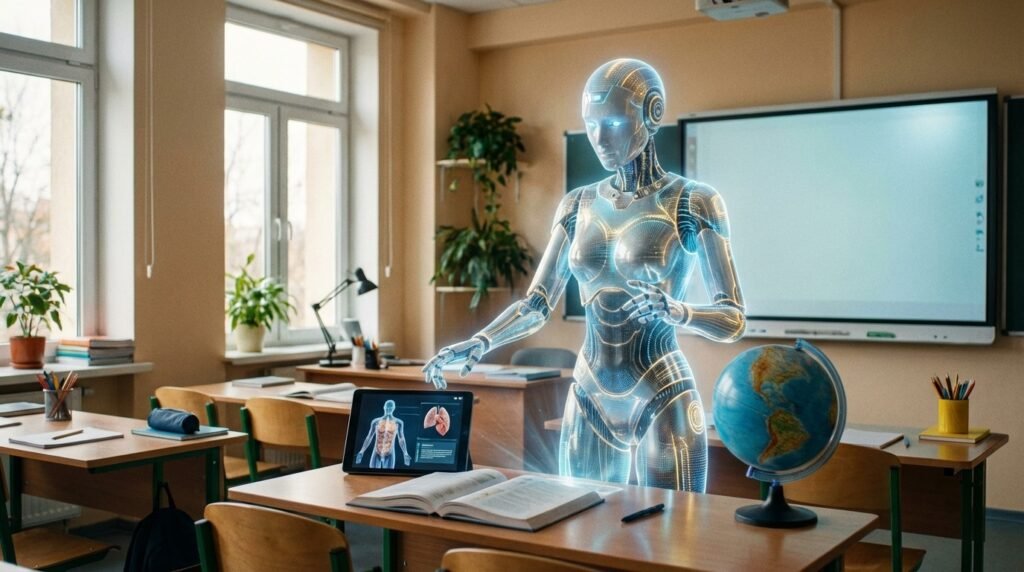
Teacher: from teaching to mentoring
Teachers will no longer be mere disseminators of knowledge. AI can correct papers or take attendance in a matter of seconds. This finally frees up valuable time for real human tutoring.
The teacher becomes a coach who guides critical thinking. They help students navigate intelligently through the mass of available information. Their social and emotional role is more important than ever before in this technological context.
Creating educational content also becomes easier and faster. Quizzes or summaries can be generated with a single click to liven up the classroom. Of course, the teacher retains final control over the educational quality.
Skills of tomorrow and market relevance
In this new technological environment, critical thinking is becoming a fundamental skill to cultivate. It is now imperative to learn to evaluate the answers provided by artificial intelligence with hindsight, rather than accepting a generated result as absolute truth. This attitude of intellectual vigilance is becoming a golden rule for navigating with discernment. At the same time, continuing education is becoming a requirement for all workers, as learning no longer ends with the initial degree. To remain professionally relevant and maintain employability in the face of machines, it is essential to regularly update one’s skills through constant technological monitoring.
Ethical challenges and transparency of automated systems
However, this picture is not without its gray areas, as delegating crucial decisions to simple lines of code carries major risks.
Recruitment bias and data neutrality
Algorithms inevitably inherit our own biases, as they rely on historical data that is often skewed. If training databases convey sexist or discriminatory behaviors, artificial intelligence will simply mimic them, at the risk of unfairly excluding qualified candidates during automated recruitment processes.
These systems must therefore be audited regularly without delay. We must verify that the selection criteria are fair and equitable. Transparency regarding how the calculations are made is an absolute democratic necessity.
These automated errors often affect the most vulnerable. The Council of Europe’s report on algorithmic discrimination explains the negative impact on disadvantaged groups.
Confidentiality and European legal framework
Our personal data is the fuel that powers AI. Protecting it is a matter of individual freedom in the face of tech giants. The GDPR already sets strict limits that must not be crossed.
To go further, Europe has adopted the AI Act, a pioneering law that classifies AI systems according to their level of risk in order to protect citizens. This regulation strictly prohibits abuses such as social scoring, ensuring that innovation does not come at the expense of our fundamental rights. Faced with the threats of mass surveillance, the CNIL’s recommendations on impact analysis remind us of the importance of remaining vigilant in order to preserve privacy and the integrity of our democracy.
Impact on the brain and social connections
Beyond laws, it is our way of thinking and interacting that is undergoing a profound change.
Standardization of thought through generative AI
Generative AI polishes our words to excess in order to appeal to the masses. By delegating our style, our writing ends up becoming dangerously similar. It is a cultural standardization that is quietly taking hold.
True human creativity often arises from error or unexpected chaos. Algorithms, on the other hand, always aim for the most probable and reassuring statistical answer. By following this logic, we risk impoverishing our artistic diversity. This smoothing of ideas, induced by the impact of artificial intelligence, directly threatens artistic diversity by favoring predictability over emotion. To preserve our intellectual uniqueness, it is essential to keep machines in their role as mere technical executors. In the face of the power of code, raw emotion and intuition must remain the exclusive domain of humans, ensuring that technology serves to amplify our vision rather than constrain it within a digital mold. Machines must remain mere executors, never the masterminds.
Risks of mental laziness and information overload
Delegating our fundamental reasoning to artificial intelligence risks causing genuine cognitive atrophy. By abandoning the effort required to synthesize, memorize, or structure information ourselves, we weaken our natural intellectual abilities. At the same time, the incessant flow of automated content saturates our digital attention. We find ourselves overwhelmed by a mass of data that is sometimes meaningless, where discerning truth from falsehood becomes an exhausting daily ordeal for our brains.
Faced with this digital burden, imposing strict periods of disconnection is no longer a luxury, but a necessity for our mental health. It is urgent that we regain control over our available brain time and no longer let technology dictate our biological rhythm. Preserving our ability to concentrate and think deeply is the ultimate bulwark to ensure that AI remains a tool to assist us and not a substitute for our own intelligence.
Transformation of interactions between individuals
Algorithms now intrude unabashedly into our most intimate conversations. Pre-packaged responses often dictate the content of our personal exchanges. The spontaneity of our relationships takes a severe blow.
We end up talking to bots without even really realizing it. This blurred line between humans and code disrupts our usual social norms. Trust, the glue that holds our society together, is slowly crumbling. You no longer know who you’re talking to.
We are sliding towards a form of assisted solitude, where machines fill the silences but impoverish the depth of our exchanges. To protect our social interactions, it is crucial to remain aware of the impact of algorithms on the way we communicate, so that we do not allow technology to replace genuine human connection with a simulation of presence.
Strategies for humane and ecological integration
To avoid this future, we must take back control and impose our own conditions.
Countering mathwashing with critical thinking
The concept of mathwashing represents a major rhetorical trap, consisting of concealing political or partisan choices behind the apparent neutrality of numbers. By making us believe that a decision is objective simply because it is algorithmic, we sidestep the essential ethical debate. However, it is crucial to always question data governance by seeking out the human intent hidden behind the code: who programmed the tool and with what real objective?
Questioning algorithmic neutrality is now an essential act of modern citizenship. We must not allow equations or simple accounting logic to dictate our morality or replace social justice. Keeping a critical eye on every result produced by artificial intelligence ensures that technology remains a tool that serves society, rather than an opaque instrument that serves private interests.

Frugal AI and reducing the carbon footprint
The environmental impact of technology is often overshadowed by its achievements, yet training large-scale artificial intelligence can consume as much electricity as a small town. Data centers generate a massive carbon footprint, heating up the planet with every request they process. Faced with this climate challenge, frugal AI is emerging as a sustainable alternative, involving the design of more compact models that consume significantly fewer resources.
This approach prioritizes efficiency over energy waste, charting the only possible path for responsible technological development. From now on, choosing tools that promote digital sobriety will become a powerful ecological act, as computing power must no longer be developed at the expense of the climate. The transition to sustainable AI is our next major challenge, requiring constant optimization of algorithms to reconcile innovation with environmental protection.

People at the heart of decision-making: AI serving progress
Humans must remain the final control tower of any automated system. No decision with serious consequences should be delegated exclusively to an algorithm; human judgment must always have the final say. With this in mind, ethics and empathy must guide every technological implementation, because machines, as simple servants devoid of emotions, remain incapable of perceiving the human impact of their calculations. Placing our values at the center of technical innovation is the only guarantee of successful coexistence.
While artificial intelligence is reshaping our reality, it must remain a tool that serves the greater good. In the face of this digital revolution, your critical thinking skills are the essential compass needed to guide this technology wisely and turn it into a real driver of ethical and sustainable progress.
FAQ
What is artificial intelligence (AI) explained simply?
Artificial intelligence is not a magical brain, but a set of computer systems designed to simulate certain human abilities. In concrete terms, these are programs capable of analyzing huge amounts of data to learn how to perform specific tasks, such as recognizing a face, translating a text, or solving complex problems, without having been programmed for each specific step.
What is the difference between generative AI and general AI?
This is a fundamental distinction for understanding the subject. Generative AI is what we use today: it is an expert in a single task (such as playing chess or recommending a TV series) but has no consciousness. General AI, on the other hand, remains theoretical and belongs to the realm of science fiction: it would be a machine with its own consciousness, capable of understanding the “real” world around it and matching human intelligence in all areas.
Will artificial intelligence replace humans in the workplace?
AI is primarily a decision-making and automation tool, not a complete replacement. It excels at managing repetitive tasks and data analysis, allowing workers to focus on higher value-added tasks. While some jobs are changing, empathy, creativity, and ethical judgment remain irreplaceable human skills.
How is AI already present in our daily lives?
It often acts as an invisible assistant. You encounter it when Netflix or Spotify recommend content tailored to your tastes, when your smartphone uses facial recognition, or when your GPS app optimizes your route in real time. These algorithms make everyday life easier by processing information at speeds impossible for humans.
What are the ethical risks associated with the use of AI?
The main challenges concern algorithmic bias and confidentiality. If AI learns from data that contains biases (such as sexism or racism), it risks reproducing them in its decisions. There is also a major issue surrounding the protection of your personal data, which fuels these systems, requiring constant vigilance and strict regulations such as the GDPR.
How is artificial intelligence transforming education?
AI offers a unique opportunity to personalize learning. It can adapt exercises to each student’s level and identify difficulties in real time, acting as a digital tutor. This frees teachers from administrative tasks so they can devote more time to providing personal support and mentoring to students.