
How generative AI creates augmented humans
Key takeaways:
Unlike traditional AI, which sorts, generative AI creates. It acts as a creativity engine, freeing your mind from repetitive tasks to preserve your mental energy.
Your role? To remain the pilot, ensuring the fairness of the outcome.
Artificial intelligence is not there to replace your expertise, but to take it further.
By incorporating how it works, you transform this technology into a lever for cognitive energy.
The tool manages execution; you focus on strategy and your mental health.
What is generative AI?
Between fantasy and technical reality, generative AI marks a breakthrough: it creates original content (text, images, code) where traditional AI was content to simply classify. This leap forward is based on deep learning, systems that mimic our neural networks to analyze colossal volumes of data. These “foundation models” integrate entire libraries to simulate creativity.
However, the tool does not “think.” It assembles elements according to statistical probabilities. Mastering how it works allows you to transform AI into a productivity partner, freeing you from the fatigue associated with pure execution.
How does generative AI work?
AI does not think, it predicts. Just as your brain anticipates the end of a sentence, it calculates the logical continuation of content on a dizzying mathematical scale. In this process, the prompt (your instruction) is your control lever. As the pilot, your intention dictates the quality: a clear command delegates the effort of execution to protect your precious mental fuel.
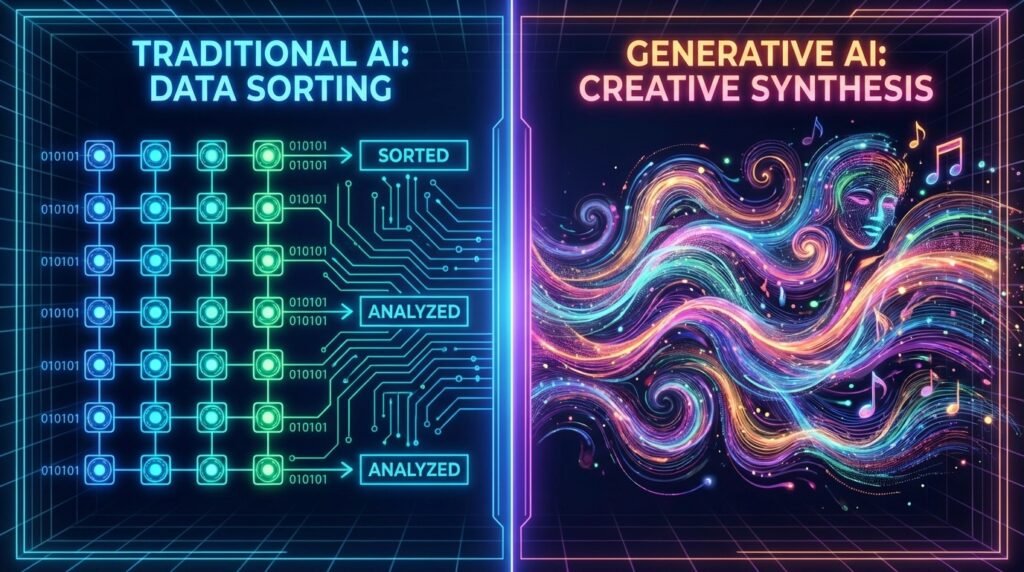
Generative AI and the human brain: a balanced collaboration
According to studies conducted by MIT and Stanford in 2023, using tools such as ChatGPT or Claude can increase worker productivity on complex tasks by nearly 40%.
A drastic reduction in mental load
Consider that artificial intelligence absorbs the structuring and synthesis tasks that often saturate your working memory. By delegating the writing of a first draft or the analysis of long documents to tools such as Perplexity (for research) or Notion AI (for organization), you immediately reduce your mental load.
The new role of the knowledge worker: from creator to curator
In this new landscape, added value no longer lies in the ability to produce raw material, but in the art of curation. AI can generate ten versions of a project in a matter of seconds, but it is unable to determine which one is most relevant to your audience or your strategy.
It is your critical eye that transforms a standardized product into an exceptional piece. Success no longer depends on creative effort, but on the high standards of your selection.

The challenge of intellectual laziness: staying in the driver’s seat
However, for this collaboration to remain healthy, a balance must be maintained to avoid the trap of intellectual laziness. While the tool works for you, it should never think for you.
Generative AI: 4 practical applications to boost your productivity
Beyond theory, artificial intelligence is now embodied in your everyday tools, transforming the way you work. This is not just a feeling: according to a study by NN/g (Nielsen Norman Group), the use of AI improves user performance by an average of 66% on writing and analysis tasks.
Generative AI for text: unleash your writing skills
Writing emails, reports, or articles finally becomes easy. AI structures your ideas as soon as you face the blank page, a phenomenon that consumes a lot of your mental energy. Tools such as ChatGPT, Claude, or Mistral AI allow you to unlock your creativity instantly.
Reformulation is a major asset: it allows you to adjust the tone or simplify a complex message with a single click. By using AI to summarize long documents or correct style, you gain tremendous clarity. A Harvard study has shown that consultants using AI complete their tasks 25% faster with 40% higher quality. It’s an immediate productivity boost that protects your mental health by preventing burnout from purely formatting tasks.

Generative AI for images and audio: a new horizon
Creating custom visuals is now accessible to everyone thanks to models such as DALL-E 3 and Adobe Firefly. You can illustrate an abstract concept in seconds, giving your brand a unique identity without relying on generic image banks. This visual storytelling enhances the impact of your presentations and captivates your audience while saving you design time.
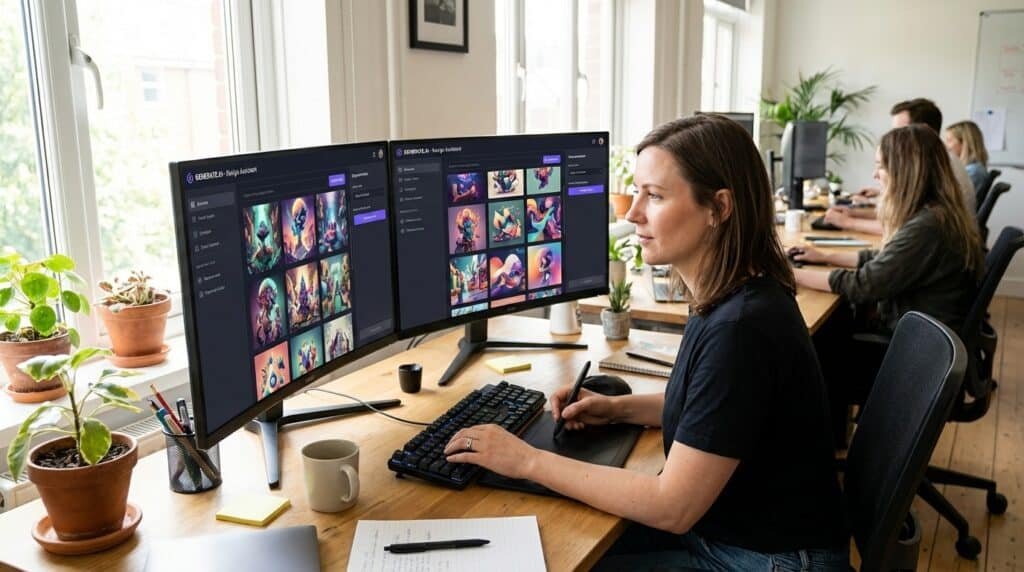
On the audio side, speech synthesis achieves impressive realism with solutions such as ElevenLabs. Transforming text into high-quality podcasts becomes child’s play, facilitating learning through listening (internal “podcasting”). This multi-sensory approach is an excellent way to combat visual fatigue and promote more flexible memorization of your complex content.

Global synergy for microbusinesses and SMEs
The system approach, which combines text, images, and sound, offers unprecedented power. By using platforms such as Canva or HeyGen (for video), you have a real creative agency in your pocket. Your campaigns are completely consistent, and production times are slashed.
This fluidity allows you to move from idea to technical implementation without friction. By automating these workflows, technology fades into the background, leaving room for the final project. You become the conductor again: humans provide the intention and strategy, while AI takes care of the repetitive execution. This is the key to maintaining mental health in a fast-paced digital world.

Key figure: According to Statista, the generative AI market is expected to grow by 24% through 2030, proving that its adoption is no longer an option but a new standard of work.
The benefits of generative AI for your mental well-being
Saving time for no reason is pointless: it’s the time saved for strategy that really counts. A large-scale study conducted by the NBER (Stanford/MIT) confirms an average increase in productivity of 14%, particularly for support and problem-solving tasks. This massive lever allows you to finally focus on what is valuable, letting strategic creativity take precedence over pure execution.
Limits and vigilance: don’t fall into the illusion
The major risk lies in hallucinations: AI can invent facts with deceptive aplomb. Without verification, your critical thinking skills will atrophy. Doubt must remain your protection.
Ethics and confidentiality: manage without putting yourself at risk
In 2026, with the GDPR and the European AI Act in place, protecting your assets is vital. Protection means making your sensitive data (customers, trade secrets) inviolable with regard to model training. According to Cisco (2024), 27% of companies have already restricted AI for fear of leaks.
To navigate with peace of mind, adopt these two habits:
- Transparency: Be clear about the extent of human-machine collaboration in your outputs. Ethics are based on honesty of use.
- Technical security: Choose “Enterprise” versions or local models (installed on your own servers). They ensure that your information remains confined to a secure environment.

The method for intelligent collaboration with AI
To get the most out of these models without exhausting yourself, it is crucial to adopt a rigorous and conscientious working method.
Think before you prompt: the golden rule of “mental drafting”
Don’t rush headlong into typing. Take five minutes to define your real goal before turning to the machine. The clarity of your thinking automatically dictates the quality of the result: AI cannot compensate for a lack of direction. This preliminary reflection process is essential to protect your mental energy.
By knowing exactly what you want, you avoid “prompt loops” — those exhausting back-and-forths where you desperately try to correct a mediocre result because you weren’t clear from the outset. Research in cognitive psychology suggests that “decision fatigue” occurs more quickly when interacting with unpredictable systems without a clear framework.
Use AI as a co-pilot, not as the pilot
Always keep a firm hand on final approval. AI suggests options based on statistics, but you are the one who signs off on the final product. According to a Microsoft study (Work Trend Index), the most successful users are those who view AI as a “very fast intern who needs to be proofread.”
Your expertise remains the ultimate filter of relevance. Be ruthless with the outputs generated: never settle for the first draft without adding your human touch. It is this “finishing touch” that ensures the content remains authentic and avoids the banality of 100% automated productions.
Alternate between assisted production and independent thinking
Set aside time for offline creativity, away from screens and algorithms. This discipline is vital for preserving your neural plasticity and ensuring your originality in the face of standardized AI-generated content.
The reflex to adopt: Before each interaction with AI, ask yourself the question: “Am I asking AI to do the work, or to help me do it better?” The answer will determine whether you remain the driver or become a mere passenger.
Productivity and AI: Why artificial intelligence will not replace human judgment
Artificial intelligence should not be seen as a replacement, but as a driver of transformation. Contrary to popular belief, technology will transform jobs rather than eliminate them. According to the World Economic Forum’s Future of Jobs Report, it is estimated that 78 million new jobs could emerge by 2030 thanks to the integration of AI. This profound change is shifting the value curve: the most sought-after skill is no longer the ability to produce massively, but the ability to ask the right questions and manage systems.
A skills revolution
In this new era, knowing how to collaborate with AI is becoming a basic skill, just as computer literacy was thirty years ago. This professional transformation is based on three fundamental pillars to ensure your performance and mental health:
- Automating energy-intensive tasks: The first benefit is freedom. By delegating time-consuming and repetitive processes (data synthesis, formatting, administrative sorting), you eliminate tasks that overload your mental capacity.
- The emergence of prompt engineering: The profession of Prompt Engineer symbolizes this new stage. It is not just a matter of “talking” to a machine, but of knowing how to structure a complex thought in order to obtain a highly accurate result.
- The need for continuous training: Faced with rapid technological change, agility is your best insurance. Continuous training is no longer an option.

Refocusing on what matters most: human potential
This revolution is, in essence, a historic opportunity for humanity at work. By freeing us from mechanical tasks, generative AI allows us to refocus on our unique strengths: empathy, disruptive creativity, global vision, and complex problem solving.
The future of work will not be a competition against machines, but a synergy where AI handles the computing power while humans handle the meaning. It is the transition from the “executing” worker to the “architect” worker.
Become the conductor of your productivity
Understanding how generative AI works transforms this probabilistic engine into a true exoskeleton for your mind. By delegating repetitive tasks, you free up your cognitive energy for what really matters: strategy and innovation. Don’t delegate your creativity, but enhance it by driving the tool with high standards. Your added value now lies in the art of asking the right questions.

FAQ: Everything you need to know about generative AI
Will generative AI replace humans in the workplace?
It does not spell the end of employment, but rather its transformation. It lacks empathy and ethics, qualities that remain human.
What is the difference between generative AI and ChatGPT?
Generative AI is the engine; ChatGPT is a specific car model. There are other high-performance models such as Claude and Mistral.
Is the information provided by AI always reliable?
No. It calculates probabilities and can “hallucinate.” Human verification is essential.
Do you need technical skills to use these tools?
No. Natural language is the new code. Knowing how to formulate a clear request is enough to operate the tool.
The last word
Technology takes a back seat to the project, and humans once again become the conductors. Now is the perfect time to strengthen your curiosity and make AI your most powerful growth driver.