Digital technology and human behavior:
What impact does it have on the brain?
Key takeaways:
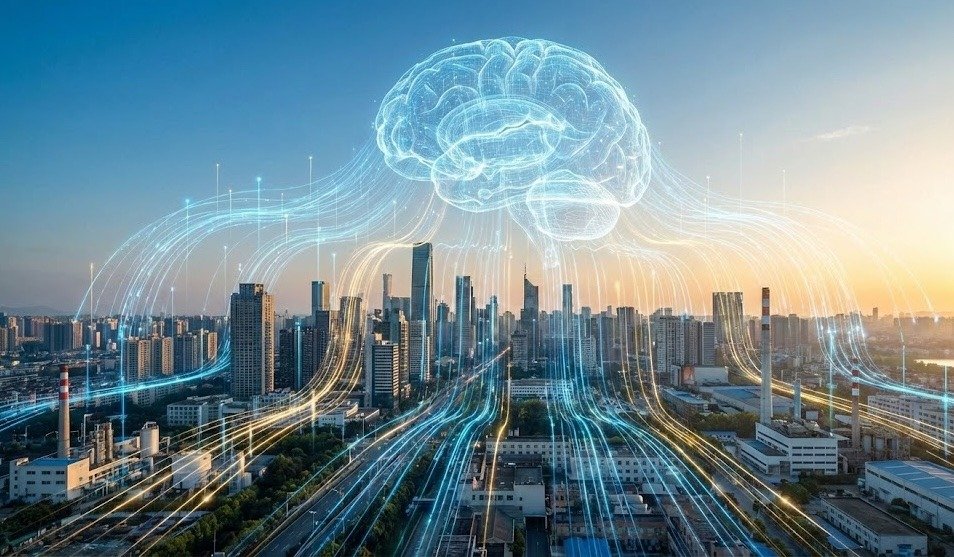
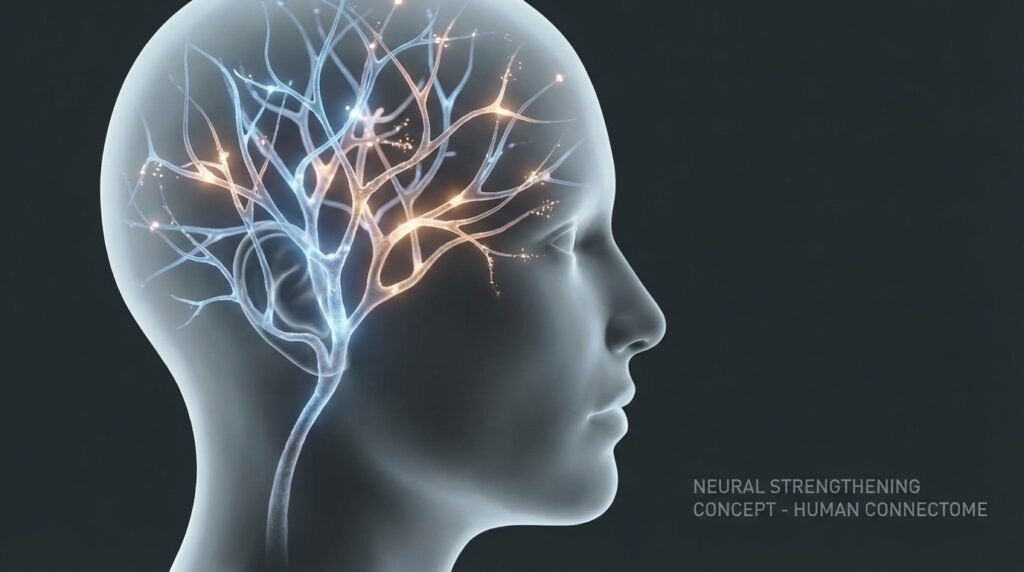
Digital technology tends to act as a global environment that can influence the very architecture of the brain.
This almost constant stimulation of the reward circuit can, in the long term, place excessive demands on cognitive abilities and promote anxiety.
Understanding these biological mechanisms therefore becomes essential.
Do you feel your attention waning and your anxiety rising under the deluge of notifications that plague your daily life? This report analyzes the impact of digital technology on human behavior to reveal how this artificial environment biologically reconfigures your brain circuits and insidiously alters your social connections.
From the trap of “likes” to the loneliness hidden behind your screens, we analyze how your brain is changing despite yourself.
Understanding these biological processes is one of the most effective ways to limit the mechanisms of addiction and regain greater control over your attentional processes.
The effects of digital technology on human behavior and the brain
Having laid the groundwork for the importance of the brain, it is time to explore its inner workings to observe how this machine is physically assembled and how it reacts to the ubiquity of screens.
Learning to survive the flood of information
Your brain is faced with a constant barrage of data. To adapt, it radically changes the way it works: instead of delving deeply into subjects, it has gotten into the habit of skimming over everything very quickly.
While this reflex allows you to sort out the essentials in this constant flow, it weakens your ability to stay focused on a single task for a long time. For your mind, it’s an exhausting effort that resembles forced gymnastics to avoid being overwhelmed by screens.
Behind the scenes at your control tower
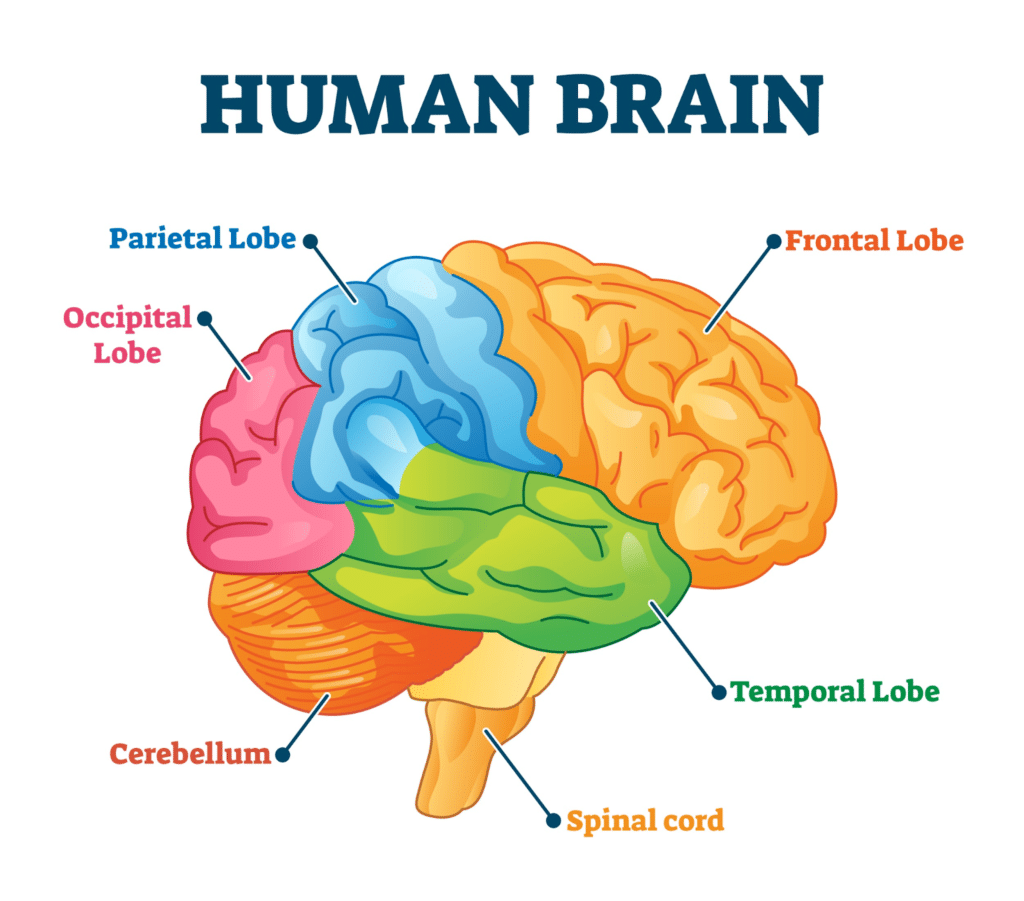
Imagine your brain as a command center where each area has its own specialty:
- Front: this is where you make decisions and think.
- On top: this is the area that receives all your physical sensations.
- On the sides: your brain processes sounds and stores your memories there.
- At the very back: it works to transform light into sharp images.
It is this perfect collaboration between all these positions that brings each of your ideas to life.
The dialogue between your two hemispheres
The left side of the head is often contrasted with the right side. However, these two halves work together every second to coordinate your thoughts and actions. The left side generally deals with logic and words, while the right side manages intuition and your perception of space. A very dense bridge of fibers connects the two: without this constant exchange, your view of the world would lose all meaning.
Gray matter and white matter in mental reactivity
To understand your responsiveness to digital technology, you need to look at two key areas. The “gray matter,” located on the surface, is where your information is actually processed by your cells.
Just below, the “white matter” serves as a connection network. It transports electrical signals at high speed between different regions of your brain. While one analyzes, the other transmits. It is this inseparable duo that allows you to react instantly to what appears on your screens.
4 mechanisms that capture your attention despite yourself
Dopamine: your brain’s pleasure magnet
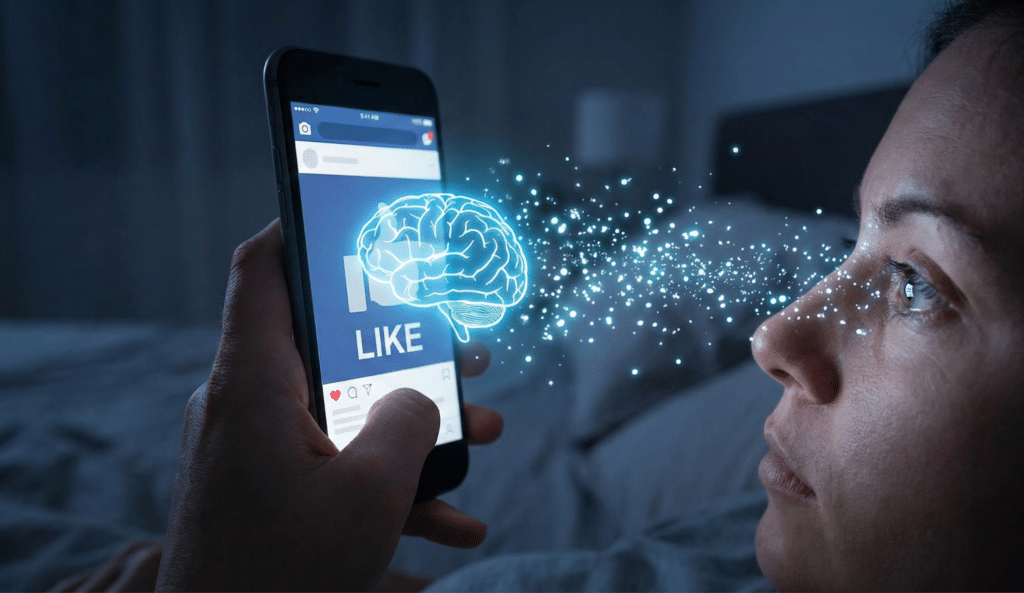
Dopamine is the motivation hormone. It is at the heart of your reward circuitry. Imagine that every notification on your phone acts like a small burst of pleasure in your “pleasure center” (the nucleus accumbens).
Social media is designed to exploit this reflex: it creates endless expectations that force your attention to remain alert. Scientific studies confirm that this system ultimately “hacks” your natural reflexes to make you want to keep coming back to the screen.
To take this further, a scientific study published on ScienceDirect explains how alerts on your phone disrupt your ability to think. It confirms that this system can gradually divert certain natural biological reflexes.
The accelerator and the brake: a question of balance
To function, your brain juggles two chemicals:
- Glutamate (the accelerator): It stimulates your cells to activate sharp thinking. It is the engine of your responsiveness.
- GABA (the brake): It calms overall activity to prevent your mind from becoming overwhelmed or overheated.
Under constant digital pressure, this duo becomes unbalanced. Too much excitement (the accelerator pedal pressed to the floor) without enough rest (the brake pedal) can contribute to the emergence of diffuse anxiety in some people.
Your internal system eventually becomes exhausted due to a lack of real breaks.
The ultra-fast journey of your nerve messages
Your nerve cells, or neurons, are veritable information highways:
- Their “antennae” (dendrites) pick up signals.
- A central “cable” (the axon) propels information at high speed.
- The signal then crosses a “small bridge” (the synapse) to pass to the next cell.
It is this incredible architecture that allows you to react instantly to a visual stimulus on a screen. But this processing speed comes at a price: it consumes a lot of energy.
From habit to trap: when control fades away
Screens end up subtly changing your relationship with reality. There is a major difference between two situations:
- Intensive use: You use the tool a lot, but you remain in control.
- Addiction: Control disappears. You no longer decide to open the app; you do it automatically.
This reinforcement mechanism is powerful. It bypasses your real desires and replaces them with virtual needs.
Little by little, a form of loss of control can set in.
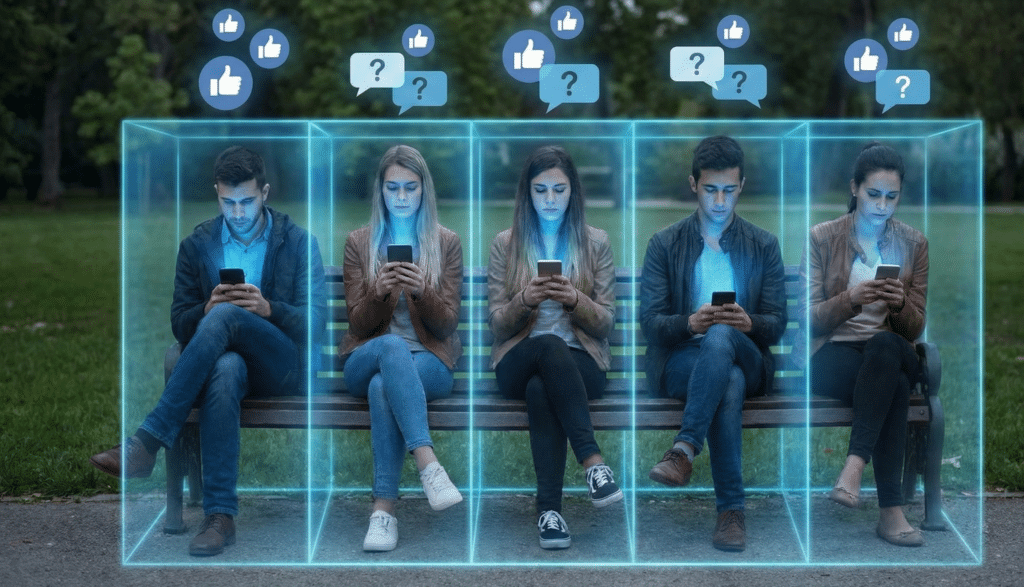
How is digital technology transforming our relationships?
Now that we have seen how your brain reacts chemically, how does this translate into your everyday life with others?
The trap of “connected loneliness”
This is the great paradox of our time: we have never been so connected to each other, yet we often feel increasingly alone. Social ties tend to weaken in certain contexts of intensive use.
Here’s what isolates us without us realizing it:
- The inability to disconnect: one feels obligated to be reachable everywhere, all the time.
- The weight of algorithms: they push us all to behave in the same way in order to “please” the network.
- Tailored exchanges: we end up only talking to people who think exactly like us.
Self-presentation: the reign of appearances
On social media, we are all actors to some extent. We present an idealized image of our lives, often far removed from reality. This need to show ourselves in the best light changes our relationship with the truth.
By constantly comparing ourselves to the “perfect,” filtered lives of others, our self-esteem takes a hit. We end up chasing digital validation (likes) instead of seeking genuine connection. Authenticity fades behind a glossy image.

When “likes” replace real discussion
A simple click on a heart is much faster than a long discussion, but it is also much less meaningful. Today, we want everything right away. Fast-forwarded voice messages and instant reactions are gradually replacing real dialogue, where we take the time to listen to each other.
This culture of immediacy transforms our relationships into mere exchanges of services. We react quickly, but we no longer think together.

The end of daydreaming
In the past, we had moments of downtime: waiting for the bus, standing in line, or simply doing nothing. Today, every free second is immediately filled by a screen.
Yet boredom is essential. It is the breeding ground for imagination. When the brain no longer has space to wander freely, creativity dies. Digital technology abhors a vacuum and systematically fills it, depriving us of our ability to dream.
Why boredom is the “reset” your brain needs
Activating the “Default Network” (DMN)
Contrary to appearances, when you are doing “nothing,” your brain is working at full capacity. It activates what researchers call the Default Mode Network. It is in this state that the mind wanders, rests ideas that seemed unrelated, and participates in connecting ideas and deferred problem solving.
Boredom as a driver of creativity
A study published in the Journal of Experimental Social Psychology showed that people who were given a “boring” task (such as copying a phone book) subsequently developed more original thoughts than those who kept themselves active.
- The mechanism: Dissatisfaction linked to boredom prompts the brain to seek internal stimulation.
- The result: You invent, you imagine, you create your own worlds.
A bulwark against cognitive overload
Hyperconnectivity saturates our receptors. Boredom acts as a natural detoxification. It allows us to:
- Emotional digestion: Sort through the memories and feelings of the day.
- Self-awareness: Returning to internal listening rather than external reaction.

Algorithms: when machines guide your free will
Behind your favorite apps, thousands of lines of code work silently to guide your choices, from the simplest to the most intimate.
The comfort bubble that shrinks your world
Algorithms scrutinize your every click to anticipate your every desire. While this service may seem convenient, it hides a trap: by showing you only what you already like, it reinforces your beliefs and traps you in a comforting bubble. Little by little, surprise and the discovery of new ideas disappear. Without realizing it, you gradually allow automated systems to guide what captures your attention.
Mirrors that isolate us from one another
On the internet, we end up living in “echo chambers” where we only hear the reflection of our own opinions. This mechanism prevents any real dialogue with those who think differently. Instead of debating, we become more radical. This phenomenon poses a major challenge to the quality of social dialogue: when we no longer encounter contradictions, understanding others becomes impossible and society ends up breaking down into isolated pieces.
Gentle but very real manipulation
This invisible influence does not stop at your leisure activities; it also guides your purchases and sometimes even your votes. Each digital suggestion nibbles away at your free will. ADEME is analyzing this complex phenomenon of automated behavioral change. These systems modify our habits without any direct human intervention. It is a subtle but very real and documented form of manipulation.
The brain: a muscle that falls asleep when faced with AI
Today, we tend to entrust our thinking to machines. We entrust our memory and calculations to remote servers. But delegating our thinking is not without risk: like a muscle that is no longer used, our natural thinking abilities weaken.
Résoudre un problème simple sans assistance devient alors une épreuve. L’outil numérique, au départ une aide, se transforme en une béquille indispensable qui met en danger votre autonomie et votre liberté de penser.
3 major consequences on mental health and well-being
This algorithmic influence is not limited to our ideas; it directly impacts our biological and psychological balance.
Cognitive overload and anxiety related to hyperconnectivity
Digital stress saturates your anterior cingulate cortex. This area manages conflicts and strong emotions. Constant hyperconnectivity is frequently associated with increased stress and anxiety.
One feels immense loneliness despite being connected. The brain does not perceive these exchanges as real. The feeling of isolation eventually takes root deep within the user.
Mental fatigue builds up. Constant digital exposure can gradually undermine mental balance.
Impact of screens on sleep and sedentary lifestyles
Blue light disrupts your natural circadian rhythms. It blocks the secretion of melatonin, the sleep hormone. Falling asleep then becomes a real challenge.

Prolonged inactivity in front of screens is harmful to the body. A sedentary lifestyle leads to serious physical problems in the long term. Lack of movement quickly weakens our overall vitality.
The body stiffens. The mind becomes clouded without rest. It’s a vicious circle.
Mental fatigue and the weakening of human equilibrium
Information overload literally exhausts your neural resources. The brain becomes clogged with metabolic waste without sufficient rest. The glial cleaning mechanisms then become ineffective. This mental fatigue undermines your entire human and emotional balance.
We lose clarity and patience. The slightest intellectual effort becomes an insurmountable mountain for the mind.
It’s time to slow down the flow. Your brain needs some welcome silence to function properly.
Practical Guide: Taking Back Control of Your Brain
Taking back control doesn’t mean becoming a digital hermit, but moving from the role of passive consumer to that of conscientious pilot.
Become an “Augmented User” (The Pilot Test)
For each application, ask yourself this question: “Does this tool make me more capable, or does it replace me?”
- Digital technology that “augments” you: This is the kind that requires active effort. Use a language app, follow a carpentry tutorial, or organize a complex project. Here, digital technology is a lever.
- Digital technology that “replaces” you: This is technology that does your work for you or numbs your senses. Endless scrolling, automatic recommendations that choose your movies, or AI that writes your messages without you having to think. Here, digital technology is a crutch.
Practical action: Clean up your home screen. Only keep “augmentative” tools in view. Hide “substitute” tools in folders deep within your phone to break the habit.

Sanctuarize your environment (The rule of 3 places)
The brain is very sensitive to habits associated with places. To calm anxiety, create areas of total “digital silence”:
- The bedroom: It must once again become a sanctuary for sleep and intimacy. Blue light is biologically harmful to your melatonin.
- The dining table: This is where real social interaction takes place. A phone on the table, even if it is turned off, reduces the quality of conversation (this is the “iPhone effect” documented by researchers).
- The journey (without a screen): Use your travel time to look out the window or simply let your thoughts wander. That’s where creativity comes from.

The chemical imbalance: Dopamine vs. Serotonin
It is crucial to understand that your brain does not seek the same pleasure depending on the activity.
- Dopamine (the “flash”): This is triggered by immediate novelty (likes, notifications). It is a quick pleasure that often leaves you feeling empty afterwards.
- Serotonin (The “Flow”): It is triggered by accomplishment, physical effort, or manual creation. It is a lasting feeling of satisfaction.
| Activity | Neurotransmitter | Effect on mood |
| Scrolling through Instagram | Dopamine | Rapid excitement followed by fatigue or desire. |
| Cook a dish | Serotonin | Pride, calmness, and a sense of purpose. |
| Receive a notification | Dopamine | Alert, interruption of concentration. |
| Do 30 minutes of exercise | Serotonin/Endorphin | Deep relaxation and mental clarity. |
Train your attention “muscle”
Attention works like a muscle: if you never exercise it over long periods of time, it atrophies.
- Practice “Deep Work”: Choose an activity (reading, writing, drawing) and set yourself 25 minutes without any interruptions.
- Turn off 90% of notifications: Take back your right not to be interrupted. Keep only phone calls (for emergencies) and turn off everything else.
- Embrace boredom: Next time you’re waiting for someone, resist the urge to pull out your phone. Observe your surroundings. It’s in this void that your brain regenerates.
That’s the secret to lasting well-being. Rediscover the taste for concrete things.
Conclusion: Becoming the architect of your own attention
Ultimately, digital technology is not just a window onto the world; it is a total environment that shapes the biology of your mind, day after day. Between the fleeting dopamine rush of notifications and the numbing comfort of algorithms, the challenge is immense, but the power remains in your hands.
Your brain is the most complex work of art in the universe: don’t let a line of code become its sole architect.
By consciously choosing to put down your screen to rediscover silence, movement, or real conversation, you are not just “disconnecting.” You are protecting your ability to think, create, and remain free. Taking back control of your attention literally means preserving your ability to think, create, and decide freely.
FAQ : Comprendre l’impact du numérique sur votre cerveau
How does digital technology actually change the way your brain works?
Digital technology acts as a new environment to which your brain is constantly trying to adapt. Faced with a deluge of information, your mind relegates deep thinking to a quick, superficial scan (known as “zapping”).
Biologically speaking, this habit can alter the very structure of your brain. The decision-making center (the prefrontal cortex) and the memory center (the hippocampus) can weaken. In short, your brain reconfigures itself to deal with urgency and immediacy, but it loses its ability to concentrate and take a step back.
Why are social media and notifications addictive?
Everything depends on the reward circuit. Every notification or “like” triggers a small rush of dopamine, the hormone associated with motivation and pleasure. It is this mechanism that causes you to automatically check your phone.
Through constant stimulation, your brain becomes accustomed to it and demands increasingly frequent “doses” to feel the same satisfaction. This is how a cycle of dependence sets in: you no longer connect out of desire, but out of reflex, to calm a form of anxiety or withdrawal.
How does screen use affect the quality of your social relationships?
This is the paradox of digital technology: we are hyper-connected, but often more alone. The presence of a screen between two people creates an invisible barrier that weakens our ability to pay attention to each other. Conversations become faster, but less meaningful.
What’s more, social media encourages self-promotion. By constantly comparing yourself to “filtered” and idealized lives, authenticity disappears. A simple “click” ends up replacing real conversations, sometimes turning friendship into a series of virtual interactions without any real human warmth.
How do algorithms impact your freedom to choose?
Algorithms are not neutral: they are designed to show you only what you already like. This creates a “comfort bubble” where your opinions are never challenged. Your worldview narrows without you even realizing it.
By letting a machine choose your conferences, purchases, or videos, you are delegating part of your critical judgment. Your free will is gradually being replaced by lines of code that favor strong emotions over truth or reflection.
Is there a proven link between hyperconnectivity and mental health?
Yes, studies show that intensive screen use is linked to increased anxiety and stress. The constant flow of data overwhelms your brain and causes lasting mental fatigue. People often fear missing out on important information, which prevents them from truly disconnecting.
There is also a physical impact: blue light from screens blocks the sleep hormone (melatonin). Poor sleep weakens your emotional balance, creating a vicious circle between physical fatigue and psychological depression.
How can you tell the difference between technology that helps you and technology that replaces you?
This is the difference between a tool and a crutch:
- Digital technology that “augments” you: This is the kind that acts as a lever. It helps you learn, create, or organize your projects. Here, you are the one controlling the machine to grow.
- Digital technology that “replaces” you: This is technology that thinks or acts on your behalf. It chooses your content, replaces your memory efforts, or makes you passive.
To regain control, prioritize activities that require action on your part and limit those that turn you into a mere spectator.
The last word
In short, your attention is your most valuable asset: don’t let it get lost in the maze of an algorithm. To take back control today, try putting your phone away an hour before bedtime and watch as calm naturally returns to your mind.