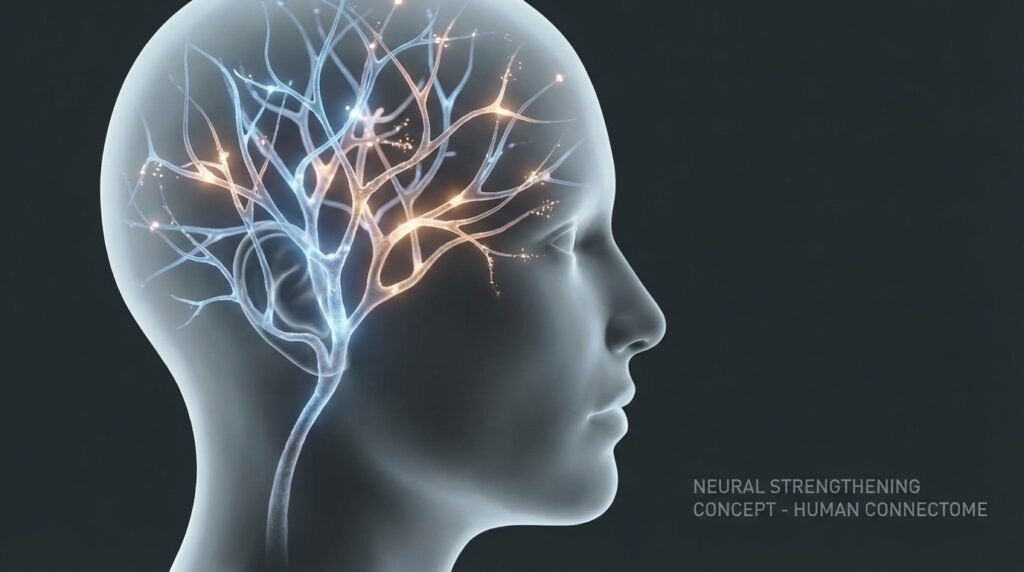
Why does your brain get stressed?Understanding and taking action on a daily basis
The key takeaways:
Perceiving stress as a signal helps maintain personal balance .
Integrating micro-routines and active listening defuses family tensions by restoring mental energy.
This shift in perspective transforms pressure into a driver of creativity.
You come home after a busy day. Your mind refuses to switch off. You’re physically present for dinner, but your head is still busy dealing with work issues or anticipating tomorrow’s unexpected events.
Stress does n’t stop at the door of your workplace.
It’s a signal sent by your brain that, second by second, alters how you interact with the world.
Seeking a perfect “balance” between work and personal life is an exhausting trap.
The brain doesn’t function like a balance, but as a dynamic energy system.
What you need to aim for is rhythm. Learning to manage this pressure isn’t about being an emotionless robot;
it’s about taking back control of your life.

Understanding the mechanics:
In your mind, the “Alert” mode
To understand why your stress overwhelms you, we need to examine the biological mechanisms at work.
Your brain is not just an organ of thought; it is first and foremost a biological machine designed for your survival.
The “stress relay”: why your body remains under pressure
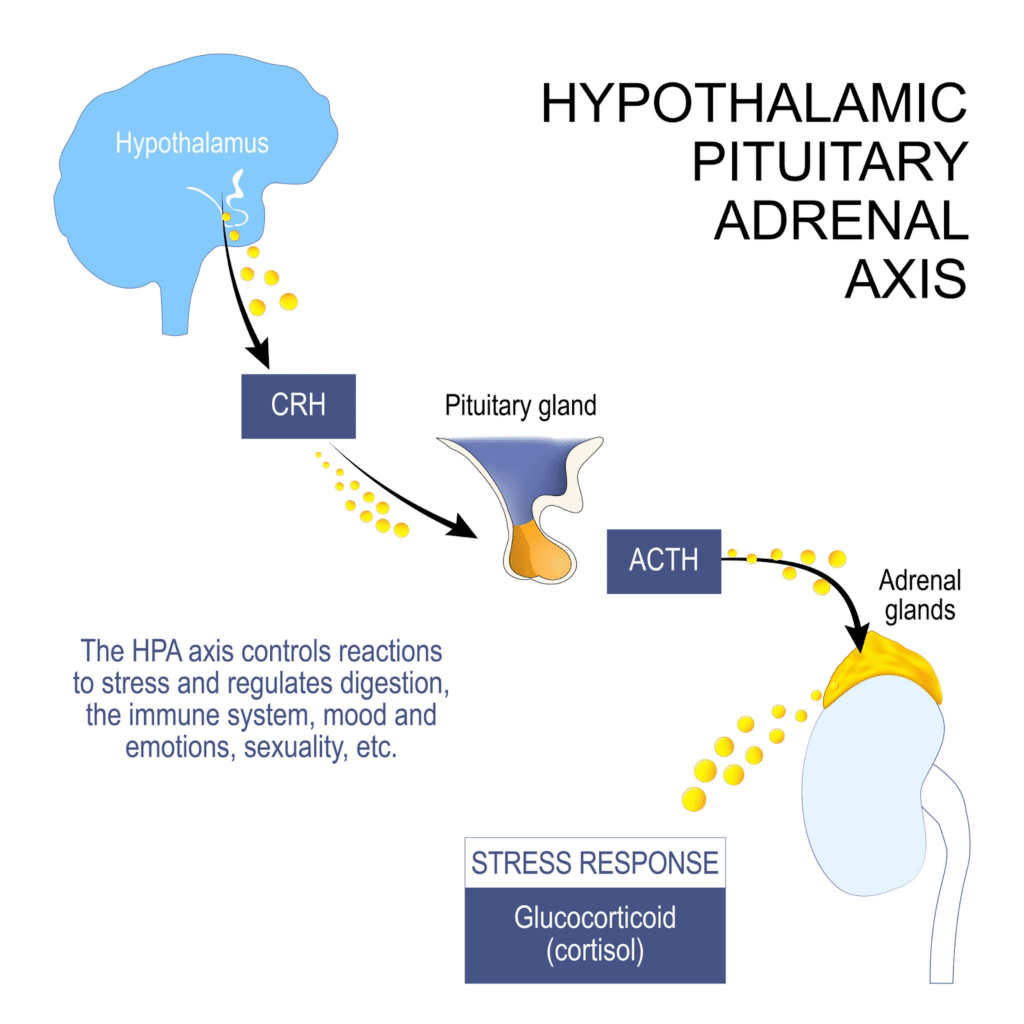
To understand what’s actually happening, imagine your stress management system as a three-stage command chain.
This is what scientists call the “HPA axis,” but simply.
Everything plays out in three stages:
- The Hypothalamus (The Command Center): This is the area of the brain that constantly analyzes your environment. As soon as it detects a situation that requires your attention (a danger, an emergency, an overload), it gives the order to act.
- The Pituitary Gland (The Relay): This is a small gland that receives the order from the brain. Its role is to transmit the signal very quickly to the rest of your body via the blood.
- The Adrenal Glands (The energy suppliers): Located above your kidneys, they receive the message and get to work by releasing a key hormone: cortisol
What is the purpose of cortisol?
It’s your emergency fuel. It raises your blood sugar levels to give your muscles and brain the energy they need to cope with the situation.
It also puts “secondary” functions (like digestion or the immune system) on hold to focus all your resources on managing the emergency.
To complete this overview, it’s helpful to remember that other neurotransmitters also play a role in the stress response. Adrenaline prepares your body to react instantly to danger by increasing heart rate and alertness, while dopamine influences motivation and the feeling of reward.
These chemical messengers work in conjunction with cortisol to regulate your energy and emotions.
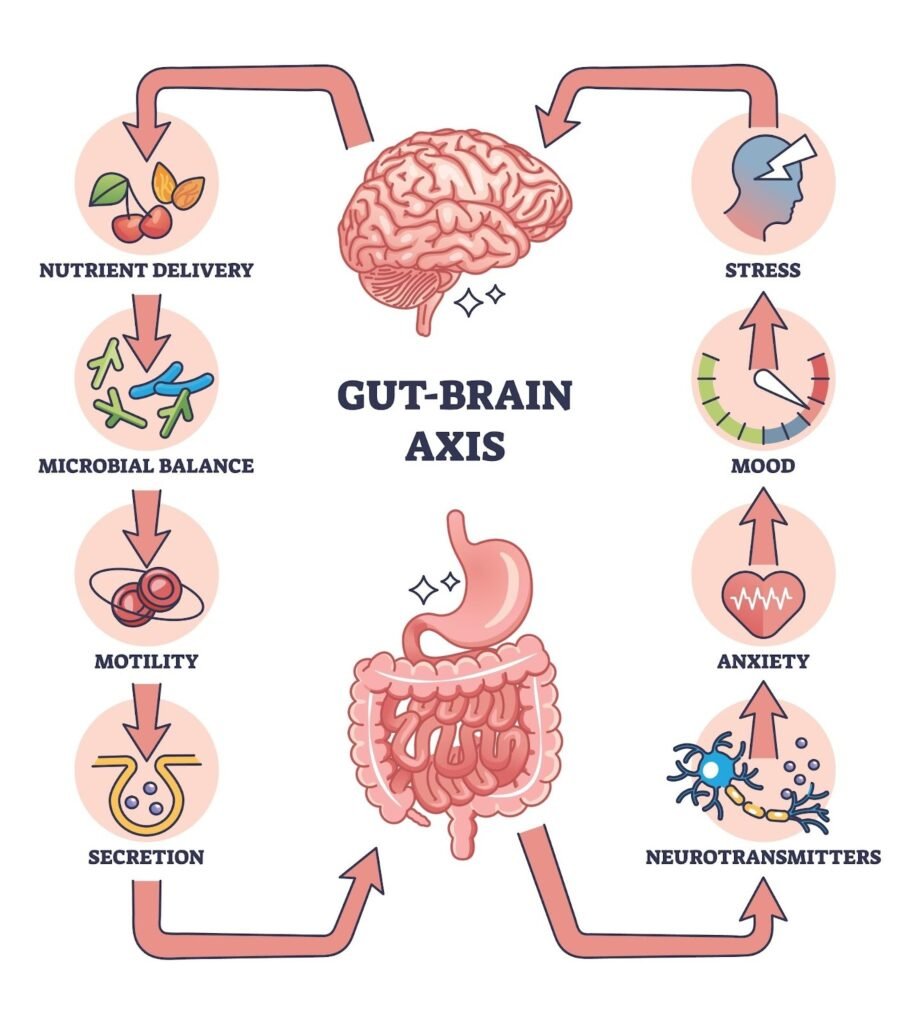
Furthermore, the gut-brain axis plays a key role in your mental state: the gut microbiota contributes to the production of serotonin, a neurotransmitter central to the regulation of mood and well-being. Thus, stress affects not only your brain, but your entire body, demonstrating how body and mind function in constant interaction.
The problem in our modern lives is that this system doesn’t distinguish between a life-threatening danger and an excessive workload.
If this alarm is constantly triggered, your “battery” never recharges. You remain in a state of alert, even when you’re resting.
To delve deeper into these complex physiological mechanisms, you can consult this reference article from the Harvard Medical School.
Body signals of stress and how to listen to them
Stress isn’t an abstract concept that happens solely “in your head.” It’s a complete biological reaction that manifests physically. Your body, like a precision machine, is constantly self-regulating.
Ignoring its warning signs is like ignoring your car’s check engine light: you might keep going for a while, but the risk of running out of fuel or breaking down becomes inevitable.
Before mental exhaustion sets in, your body sends you clear messages. Let’s learn to decode them.
Muscle tension: the “defense” mode activated
If you wake up with your jaw clenched or your shoulders seem to rise towards your ears as the day progresses, your nervous system is in “alert” mode.
This is a reflex contraction: your body is physically preparing for imminent danger, even if the threat is just a stressful email or a deadline.
The signal: The muscle remains in residual tension, which ends up unnecessarily consuming precious energy.

Shortness of breath: the trap of hypervigilance
Shallow, rapid, chesty breathing keeps your nervous system in a state of anxiety. Conversely, deep abdominal breathing is the biological signal of “safety.” If your breath is shallow, you are biologically telling your brain: “We are in danger, stay alert.”
The signal: This breathing prevents your parasympathetic nervous system — your recovery system — from taking over
Digestive imbalance: the gut-brain axis is overheating
The gut is often called our “second brain.” As studies on the gut-brain axis demonstrate, stress directly disrupts our microbiota, causing bloating or chronic discomfort.
The gut microbiota plays a key role in the production of neurotransmitters, including serotonin, which regulates mood and well-being. If your gut flora is unbalanced, the brain-gut communication is disrupted, which amplifies anxiety and mental fatigue.
If you experience bloating or chronic discomfort during periods of high activity, it’s not a coincidence: your digestive system is “put on pause” to prioritize energy for survival functions.
The signal: your body is sacrificing its internal maintenance to manage external pressure
Fragmented sleep: excess cortisol at the end of the day
This is the classic sign of “the engine that won’t stall.” You fall asleep, then wake up at 3 a.m. with your thoughts racing.
Why? Because your cortisol levels—the stress hormone—haven’t dropped low enough by the end of the day.
Your brain is still busy solving problems that don’t require immediate attention.
The signal: Your internal regulator is malfunctioning and preventing you from switching to “repair” mode.
Ignoring these signals means accepting a life of permanent “survival” mode.
And when you’re in survival mode, you’re no longer truly living. It’s not just your body that suffers; it’s also your ability to enjoy life, escape, and connect with others.
If your weekends are no longer enough to recharge your batteries, stress has already invaded your personal life.
These signals are not isolated; they directly affect your daily life and your creativity.
The impact of stress on your private life and leisure activities
Work-related stress never stays “at the office.”
Your brain isn’t a computer that you can switch off with a simple click when you leave your desk; it’s a continuous biological system.
This is called the spillover effect: your mind continues to process the day’s problems long after you leave, consuming energy in the background.

Mental overload: the accumulation of small shocks
Unexpected events—a canceled trip, a notification, a household chore—overwhelm your processing capacity.
Taken individually, they’re minor details. Added up, they create constant friction.
The result? You end the day with your internal energy nearly depleted, not because you’ve “worked too hard,” but because your system has been running at full capacity to manage micro-stressors all day long.
Why your hobbies seem difficult
This lack of mental “bandwidth” also explains why your creativity is withering away.
- Survival Mode vs. Exploration Mode: When your brain is in “alert” mode, it prioritizes reflexes and known solutions to conserve resources. It simply no longer has enough energy for exploration, learning, or creation.
- The diagnosis: If you can no longer get involved in that creative activity you used to enjoy (cooking, sports, reading), it’s not a lack of talent or motivation. It’s a depletion of available cognitive resources. Your…
Your private life is not a magical space separate from your constraints; it is the terrain where your brain tries (sometimes in vain) to recharge.
Domestic stress, family relationships and their impact on the brain
Your relationships as a mirror of your internal state
Your loved ones are a true reflection of your inner state. It’s important to understand that we are profoundly social beings, biologically equipped to detect domestic stress in others thanks to our mirror neurons .
If your nervous system is tense, you don’t need to say a word for it to be felt: your body language becomes rigid, your tone of voice hardens, and your expressions freeze.
Your loved ones unconsciously perceive this danger signal and, as a defensive reflex, become distant or tense

Create transitions to preserve balance
To prevent this pressure from disrupting your daily life, the key isn’t to change your personality when you get home, but to ritualize your transitions.
Never go directly from an intense activity to the family sphere without marking a break.
Consider those few minutes of travel, walking, or quiet upon arrival as a true decompression chamber.
Use this time to mark the boundary: tell yourself internally that the previous sequence is over and that you are switching roles.
This isn’t wasted time; it’s a necessary recalibration for your body to understand that “alert” mode is no longer required.
Attention as a driver of connection
Once this initial phase is over, the challenge becomes your actual presence.
When you are overwhelmed by mental workload, your attention is fragmented, and your brain struggles to focus on the other person.
Always put your phone away during important conversations: this simple physical action sends a powerful message to both your brain and the person you’re speaking with.
By practicing active listening, you automatically reduce tension in the conversation. It’s by stepping out of your mental “tunnel vision” that you allow social connection to be re-established.
Finally, if you’re dreading a social gathering after a particularly busy day, don’t go in with the illusion that you have to be perfect. Practice pre-framing: set yourself a simple goal, such as listening rather than solving problems or entertaining the evening.
By agreeing to lower your performance expectations, you free up the mental space needed to truly enjoy the moment.
Daily anti-stress micro-routines
No need to overhaul your schedule. The key lies in simple, repeated actions that signal to your brain that it can release the pressure.
- In the morning (anchoring calm): Don’t let your phone dictate your wake-up time. The first 10 minutes are crucial. Avoid emails and the news. Keep this space for yourself: a coffee in silence, a few stretches. This sets an intention of control over your day.
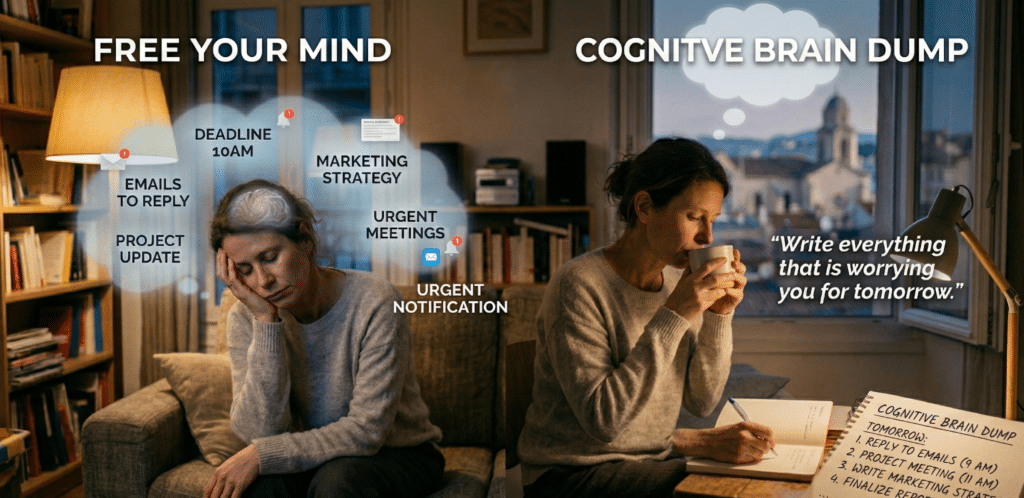
- In the evening (the “Brain Dump”): Having trouble sleeping because your brain is racing? Grab a pen and paper. Write down everything that’s on your mind for the next day. By externalizing these thoughts, you free up your working memory. Your brain can finally let go.
- Delegate to technology: Use shared lists for household chores so you no longer carry the mental load alone. Automate repetitive tasks (subscriptions, scheduling) to free up space.
Technology as a personal “dashboard”
Technology should no longer be your task manager, but your biological confidant.
Use trackers (sleep, heart rate variability) not to aim for ideal performance, but to objectively assess your internal state.
They are your sensory extensions: when your watch shows a decline in your recovery capacity, it’s not a failure, it’s data.
It gives you permission to slow down before your body forces you to stop.
Transforming pressure into positive energy
Stress isn’t always a personal failing; it’s often a healthy response to an unsuitable environment.
Company culture, workspace design, excessive digital demands: all these elements are part of the cognitive equation.
Understanding this systemic dimension removes an immense burden: the goal is not only to “fix” the individual, but to act on the individual and their environment to restore balance and mental energy.
Stress is not an enemy to be defeated; it’s an indicator. It’s physical proof that a situation matters to you, that it touches on your values or your ambitions.
In reality, effective stress management is not about eliminating all tension—which would be biologically impossible—but about learning to change its polarity and transform it into positive energy.
Instead of being at the mercy of this state, learn to reframe it using a simple tool: inner dialogue
“Good stress”: a catalyst for your creativity
It is crucial to distinguish between paralyzing stress and “good stress.” In psychology, the latter is what keeps your brain alert and promotes learning.
Without this gentle, stimulating pressure, we would tend toward apathy; with it, we activate our resources to solve problems. This “good stress” is precisely the breeding ground for creativity. When you face a stimulating yet achievable challenge, your brain enters a state of concentration that fosters innovation.
The key is to stay in that optimal zone: enough pressure to mobilize your talents, but not so much as to overload your mental load.
Instead of being at the mercy of this state, learn to reframe it using a simple tool: inner dialogue.
Ask yourself this crucial question when faced with a complex situation: “Am I facing a threat, or am I rising to a challenge?”
This change in vocabulary is not just a linguistic trick; it’s a powerful mechanism derived from neuroscience.
When your brain perceives a “threat,” it instantly activates the survival system, which triggers anxiety.
Conversely, characterize the situation as an active “challenge” for your prefrontal cortex, the area of the brain responsible for strategy and concentration.
The art of oscillation: a protocol for everyday life
However, no biological system can remain under constant strain 24/7 without risking overheating.
This is where the art of oscillation comes in. Sustained performance relies on a rigorous alternation between phases of intense engagement and periods of complete recovery.
To integrate it effectively, don’t rely solely on your willpower; follow a simple protocol:
- The concentration cycle (90 minutes): The human brain operates according to ultradian rhythms. After approximately 90 minutes of focused work, your attention span naturally drops. Don’t wait until you feel exhausted: force a break at that point.
- Micro-breaks (5 to 10 minutes): Between cycles, give yourself a real break. No emails, no social media, as these cognitive activities prevent your cache from clearing. Opt instead for walking, breathing exercises, or simply resting your eyes.
- The 20-20-20 rule: On very busy days, every 20 minutes, look 20 feet (about 6 meters) ahead for 20 seconds. This is a strong biological signal that tells your nervous system you’re coming out of “tunnel vision” and returning to a broader perspective.

An hour of “nothing” — a true disconnection without cognitive stimulation — is often more productive than an extra hour of work spent in a state of latent fatigue.
By allowing yourself to fluctuate, you enable your body to regulate its cortisol levels and recharge its internal batteries.
Think of it like an engine: it needs to rev up to move forward, but it also needs periods of inactivity to avoid breaking down.
By incorporating these strategic breaks, you’re not just surviving the pressure, you’re using it as fuel to boost your mental energy daily, while protecting your long-term balance.
The observation is simple: Pressure is a given, but your reaction is a skill you can train.
Conclusion
Stress will never disappear from your life. It’s a sign that you’re experiencing things that are important to you.
The goal isn’t to eliminate pressure, but to prevent it from becoming your autopilot.
By adopting these micro-habits, listening to your body’s signals, and reframing your perspective, you open the door to a richer life and more peaceful relationships.
Be small, be kind to yourself, and observe how pressure gradually transforms into energy that you can control.
FAQ: Your questions, our answers
How can I tell if my stress is disrupting my personal life?
The most reliable sign is losing patience with trivial things. If you overreact to unexpected household events, your coping mechanisms are overwhelmed.
What small actions can reduce emotional pressure?
Practice a “decompression chamber” when you get home from work. Turn off non-essential notifications after a certain hour to allow your brain to naturally wind down.
How to manage stress before a social event?
Set a clear intention (“I am here to listen”). If tension rises, practice deep breathing (inhale for 4 seconds, exhale for 6 seconds) for two minutes to physically calm the nervous system.
Can technology really help me reduce stress?
Yes, on two fronts. Firstly, for logistics (planning, shared lists), which frees up mental space. Secondly, as a “biologically confident” person: the judicious use of trackers (sleep, heart rate variability) can help you objectively assess your fatigue and adjust your pace before your body forces you to stop.
The final word
Stress is not a sign of weakness, but a signal from a biological system that needs adjustment.
By combining technological monitoring of your internal signals with the optimization of your environment, you regain control.
Don’t aim for perfection, but for rhythm: make pressure the driving force of your sustainable energy