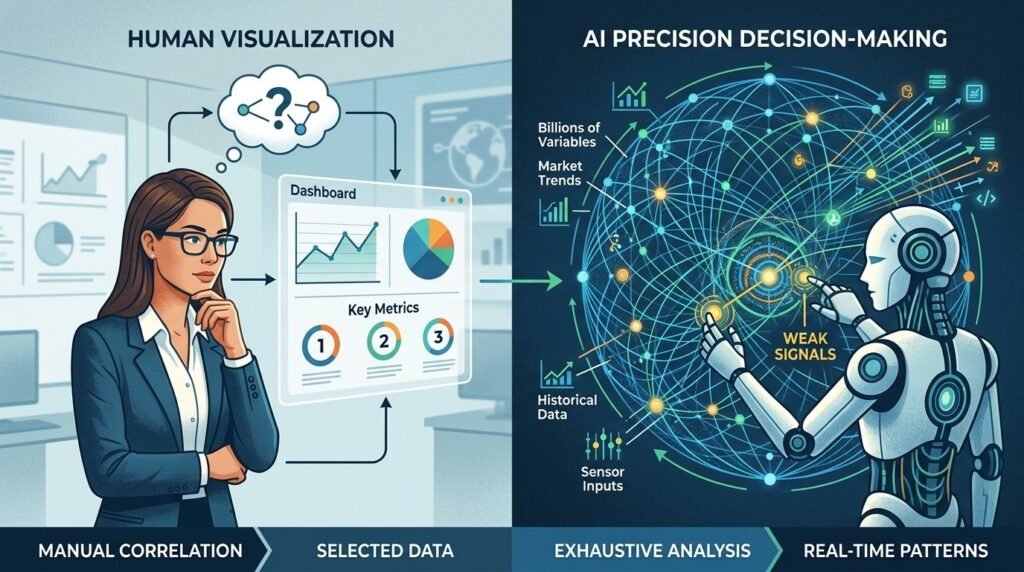

In the Age of AI, Your Real Competitive Advantage Is Your Brain
ChatGPT writes your emails. Midjourney creates your visuals. Algorithms analyze your data faster than any human analyst. So, what do you have left?
Everything that truly matters.
As artificial intelligence automates predictable tasks, one truth becomes clear: differentiation—personal and professional alike—now depends less on what you know how to do and more on how you think. Your brain, with its unique ability to contextualize, feel, improvise, and make meaning, is becoming the most valuable asset in the contemporary economy.
This is not motivational talk. It is a strategic reality that the most high-performing individuals and organizations have already understood.
In this article, you will understand why AI—powerful as it is—does not replace human cognition. You will discover which mental abilities to cultivate in order to remain irreplaceable. And above all, you will leave with concrete ideas to turn your brain into a true driver of differentiation.
Why AI does not replace human thinking
Artificial intelligence excels in one specific area: the mass processing of statistical patterns. Large language models—GPT-4, Claude, Gemini—predict the next word with remarkable accuracy. They synthesize, rephrase, and classify.
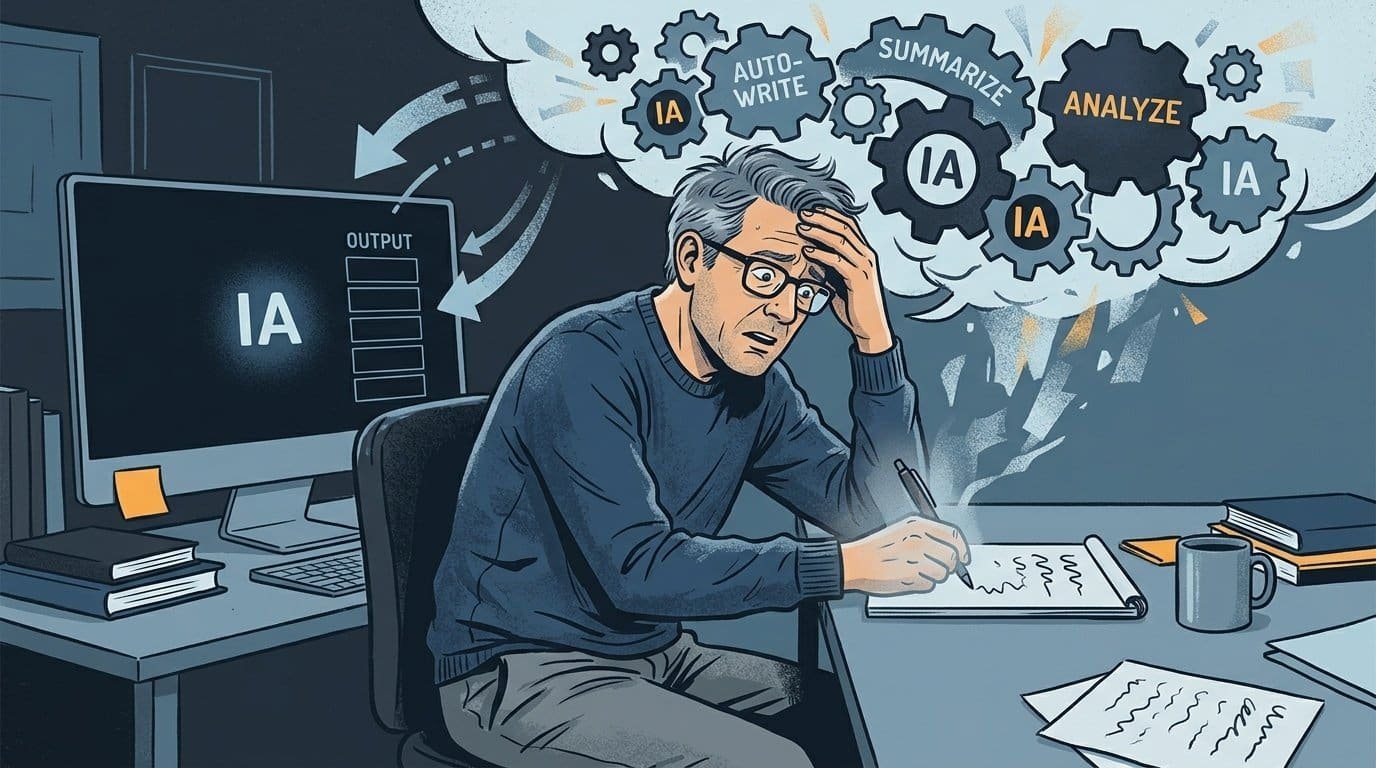
But predicting a word and understanding an idea are two fundamentally different operations.
AI manipulates symbols without accessing meaning. It produces probable answers, never correct ones in the moral, contextual, or emotional sense of the word. This distinction is not philosophical — it is operational.
Imagine these situations:
- In a negotiation, it is your ability to read between the lines that unlocks an agreement.
- Faced with an unhappy customer, it is your empathy that defuses the tension — not an automated script.
- When making a strategic decision under uncertainty, it is your contextual judgment that decides when the data is ambiguous.
In practical terms, AI has neither self-awareness, nor theory of mind, nor the capacity for lived experience. It does not know what it is to fear making a mistake, to feel the intuition that a project will fail, or to perceive that a colleague is going through a silent crisis.
Yet these are precisely the perceptions that guide the best human decisions.
Cognitive neuroscience confirms that human intelligence is not reduced to calculation: it involves emotion, autobiographical memory, projection into the future, and the ability to build meaning from ambiguity. No statistical model reproduces this.
The trap of total cognitive delegation
The most insidious risk of the AI era is not replacement. It is atrophy.
When you systematically delegate writing, analysis, synthesis, and reflection to automated tools, your brain loses training. The phenomenon is documented in neuroscience under the term cognitive offloading.
The principle is simple: the more you externalize a mental function, the less the corresponding neural network is engaged — and the less effective it remains. It is “use it or lose it” applied to your intellectual abilities.
Some concrete examples:
- A professional who never writes structured text again gradually loses their ability to argue.
- A manager who relies solely on dashboards without questioning the data loses their critical thinking.
- A creative person who delegates all ideation to AI sees their divergent thinking dull.
This phenomenon creates a major competitive paradox. Those who use AI as a crutch become increasingly interchangeable — they all produce the same standardized output, calibrated by the same algorithms.
By contrast, those who use AI as an amplifier while actively cultivating their own thinking create a growing gap. They combine the machine’s computing power with human depth of judgment.
The question is therefore not “should we use AI?” — of course, yes. The question is: are you investing as much in your brain as in your tools?
What AI automates versus what it cannot touch
To clarify the issue, let us distinguish two categories of skills.
AI efficiently automates convergent tasks — those with an identifiable right answer, a reproducible process, a structured input:
- Document classification
- Standard translation
- Basic code generation
- Tabular data analysis
- Long text summarization
These tasks, once valued in the labor market, are rapidly losing their market value. The professional who defines themselves solely by their ability to perform them finds themselves in direct competition with a tool that costs 20 dollars per month.
By contrast, AI fails at divergent and contextual tasks:
- Formulating the right question rather than the right answer
- Seeing an opportunity where the data shows nothing
- Motivating a team in times of doubt
- Making an ethical dilemma decision
- Inventing a brand positioning that resonates emotionally
- Having the courage to say “no, this strategy does not hold up” in front of an executive committee
These skills — critical thinking, authentic creativity, emotional intelligence, moral judgment — are intrinsically human. And their value explodes precisely because everything else becomes commoditized.
The 5 cognitive abilities that make you irreplaceable
If your brain is your competitive advantage, you still need to know which cognitive functions to develop first. Not all mental skills are equally valuable in the current context.

Some abilities lose value — raw memorization, mental arithmetic, encyclopedic knowledge. Others gain it massively. Here are the five capabilities to focus your cognitive investment on, whether you’re an entrepreneur, executive, freelancer, or changing careers.
1. Metacognition: thinking about your own thinking
Metacognition is the ability to observe, evaluate, and regulate your own mental processes. Simply put: it’s your ability to consciously “pilot” your brain.
In practical terms, it means:
- Recognizing when you’re falling prey to a confirmation bias
- Identifying that your fatigue is affecting your judgment
- Distinguishing between grounded intuition and simple impulsiveness
- Calibrating your mental effort according to the real stakes of a decision
In a world saturated with information and AI-generated outputs, metacognition becomes the ultimate filter. It prevents you from taking ChatGPT’s first answer at face value and allows you to question your own certainties.
Research in cognitive psychology shows that metacognition is a better predictor of performance than IQ in many professional contexts.
To develop it:
- Keep a decision journal (note your important choices, your reasoning, then evaluate the results)
- Practice “thinking about thinking” after every important meeting
- Explicitly formulate your hypotheses before looking for data
Your brain is an instrument — metacognition is learning to play it with precision.
2. Deep attention: the scarcest resource of the 21st century
Cal Newport calls it “deep work.” Neuroscientists talk about sustained attentional focus. The reality is the same: the ability to maintain intense concentration on a complex problem over an extended period has become extremely rare — and therefore extremely valuable.
Notifications, multitasking, endless scrolling and, ironically, easy access to AI itself fragment your attention into micro-sequences of a few seconds.
Yet high-value professional contributions all require blocks of uninterrupted concentration:
- An innovative strategy
- A complex medical diagnosis
- A memorable piece of writing
- An elegant software architecture
Deep attention is a neuronal muscle. The prefrontal circuits that support it strengthen with training and weaken with chronic distraction.
The good news: it is possible to restore it, even after years of digital dispersion. Among the approaches validated by research:
- Mindfulness meditation — even 10 minutes a day shows measurable effects
- Timed work sessions without interruption (a Pomodoro method adapted to 90-minute blocks)
- Voluntary reduction of digital stimuli during important work periods
Developing your deep attention capacity gives you access to the mode of thinking that produces the most differentiating results.
3. Critical thinking: the shield against mediocre outputs
AI generates content with deceptive ease. Its answers are fluid, structured, often plausible. But plausible does not mean true, relevant, or suited to your context.
Critical thinking — the ability to assess the quality of an argument, detect logical flaws, distinguish correlation from causation — is the indispensable shield against automated mediocrity. Without it, you become a mere relay between AI and your audience, with no unique added value of your own.
In a professional context, critical thinking sets you apart in two ways:
- It allows you to select, correct, and enrich AI outputs — making you an expert user rather than a passive one.
- It gives you a credibility that the machine cannot generate by itself. A client trusts someone who can say, “this analysis is incorrect, and here’s why.”
To strengthen your critical thinking, practice the Socratic exercise. For every piece of information you receive, systematically ask three questions:
- What is the source?
- What is the alternative?
- What is missing?
4. Divergent creativity: what patterns cannot invent
AI generates by recombining existing patterns. It can produce endless variations, but it never creates from nothing. It does not make conceptual leaps. It does not feel the “what if…?” that comes before a truly new idea.
Divergent creativity — the ability to explore multiple directions, make unexpected connections between distant domains, and challenge established frameworks — remains a deeply human territory.
To cultivate it:
- Expose yourself to varied disciplines (innovation often emerges at intersections)
- Practice constrained brainstorming (impose limitations that force originality)
- Allow yourself moments of intentional boredom — the brain in “default mode” is often the one that produces the most original ideas
5. Emotional intelligence: the glue the machine cannot simulate
Emotional intelligence — the ability to perceive, understand, and manage your emotions and those of others — is what turns a good professional into a leader, a good product into a memorable experience, and a good team into a united collective.
AI can analyze the sentiment of a text. It cannot feel what the person in front of you is experiencing. It cannot adapt its posture to the energy of a room. It cannot offer an authentic presence in a difficult moment.
In a world increasingly mediated by screens and algorithms, authentic human interactions become a major differentiator.
How to concretely turn your brain into a competitive advantage
Identifying the right cognitive capabilities is a first step. But without a concrete action plan, this knowledge remains theoretical.
Neuroplasticity — the brain’s ability to reconfigure itself based on experience — is a well-established scientific reality. Your brain at 25, 40, or 60 can still form new connections, strengthen existing circuits, and optimize its performance.
But this does not happen by accident. It requires method, consistency, and intention.
Here are the guiding principles for making your mental performance a project in its own right:
- Invest daily in cognitive training: 20 minutes of analytical reading, problem-solving, or active memorization is better than 3 passive hours in front of a screen.
- Protect your sleep: memory consolidation, the brain’s metabolic cleaning (glymphatic system), and emotional regulation depend directly on the quality of your nights. It is the non-negotiable foundation.
- Practice regular physical activity: aerobic exercise stimulates the production of BDNF (Brain-Derived Neurotrophic Factor), a protein essential to neuronal growth and synaptic plasticity.
- Cultivate intellectual diversity: expose your brain to varied fields, cultures, and disciplines. Innovation often emerges at the intersection of heterogeneous knowledge.
- Use AI as a sparring partner, not as a substitute: ask it to challenge your ideas, propose counterarguments, simulate scenarios. Always keep the final decision for yourself.
Building a sustainable mental performance routine
The most common mistake is to treat cognitive training as a one-off effort. Yet neuroplasticity rewards consistency, not occasional intensity.
A daily 30-minute routine produces measurable results within weeks. For example:
- 10 minutes of attention meditation — strengthens attention circuits and reduces emotional reactivity
- 10 minutes of demanding reading — stimulates critical thinking and enriches mental models
- 10 minutes of reflective journaling — develops metacognition and decision clarity
Studies in applied neuroscience show that after 8 weeks of regular mindfulness practice, gray matter density in the prefrontal cortex increases significantly. This is a structural change, not merely a functional one.
The challenge is to treat your brain with the same seriousness as an athlete treats their body. No one is surprised that an athlete trains daily, watches their diet, and optimizes recovery. Your brain deserves the same discipline.
In a context where AI levels technical skills, it is this cognitive discipline that creates the gap. Brain training tools, regular cognitive tests, and tracking your mental performance — such as those you can explore on braintech.life — are valuable allies in this approach.
Professional differentiation through augmented cognition
The concept of augmented cognition refers to the strategic alliance between a trained human brain and mastered AI tools. It is neither about rejecting technology nor about submitting to it, but about creating synergy:
- The human brings what the machine cannot — judgment, creativity, empathy, vision
- The machine brings what humans do less well — speed, exhaustiveness, consistency in data processing
Professionals who develop this dual skill set — cognitive excellence AND mastery of AI tools — position themselves in a market segment that is still relatively uncrowded and highly sought after.
In practice, this means:
- A consultant who uses AI to analyze a market but brings their own interpretive framework is infinitely more valuable than a consultant who merely delivers a generated report.
- A creative who uses Midjourney to explore visual directions but refines the final concept with their own sensitivity creates irreplaceable work.
- A manager who relies on predictive tools but decides with emotional intelligence inspires more trust.
In each case, it is the human brain that turns a generic output into unique value. That is exactly your competitive advantage.
The augmented human, not the replaced human
The dominant narrative around AI oscillates between two extremes: the technological utopia (“AI will solve everything”) and the anxiety-inducing dystopia (“AI will destroy everything”).
The reality is more nuanced — and more stimulating.
We are entering an era in which the human capacity to think, create meaning, forge authentic bonds, and exercise moral judgment has never been so valued. Precisely because it has become the differentiating factor in an ocean of automated content, services, and products.
Sustainable competitive advantage will be neither purely technological nor purely human. It will be hybrid. But in this hybridization, it is the human brain that plays the role of pilot:
- It is what provides direction
- It is what assesses risks
- It is what perceives opportunities invisible to algorithms
- It is what builds trust
- It is what carries the responsibility for decisions
Investing in your brain — in your attention, memory, emotional intelligence, critical thinking — is not a luxury. It is the most lucid differentiation strategy you can adopt today.
FAQ — Your brain as a competitive advantage in the age of AI
Why is the human brain said to be a competitive advantage against AI?
Because AI excels at repetitive and predictable tasks, but fails when faced with contextual thinking, emotional intelligence, authentic creativity, and moral judgment. These abilities, unique to the human brain, become even more valuable as automatable tasks lose value in the labor market.
Which cognitive skills should be developed first to stand out?
The five most strategic capabilities are:
- Metacognition (thinking about your own thinking)
- Deep attention
- Critical thinking
- Divergent creativity
- Emotional intelligence
These are the skills AI cannot reproduce and for which demand is growing across all sectors.
Does brain training really work?
Yes. Neuroplasticity is a scientifically established phenomenon. Regular practices such as meditation, analytical reading, physical exercise, and cognitive tests strengthen the neural circuits involved in concentration, memory, and decision-making. The key is consistency, not occasional intensity.
How can you use AI without weakening your mental abilities?
The golden rule: use AI as an amplifier, never as a substitute. Continue to write, analyze, and think for yourself before asking AI. Use it to challenge your ideas, speed up your research, or explore alternatives — but always keep the final interpretation and decision for yourself.
Where should you start to invest in your mental performance?
Start with three simple habits:
- Protect your sleep (7 to 9 hours)
- Practice 20 minutes daily of targeted cognitive training (reading, journaling, meditation)
- Reduce digital sources of distraction during your important work periods
The tools and tests available on braintech.life can help you assess your starting point and measure your progress over time.