
Brain plasticity
How the brain learns, adapts, and performs in the digital age ?
Key takeaways:
At a time when artificial intelligence is transforming our professions and lifestyles, neuroplasticity is our trump card.
This mechanism of perpetual remodeling is not just a laboratory concept: it is the foundation of our ability to learn, retrain, and age healthily.
For citizens and professionals in 2026, understanding the brain is the key to remaining clear-headed, creative, and balanced in an increasingly saturated world.
The paradox of our time is striking: while our digital tools are updated every week, we too often perceive our brains as organs that remain static after youth.
Yet science is clear: your brain is remodeling itself every second, whether you are at work or with your family. This ability to constantly update is your best guarantee of survival and happiness.
To consolidate these connections, the rule of brain plasticity is imperative: “use it or lose it”
Any neglected neural circuit fades away, like an abandoned forest path, in favor of new highways of thought.
Mechanisms of brain plasticity: the biology of agile change
Brain plasticity is not a metaphor, it is a physical reality. Your brain is not a block of marble carved once and for all, but a dynamic network that reorganizes itself according to your actions.
The law of reinforcement: optimizing your circuits
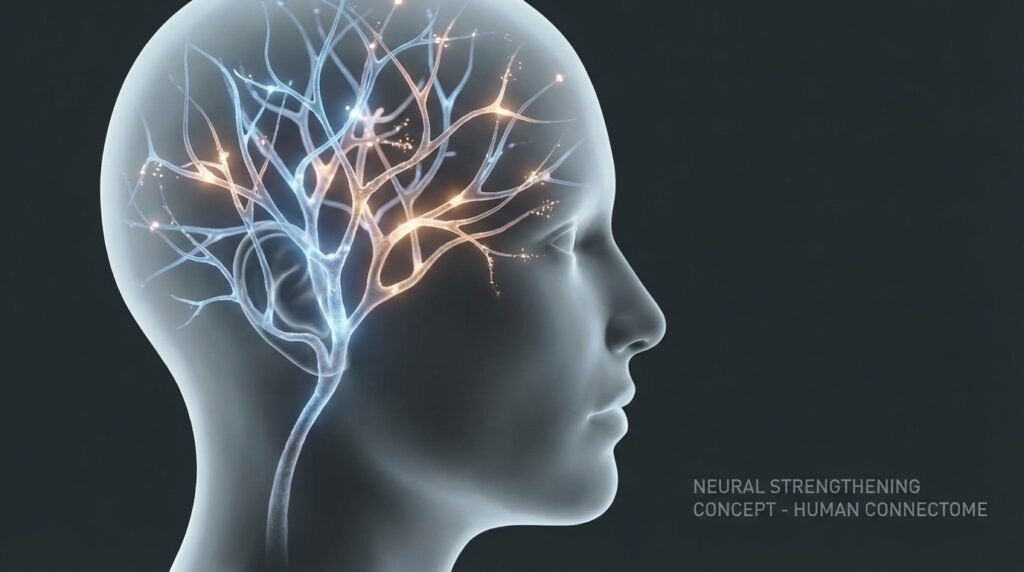
Every time you learn a skill or change a habit, you activate a specific electrical circuit. If you repeat this action, your brain decides to isolate this circuit to make it more efficient.
This is the role of myelin. Imagine a protective sheath that thickens around your most active connections. Its impact is massive, drastically increasing transmission speed. What was once a conscious and laborious effort becomes a fluid automatic response. Conversely, according to the “use it or lose it” principle, the circuits you no longer use weaken. Your brain constantly “recycles” energy from inactive areas to support your new projects.
The maintenance system: the key to recovery
For this remodeling to work, your brain needs a healthy environment. This role is performed by glial cells. They do more than just support neurons; they act as a veritable purification system.
It is mainly during sleep and periods of deep rest that these cells remove toxins accumulated through mental activity during the day. Without this cleansing process, your circuits become saturated, causing a feeling of “brain fog.” Sustainable performance therefore depends not on the power of your neurons, but on the quality of their maintenance.
Chemical dosing: between curiosity and stability
Finally, your brain juggles between two chemical states to stay agile:
- Activation (Glutamate): This is the fuel for novelty. It opens a “window of plasticity” for learning and quickly adapting to change (new city, new software).
- Regulation (GABA): This is the stabilizer. It calms excitement to allow the brain to firmly anchor what it has just learned.
The secret to agility lies in this balance: being able to open yourself up to the unknown, then settling down to transform the experience into a lasting skill.
Can the brain really learn and change throughout life?
For a long time, it was believed that childhood was the end of the road and that after the age of 30, our brains simply “managed what had already been learned.” Modern science proves exactly the opposite: our potential for transformation remains intact throughout our lives, as long as we know how to activate it.
Transcending perceived limitations: surgical plasticity
While a child’s brain is like a sponge that absorbs everything in a structural way, an adult’s brain develops surgical plasticity and becomes goal-oriented. Your brain no longer changes for “no reason”; it changes in response to a specific challenge.
According to data from the Harvard Business Review (2025), individuals who maintain active intellectual curiosity—whether by learning to use AI tools at work or taking up a new complex hobby such as carpentry or a foreign language—have a significantly higher density of connections in the prefrontal cortex than their peers who stick to their routine. Age influences certain functions, but stimulation and novelty strongly modulate this trajectory.

Neurogenesis: growing your vital capital
One of the most revolutionary discoveries is adult neurogenesis. Every day, new neurons are born in your hippocampus, the nerve center of memory, learning, and navigation (whether spatial or strategic).
However, these young neurons are fragile. They need a “favorable environment” to survive and integrate into your existing networks:
- The danger: Chronic stress (high cortisol) linked to an unbalanced professional life or an excessive domestic workload acts like a herbicide on these new cells.
- The driving force: Learning a new skill (retraining) and physical exercise act as a catalyst.
This is biological proof that taking on a new challenge, whether it’s a career change or an exciting personal project, is not only rewarding: it’s a real rejuvenating experience for your brain architecture.
The impact of experience on the remodeling of your cortex
Every sustained mental effort, whether related to a passion or a professional challenge, leaves a biological trace.
The most famous example remains that of London taxi drivers: the complex task of learning the city map physically enlarged their posterior hippocampus, the area dedicated to navigation. This is not an innate gift; it is mental effort that literally sculpted their gray matter.
This logic of remodeling applies to all areas of your life:
- In your personal life: Learning to play an instrument or practicing meditation reorganizes the areas of fine motor skills and emotional regulation.
- In your professional life: Developing expertise in data analysis or learning to collaborate with AI creates new “highways” in your associative cortex.
This flexibility is such that it allows for functional recovery after an ordeal (such as an injury or burnout). The brain demonstrates incredible biological resilience by reassigning healthy areas to new tasks. This is proof that nothing is permanent: your brain constantly reorganizes itself to maintain your vital functions and agility, regardless of the obstacles you encounter.
Cognitive agility: a biological advantage over artificial intelligence
Faced with algorithms capable of processing billions of pieces of data, our strength lies not in computing power, but in our flexibility. Where AI remains trapped by its programs, your brain can decide to set aside an old habit and adopt a new method. This is the essence of your agility: the ability to adapt so deeply to a new tool—whether it’s AI software at the office or a new musical instrument—that it eventually becomes a natural extension of your body, as if you had always used it.
The foundation of social flexibility
Beyond technique, this agility is the source of your emotional intelligence. Plasticity allows you to reshape your empathy circuits: by learning to decode new perspectives, you strengthen your ability to collaborate. This is what allows us to form deep connections and navigate the complexity of human relationships.
Biology vs. Artificial Intelligence: The Paradox of Efficiency
Although AI is inspired by our neural networks, biology still has a decisive advantage. Artificial intelligence is becoming more adaptable, but it remains dependent on predefined architectures and vast amounts of external data. In contrast, human plasticity integrates emotion, context, and meaning into every learning experience.
Your brain accomplishes this with remarkable energy efficiency: approximately 20 watts, or the equivalent of a light bulb. Unlike processors that run continuously, your neurons only consume energy when relevant information is circulating.
This efficiency allows us to learn from very little, extract meaning from ambiguous situations, and transfer skills from one domain to another. Where AI optimizes calculations, the human brain constructs meaning.
Dopamine: the fuel of pleasure and recovery
To activate this high-performance system, you need an engine: dopamine. This neurotransmitter is not just a simple reward; it validates every small step forward. However, it is crucial to distinguish between two types of dopamine: the fleeting and addictive “click” dopamine, which traps you in digital reactivity, and the more lasting “accomplishment” dopamine, which is released when you complete a complex project or overcome a personal challenge. While the former tires your circuits, the latter stabilizes your new learning and reinforces your perseverance.
Digital overload: the pitfalls of plasticity
While our brain is capable of rebuilding itself, it is also extremely vulnerable to saturation. In our digital environment, brain plasticity can become a trap: by constantly fragmenting our attention, we unwittingly “wire” our brains to be unable to concentrate.
The myth of multitasking and fruitless fatigue
Multitasking is a biological myth that destroys your actual concentration. A major study by Stanford University has shown that “intensive multitaskers” are paradoxically the least effective at filtering out unnecessary information and the slowest at switching between tasks.
This mental dispersion consumes a frightening amount of glucose. You end your day completely drained without having really made any progress, suffering from fruitless cognitive fatigue.
Digital dopamine: when pleasure blocks learning
The vicious cycle of notifications is based on an artificial release of dopamine. Each interaction triggers a micro-dose of immediate reward that bypasses your deep thinking circuits.
Exposure to screens also disrupts melatonin secretion, impairing sleep quality. However, as neuroscientist Matthew Walker points out in his work on the role of sleep in memory, it is during the night that neural circuits stabilize.
Intelligent filtering and preservation of your attention span
The solution is not to shy away from technology, but to use it to protect your biology.
- Smart filtering: Delegate data sorting to AI (summaries, email management). The goal is to free up mental space for your high-value-added tasks.
- Sanctuary of concentration: Learn to defend your “right to silence.” The brain needs silence and screen-free breaks to reorganize its networks and allow creativity to emerge.
To protect your ability to think clearly and maintain balance in your life, three pillars are now essential:
- AI-assisted synthesis: To reduce the volume of incoming information by approximately 30% and prevent prefrontal cortex overload.
- Total disconnection: At least 60 minutes before sleep to stabilize melatonin and allow for nighttime neuronal cleansing (essential for memory).
- Deep Work: 90-minute uninterrupted sessions to strengthen your concentration circuits and increase your efficiency, both at work and in your personal pursuits.
Practical strategies to boost your mental agility on a daily basis
Theory is not enough: brain plasticity is like a muscle. If you don’t use it, it atrophies. To transform your brain into a high-performance tool, you need to go from being a spectator to an actor.
Active practice: learn like an athlete
You don’t become a tennis champion by reading books about tennis. It’s the same for the brain. Passively reading or listening leaves no lasting impression.
The importance of feedback: In order for your brain to create new connections, it needs to make mistakes and be corrected. It is mistakes that force your neurons to adjust. According to the work of psychologist Anders Ericsson, it is this confrontation with reality that creates expertise.
The link with AI: Don’t just ask AI to do the work for you. Use it to test yourself. Ask it, “Ask me questions about this report to see if I understand it.” This simple exercise doubles your memorization.
Sleep and movement: the two essential “fuels”
Rest and exercise are not rewards after work; they are the very conditions for your effectiveness.
The crucial role of your nights: It is while you sleep that your brain does its groundwork. It sorts through the day’s information, flushes out accumulated toxins, and “prints” your new learning into your memory. A bad night’s sleep not only tires your body, it directly sabotages your ability to retain what you learned the day before.
Biological fertilizer: When you move (even a brisk walk), your body releases a protein called BDNF. It is a real “fertilizer” that helps your neurons grow and connect with each other. Thirty minutes of movement can already make a real difference to your concentration and mental efficiency.

Break the routine: the challenge of novelty
Your brain loves ease, but it “falls asleep” in routine. To stay young, it needs to be surprised.
- In your personal life: Learn something completely new (a language, an instrument, a new recipe). This forces your brain to create “bridges” between areas that were no longer communicating.
- Every day: Take a different route home, try out new software, or change the order of your morning routine. The unexpected stimulates your brain cells.
The reward: varying your activities stimulates the brain on several fronts and seems to help preserve its abilities for longer.
Intentional plasticity: become the architect of your brain
Brain plasticity is a neutral force: it does not judge, it simply reinforces what you repeat.
This includes your skills… but also your biases, limiting beliefs, and emotional patterns. A brain can become an expert in resilience or rumination.
If you spend your days dividing your attention between three tabs and ten notifications, your brain will become, purely as a coping mechanism, an expert at distraction.
Conversely, if you cultivate concentration and structured curiosity, it will become an expert in depth. The question is therefore no longer whether your brain changes, but in which direction you choose to reshape it.

Moving from passive plasticity to a directed strategy
Most of us are victims of our digital environment. For example, the reflex to check your phone at every spare moment is not just a bad habit, it is training your brain to be impulsive. Intentional plasticity is about taking back control by turning biology into strategy. Rather than letting AI or algorithms decide your next actions, you consciously choose what deserves your attention.
The triptych of change: Effort, Repetition, Rest
To transform simple information into a skill engraved in your neurons, three biological conditions are necessary. First, real effort: learning must be slightly uncomfortable to signal to the brain that it needs to reorganize itself. This is the difference between passively reading an article and trying to explain its key points to a colleague from memory.
Next, spaced repetition: consolidation takes time and regular review. It is biologically more effective to learn a new tool for 15 minutes every morning than to devote five hours to it all at once. Finally, recovery remains the forgotten pillar. It is during sleep or moments of “emptiness” without screens that the stimulated circuits stabilize. Without these breaks, the neural trace fades away before it has even been fixed.
Attentional leadership: the ultimate competitive advantage
In the age of AI, the rarest skill is no longer access to knowledge, but the ability to structure one’s attention.
Developing intentional plasticity means consciously deciding when to consume, when to produce, and when to disconnect completely.
It is these daily choices that define your mental agility. Tomorrow, the competitive advantage will not be technological, it will be attentional.
Conclusion
Brain plasticity is not just a biological phenomenon: it is a strategic responsibility.
Where algorithms process massive volumes of data according to predefined models, the human mind integrates emotion, context, experience, and intention into every learning experience.
This plasticity allows us to learn from very little, adjust our strategies in real time, and transfer our skills from one domain to another. It is not based on brute force, but on adaptability.
In the digital age, the challenge is not to compete with machines, but to cultivate what makes us biologically strong: the ability to focus our attention, structure our learning, and evolve with awareness.
True sustainable performance will not be technological. It will be intentional.

FAQ: Understanding and cultivating mental agility
How does brain plasticity actually work?
It is your brain’s ability to physically remodel itself: the circuits you use often become fast “highways” thanks to an insulating sheath (myelin), while unused pathways eventually disappear to save energy.
Can we really continue to learn as adults?
Absolutely, the brain remains malleable throughout life. Although it is less “sponge-like” than in childhood, it continues to create new neurons in the memory areas, provided it is stimulated by challenging tasks and an active lifestyle.
What impact does digital technology have on our brains?
Constant channel surfing fragments our attention and prevents deep memorization. By accustoming us to immediate rewards (notifications), digital technology weakens our ability to stay focused on complex tasks that require sustained effort.
How can you stimulate your plasticity on a daily basis?
Focus on action (trial and error) rather than passive reading, and break your routines to force your brain to create new connections. Don’t forget sleep, which repairs your circuits, and exercise, which acts as a biological fertilizer for your neurons.
What is the difference between our brain and AI?
AI performs massive but rigid calculations, while your brain is a model of agility capable of navigating the unexpected with the energy of a bedside lamp. Your superiority lies in your ability to feel and transfer your knowledge from one domain to another.
Final word:
Your brain is the only technology in the world that improves as you use it intentionally. Don’t let algorithms decide its final configuration.