
AI and productivity: Reorganize your daily routine to conserve your energy
Key takeaways:
Modern productivity is no longer about working yourself to exhaustion, but about preserving your brainpower.
Whether you’re an office executive, a technician on a production site, or a nomadic project manager, AI is the tool that allows you to delegate everyday “friction.”
By freeing your brain from repetitive tasks, you regain the space you need for innovation, security, and well-being.
Do you feel that intense mental fatigue setting in well before the end of your day? That feeling of your “brain being full” is not a lack of competence. It is a sign that your biological system is overwhelmed by a digital and industrial environment that is moving too fast.
At BrainTech.Life, we believe that AI is the exoskeleton of the mind: it carries the heavy loads so you can focus on what’s essential with clarity.
The flaws of “old-fashioned” productivity
For more than a century, our view of efficiency has been dictated by the legacy of the industrial age. In this rigid model, performance was mathematically equal to time spent at work: the more hours you spent on the job, the more productive you were considered to be.

For more than a century, our view of efficiency has been dictated by the legacy of the industrial age. In this rigid model, performance was mathematically equal to time spent at work: the more hours you spent on the job, the more productive you were considered to be.
The hidden cost of decision fatigue
Every small action you take during the day consumes a precious resource: brain glucose. The prefrontal cortex (the area behind your forehead that manages decisions) functions like a battery. Every time you approve an email, choose a priority, or monitor an indicator on a production line, you are drawing on this battery.
When it is empty, decision fatigue sets in. You start making errors in judgment, become more irritable, and lose your ability to see the big picture. Brute effort, without technological assistance, inevitably leads to a glass ceiling where fatigue cancels out work gains.
The myth of multitasking
Many professionals pride themselves on being “multitaskers.” In reality, the human brain is incapable of processing two complex processes at the same time. What we are doing is rapid “zapping.”
This constant switching between tasks comes at a price: the cost of switching. According to the American Psychological Association, this mechanism can reduce your productivity by 40%. By fragmenting your attention, you prevent your brain from entering Deep Work mode, that state of deep concentration where value and innovative solutions are created.
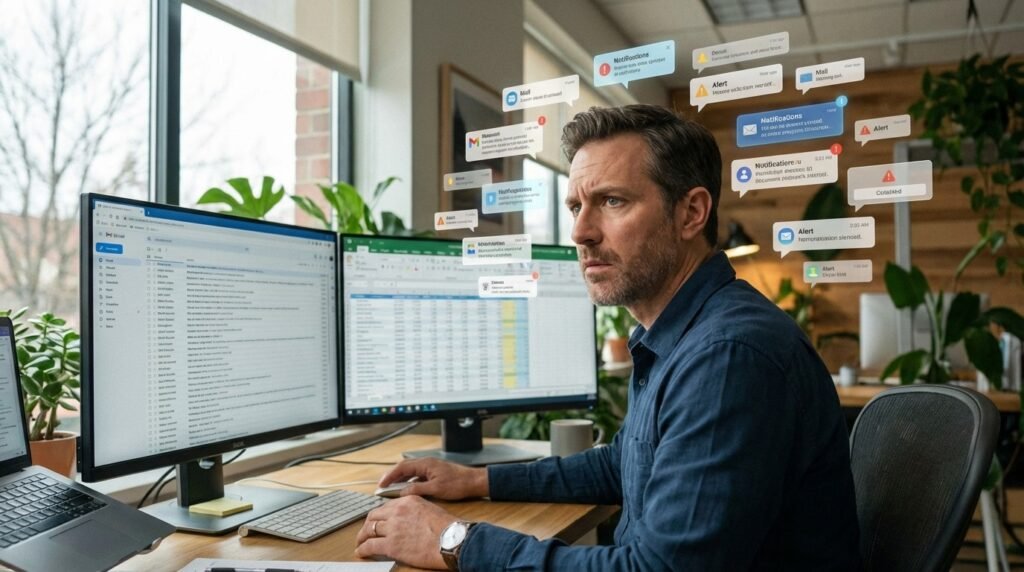
AI in the office: becoming the architect of your own time
In the office, the number one enemy is “administrative pollution.” These are the hundreds of micro-tasks that add nothing to your job but eat up your time. AI enables a radical reorganization here.
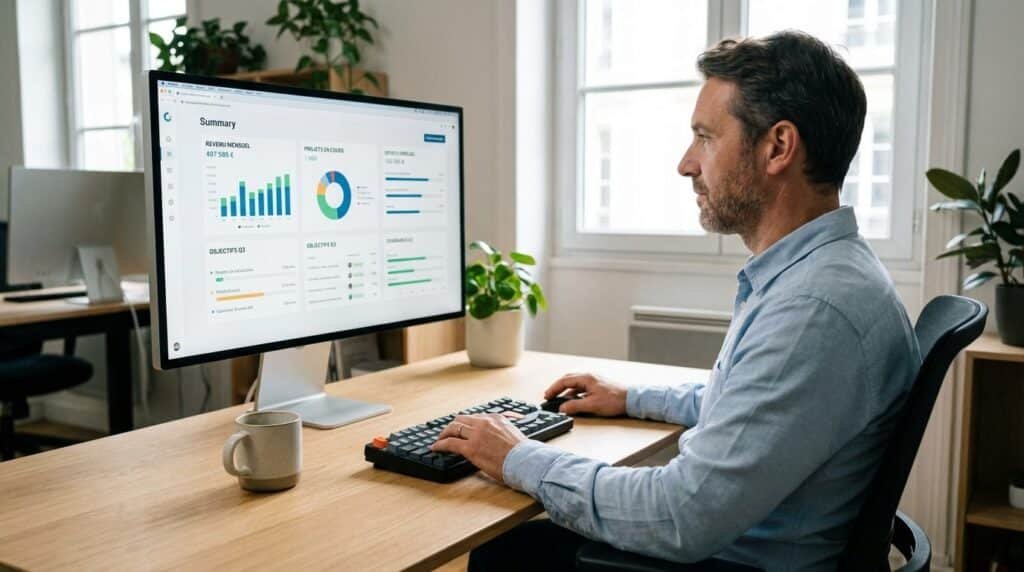
Intelligent feed filtering
Imagine no longer having to manually sort through your inbox. AI systems can now analyze the urgency and context of your messages. They only show you what requires your human intelligence. According to Microsoft’s Work Trend Index, users who delegate this sorting save an average of half a day per week.
La préparation proactive des dossiers
AI also changes the way you approach your meetings. Instead of spending an hour rereading last week’s notes, AI generates a proactive summary. You arrive at the meeting with the key points and decisions to be made already listed. You move from the role of “information seeker” to that of “decision maker.” This is a huge mental comfort gain that reduces anxiety related to forgetting.
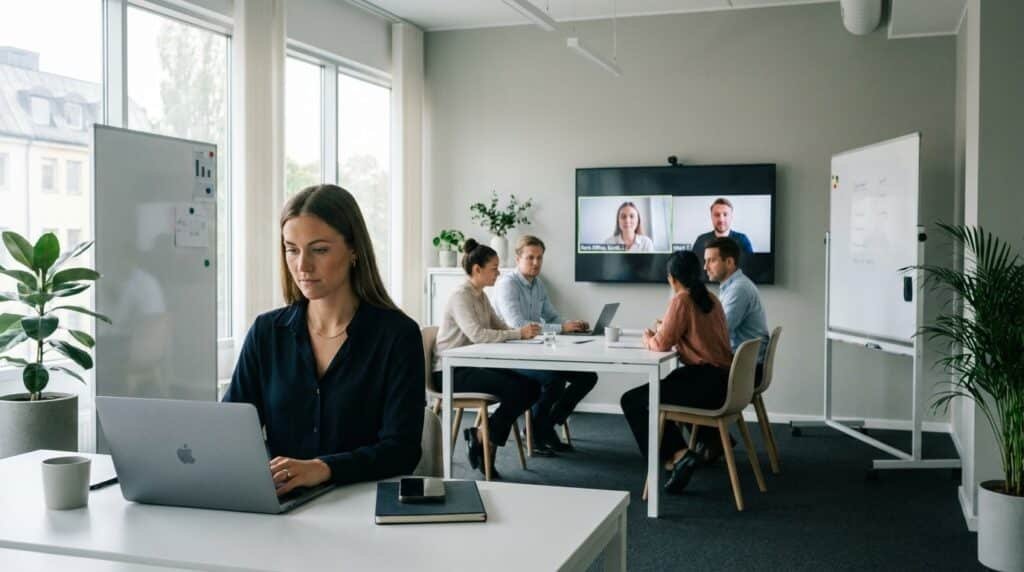
AI as the cornerstone of hybrid work: recreating connections without barriers
Hybrid working (a mix of on-site and remote working) has given rise to an invisible challenge: social fragmentation. We waste a huge amount of energy trying to find out who is doing what, from where, and whether the latest report has been read by the technical team. This dispersion creates a “mental coordination load” that eats up to 20% of our available time.
AI acts as a digital “collective brain” here. It maintains a living knowledge base. Rather than interrupting a colleague to find a document or a decision made in a meeting, AI connected to your tools (such as Microsoft 365, Slack, or Notion AI) responds instantly. It eliminates wasted time waiting and protects workflow.
Beyond data, AI orchestrates the fluidity of human interaction. Predictive algorithms now optimize office occupancy by suggesting optimal days for attendance based on the cross-referenced schedules of team members. AI no longer just manages files; it maximizes the value of your real-world interactions.
AI on production sites: vigilance and safety
In the field (factories, construction sites, logistics platforms), productivity is not measured in emails sent, but in machine availability and worker safety.
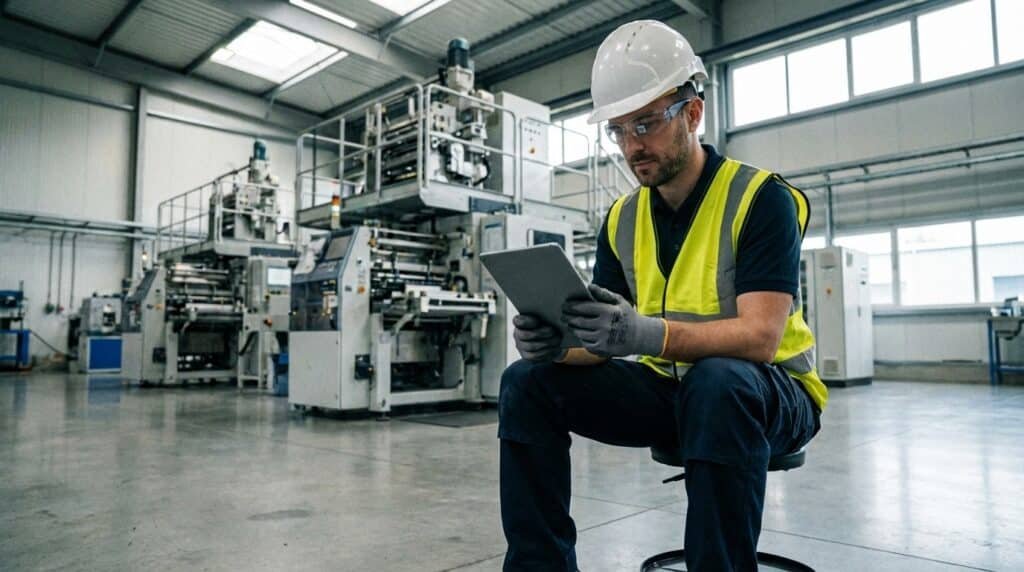
Reducing the “burden of vigilance”
Monitoring a production line requires constant visual attention, which quickly overloads your occipital (vision) and frontal lobes.
- Concrete example: In quality control, AI can analyze 1,000 parts per minute. Human operators, meanwhile, move from the role of “detector” (which is exhausting and fallible) to that of “anomaly manager.”
- Health impact: By eliminating this monotonous monitoring, we reduce the stress associated with the fear of “missing” a defect. AI acts as an extended sensory system.
Predictive maintenance: From crisis to peace of mind
Nothing is more mentally draining than an unexpected breakdown. Stress causes cortisol levels to rise, which clouds logical thinking.
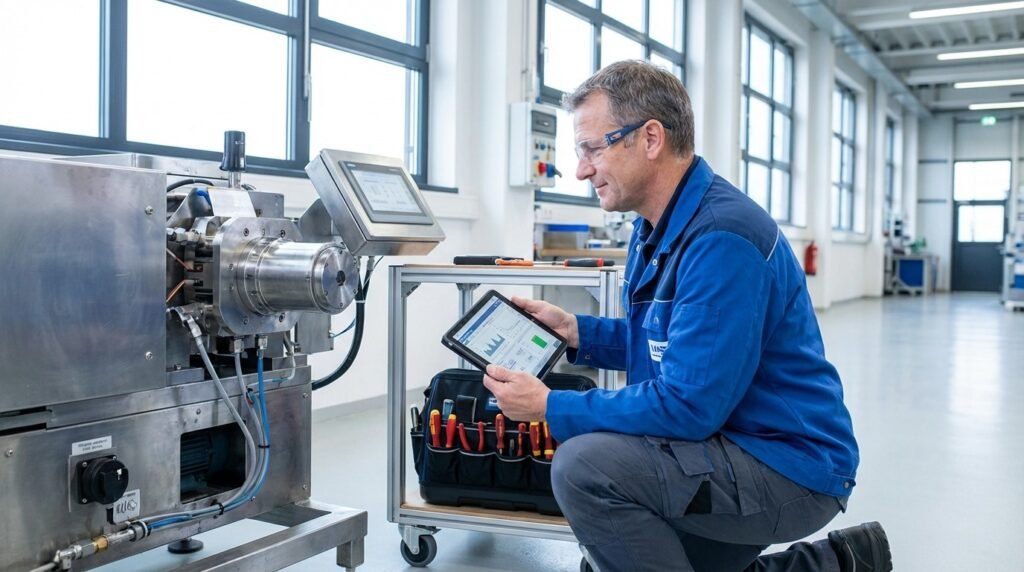
- Industrial workflow: AI analyzes machine vibrations or heat and predicts breakdowns 48 hours in advance.
- Result: The maintenance technician plans his intervention. He works calmly, with the right parts and the right manual suggested by AI. Productivity increases because “downtime” is controlled, and the social climate improves.
Method: reorganize your typical day
Focus on the daily workflow: the “30-90-AI” method
For artificial intelligence to become a performance lever rather than an additional distraction, its use must be aligned with your chronobiology. The goal is simple: synchronize your tasks with your natural energy cycles.
The protection phase (Le Matin)
When you wake up, your brain has a limited supply of glucose: your prefrontal cortex is then at peak efficiency.
- The trap to avoid: Diving into your emails at 8:30 a.m. This reflex saturates your mind with non-priority micro-information, draining your mental battery before the day has even really begun.
- The AI reflex: Delegate sorting. Use an intelligent assistant to generate a “Morning Briefing.” A simple request is all it takes: “What are the three crucial topics that require my attention today?”
- The action: Once you have identified the essentials, cut out all distractions. Devote 90 minutes to in-depth work. Here, AI acts as a “border guard”: it filters out noise to protect your concentration.
The collaboration phase (noon–3 p.m.)
This is when energy levels naturally decline. Rather than pushing yourself, take the opportunity to delegate heavy administrative tasks (those parasitic tasks that slow you down).
- Say goodbye to note-taking: Don’t suffer through meetings anymore. Let an AI transcription service (such as Otter or Fireflies) capture the conversation for you. You stay focused on the discussion, and the machine takes care of the memory.
- Writer’s block: For complex reports, never start from scratch. Dictate your ideas to the AI and ask it to structure a first draft. Biologically, editing is much less exhausting than creating. This saves your energy for the final polish and decision-making.
Managing with AI: orchestrating team intelligence
Team organization is changing. Managers no longer need to be “task controllers,” but rather facilitators of talent. AI makes it possible to move from reactive management to predictive management.
Cognitive distribution: By analyzing workflows, managers can identify in real time which employees are reaching saturation point. This allows tasks to be redistributed fairly before exhaustion impacts performance.
Enhanced mentoring: By automating 80% of reporting and administrative verification, AI frees up time for coaching. Managers can once again become mentors who focus on developing soft skills, which is something machines cannot do.
Seamless transparency: AI centralizes goals and progress, allowing each team member to see their actual contribution to the overall project, thereby strengthening their sense of belonging and motivation.

AI and Humans: An Alliance of Skills
This is where everything comes together. AI has the computing power, but it lacks your perspective and experience. Only humans can give meaning and direction to the results. In this alliance, you don’t disappear: you change roles to become the Supervisor of your activity.
This role is the cornerstone of your new organization. Rather than viewing AI as a threat, use it as a shield to protect your most valuable resource: your clarity of mind. The idea is no longer to work harder, but to keep your brain available for what really matters.
No more exhausting yourself trying to get started
When faced with too much information, the brain becomes overwhelmed and unable to make choices. AI acts as a filter: it removes the superfluous to show you only what is essential. Whether it’s summarizing a file or identifying a malfunction, your job is no longer to sift through data, but to make decisions based on your experience.
Moving from sorting to decision-making
When faced with too much information, the brain becomes overwhelmed and unable to make choices. AI acts as a filter: it removes the superfluous to show you only what is essential. Whether it’s summarizing a file or identifying a malfunction, your job is no longer to sift through data, but to make decisions based on your experience.
Keep your “brain available”
By delegating technical details to AI, you keep your “brain available” for what really matters. By avoiding exhausting yourself with micro-tasks throughout the day, you remain fully lucid for the tasks where you are irreplaceable: long-term vision, ethics, and managing your teams. Stepping out of production mode means accepting that AI provides the brute force while you provide oversight and final approval.
Relational intelligence: the new driver of performance
AI frees up your time, but this gain should not be used to accumulate even more administrative tasks. This newly found time is an asset that you must reinvest in people.
- At the office: this time finally allows for real coaching of your teams, promoting their skills development and well-being.
- In the field: it offers the opportunity to reconnect with the transmission of know-how and apprenticeship, pillars of industrial quality.
It is this human presence that cements team commitment. By listening more, you influence motivation and cohesion, levers that AI will never be able to replicate. Tomorrow’s productivity will not only be technological, it will above all be relational.
Towards a new measure of productivity: from quantity to impact
The integration of AI into our processes requires a revolution in our key performance indicators (KPIs). In the age of augmented intelligence, evaluating productivity based on the number of emails sent or hours spent in front of a screen has become biologically and economically nonsensical. We must move from a culture of volume to a culture of value.
This transformation is based on three new pillars:
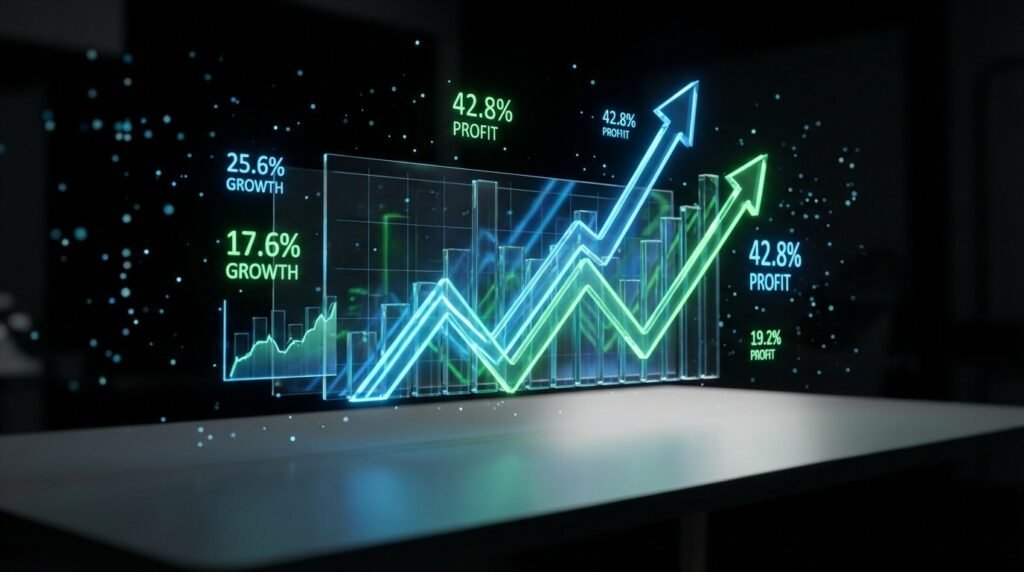
- The impact index: Modern productivity is now measured by the quality of decisions made and the added value created. A Harvard study shows that AI increases performance by 20% on complex tasks.
- Serene velocity: The new indicator of success is the ability to deliver high-quality projects without exhausting teams. We no longer measure raw execution speed, but strategic relevance.
- The value of “Free Time”: In this new model, the time saved thanks to AI is not a void to be filled, but an investment in long-term vision and creativity.
Conclusion: Towards sustainable performance
Artificial intelligence marks the end of the era of exhaustion. It offers us the opportunity to regain control over our time and energy. Whether you’re behind a screen or on a production line, acting as the architect of your own workflow is the secret to peaceful success.
Productivity is no longer measured in hours of hard work, but in clarity of mind. By protecting your brainpower, you not only become more efficient: you also become more creative, more confident, and more fulfilled.
FAQ: Everything you need to know about increased productivity
Will AI eliminate my usefulness at work?
No, it will eliminate the “robotic” part of your job. Your value now lies in your ability to operate these tools, interpret the results, and make the final decisions.
Does AI really increase factory safety?
Yes. In particular, AI drastically reduces the risk of mental fatigue among operators, which remains the leading cause of workplace accidents. It acts as a vigilant co-pilot at their side.
How long does it take to see results?
The time savings are almost immediate as soon as you start using synthesis or calendar automation tools. Within a week, the reduction in stress is already noticeable.
The last word
AI is not just a technical update, but a historic opportunity to put people back at the center of their own work. By delegating daily friction to this external nervous system, you protect your neural capital and regain the clarity of mind needed to innovate. Stop being the executor of a workflow that you endure, and become the architect of sustainable and serene performance.