Understanding artificial intelligence: basics, uses, and everyday applications
Key takeaway:
Artificial intelligence is a sophisticated mathematical system that mimics our thinking abilities without ever possessing consciousness itself. By learning from massive amounts of data, it simplifies our most tedious tasks and personalizes our services invisibly.
Understanding AI can simplify your daily life, secure your personal data, and help you better organize your days, both at work and at home
The ubiquity of AI in our daily lives, from social media to work tools, can cause real frustration or a feeling of digital insecurity.
This comprehensive guide aims to lift the veil on the mysteries of technology, from its historical roots to its most practical applications, so you can regain control of your data. Today, artificial intelligence is everywhere: smartphones, search engines, voice assistants, personalized recommendations, and creative tools.
What is AI?
Artificial intelligence is not a magical phenomenon that spontaneously emerged with the arrival of ChatGPT. To fully understand artificial intelligence, it must be viewed as a branch of computer science whose goal is to create systems capable of performing tasks that, until now, required human intelligence. This includes speech recognition, complex decision-making, machine translation, and computer vision.
The intellectual journey really began in 1950. Visionary mathematician Alan Turing published a seminal article in which he posed a revolutionary question: “Can machines think?” He then devised the Turing Test, an experiment in which a human engages in a blind conversation with a machine and another human. If the interrogator can no longer distinguish who is who, the machine has passed the test. A few years later, in 1956, the Dartmouth Conference brought together the greatest minds of the time, who effectively christened the field. At that time, the ambition was immense: it was thought that in one summer, the problems of language and logic in machines could be solved.
The reality was more complex. For decades, AI went through difficult times, periods when funding dried up due to a lack of results, because machines lacked computing power and data. Why? Because traditional software works like a cookbook. The programmer writes each step: “If the user clicks here, do that.” This is called an expert system. But to recognize a face or translate a poem, it is impossible to write all the rules manually.
Modern AI has solved this problem by changing its approach: instead of following a recipe, it learns by observing millions of examples.
This evolution from rigid rules to flexible learning has given rise to a huge diversity of technologies. To make sense of it all, it is necessary to map out this universe.
The AI Galaxy: Capability, Technology, and Function
It is crucial to understand that there is no single form of artificial intelligence, but rather a family of technologies that can be classified according to two main criteria: their intellectual power (capacity) and their mode of operation (technology).
Classification by capacity: From everyday life to science fiction
This category allows us to distinguish between what is already part of our reality and what is still fantasy.
- L’IA faible (Narrow AI) : C’est l’ IA que nous utilisons tous les jours. Elle est “étroite” car elle excelle dans une seule mission précise.
- Concrete examples: Siri or Alexa (voice assistance), Waze (route calculation), or Netflix algorithms (recommendations).
- The limitation: A system like DeepL is brilliant at translating, but it is incapable of driving a car or playing chess.
- General AI (AGI): This is the stage where machines possess mental plasticity identical to ours, capable of learning any human task without specific prior training. AGI remains a theoretical horizon today.
- Super-intelligent AI (ASI): A speculative concept in which artificial intelligence would radically surpass the human brain in all areas (creativity, wisdom). This is the AI of science fiction films.
Classification by technology and function
This is where we understand how technology has evolved to become capable of “creating” content.
- IA symbolique (logique) : Elle fonctionne par des règles strictes (“Si… Alors…”).
- Exemple : Les filtres anti-spam classiques. Si un mail contient “Loterie” ET “Gagné”, ALORS il va en quarantaine. C’est rigide mais fiable pour des tâches administratives simples.
- Exemple : Les filtres anti-spam classiques. Si un mail contient “Loterie” ET “Gagné”, ALORS il va en quarantaine. C’est rigide mais fiable pour des tâches administratives simples.
- Machine Learning (Apprentissage automatique) : La machine n’attend plus de règles, elle les crée en analysant des données et s’améliore avec le temps.
- Exemple : Spotify ou les prévisions météo. La machine analyse les habitudes de millions d’utilisateurs pour prédire vos goûts futurs.
- Exemple : Spotify ou les prévisions météo. La machine analyse les habitudes de millions d’utilisateurs pour prédire vos goûts futurs.
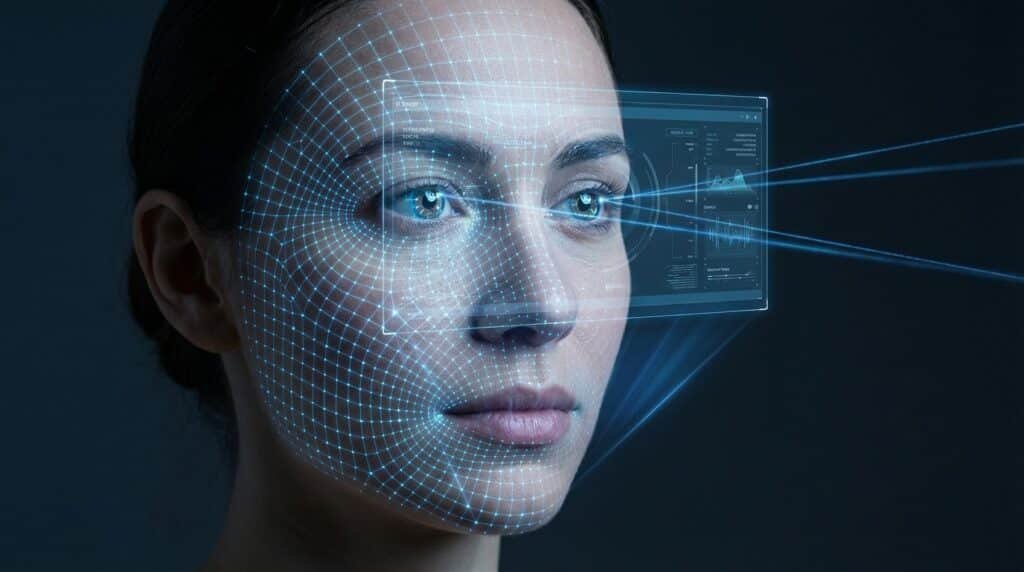
- Deep Learning (Apprentissage profond) : Inspiré par les réseaux de neurones , il traite des données “brutes” et complexes (images, sons, vidéos).
- Exemple : FaceID Deep Learning: Inspired by neural networks, it processes complex “raw” data (images, sounds, videos).
Example: FaceID on iPhone or fluent machine translation. The machine identifies complex structures using layers of intensive computation.
- Exemple : FaceID Deep Learning: Inspired by neural networks, it processes complex “raw” data (images, sounds, videos).
- Generative AI: The creative revolution. This is the most advanced form of deep learning. It no longer simply classifies data, but produces original content (text, images, audio, video).
- Examples: ChatGPT or Claude for text, Midjourney or DALL-E for images.
While these categories describe what AI does, they do not explain how it learns. To understand the revolution underway, let’s compare the two engines of modern AI below.
Understanding the difference between Machine Learning and Deep Learning in simple terms
To understand the difference between these two pillars of artificial intelligence, let’s forget about the technical aspects and imagine that we have to teach a machine to recognize a simple apple. There are two opposing methods: that of the diligent student and that of the instinctive newborn.
Machine Learning: the student under human influence
In machine learning, humans remain indispensable mentors who do much of the work.
In concrete terms, you act like a teacher giving strict instructions to your computer: “If the object is round, if it is red, and if it has a stem, then it is an apple.” The machine does not think for itself; it simply scans thousands of photos to statistically verify whether your criteria are met.
Here, humans choose the important details, and the machine does the final calculation. Its limitation is obvious: show it a red, round potato, and it will fall for it, because it is unable to think outside the box you have set for it.
Deep Learning: the newborn with total autonomy
Deep learning represents a much more fascinating and autonomous evolution. Here, there is a radical change in philosophy: humans no longer give any instructions on the appearance of the object.
The concept is based on immersion: the machine is fed millions of images of apples without ever being given any explanation other than “This is an apple.” The machine then observes these images through its neural networks, a series of increasingly fine filter layers. The first layer detects lines, the second identifies curves, the third analyzes textures and reflections, and so on.
Upon arrival, she finally understands on her own what defines the essence of an apple. She identifies a mixture of thousands of mathematical micro-details that a human would be quite incapable of listing.
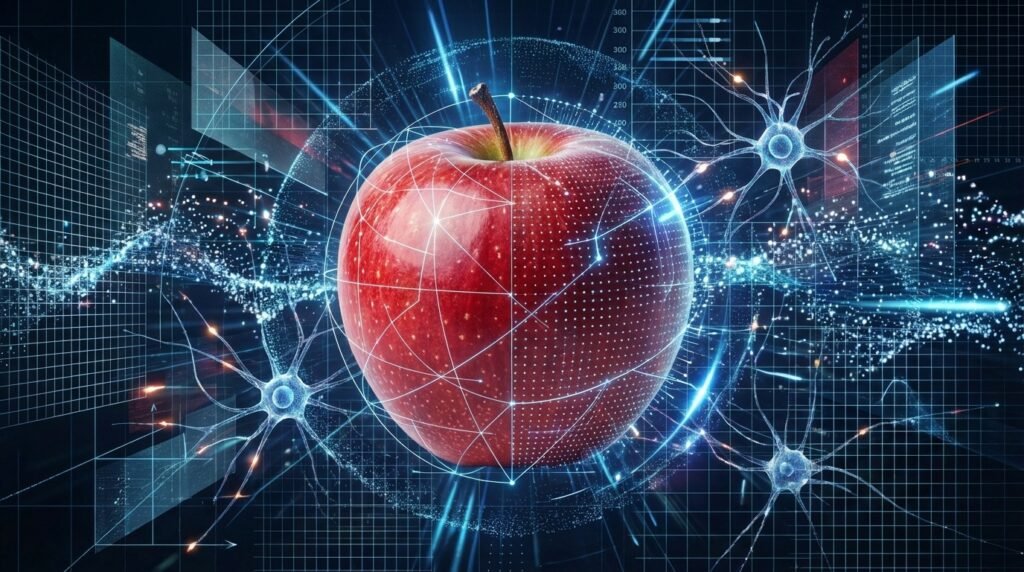
It is this autonomous analytical power that now enables facial recognition and the creation of complex images by generative AI. In short: humans provide the raw data, and the machine discovers its own criteria for truth, all on its own.
This analytical autonomy has enabled AI to take a final step forward: no longer just recognizing the world, but beginning to create it.
L’IA générative : Le sommet de la création artificielle
Generative AI is the spectacular result of this evolution. Unlike traditional AI, which was used to “classify” (This is a cat / This is a dog), generative AI uses its learning to produce something new.
It has no inspiration or emotion. It operates by statistical prediction on a gigantic scale.
When generating text, it calculates the probability of the next word based on billions of sentences it has ingested. For images, it starts with a cloud of random pixels and gradually transforms it to produce a coherent image. This capability transforms our tools into true creative partners, capable of producing reports, logos, or music in a matter of seconds.
- For text: When tools such as ChatGPT (OpenAI), Claude (Anthropic), or Gemini (Google) generate a paragraph, they calculate the probability of the next word based on the billions of texts they have analyzed. They can thus compose emails, blog articles, or even scripts.
- For the image: Platforms such as Midjourney, DALL-E (OpenAI), and Stable Diffusion start with simple visual “noise” (a cloud of random pixels) and gradually transform it into a coherent image based on a textual description (“an astronaut skateboarding on Mars”).
- For sound and video: Innovations such as Suno or Udio (for music) and Sora (for video, also from OpenAI) are beginning to emerge, capable of creating complete audio tracks or dynamic video sequences from just a few instructions.
This massive production capacity transforms our tools into true creative partners, capable of generating drafts, design ideas, marketing plans, or songs in a matter of seconds, thereby increasing our own potential tenfold.
But innovation doesn’t stop at isolated generation. Today, AI combines all its senses to interact with us in a natural way.
The future of collaboration: multimodal AI and hybrid AI
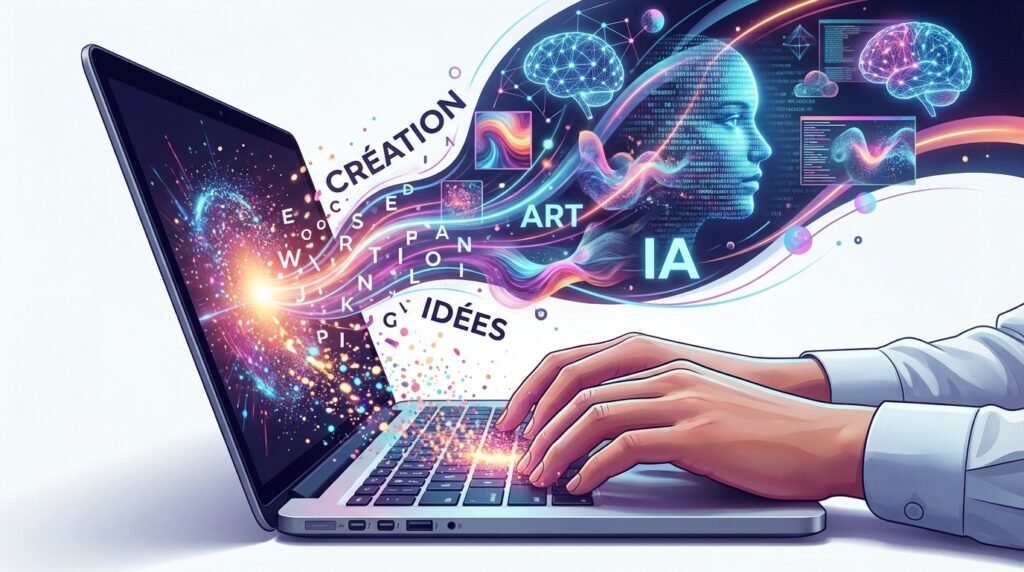
We are entering the era of multimodal AI, a development that marks the ultimate fusion of generative AI capabilities.
In 2026, systems no longer process just one type of media; they can now “see,” “hear,” and “speak” simultaneously, within the same exchange.
The link with generative AI is fundamental here: it is what gives voice and body to this perception. Now, you no longer just type text on a keyboard. You can show a faulty mechanical part to your smartphone camera and ask aloud, “How do I fix this?” Artificial intelligence uses its vision to analyze the object, then generative AI takes over to instantly create a personalized voice response or project a repair diagram in augmented reality.
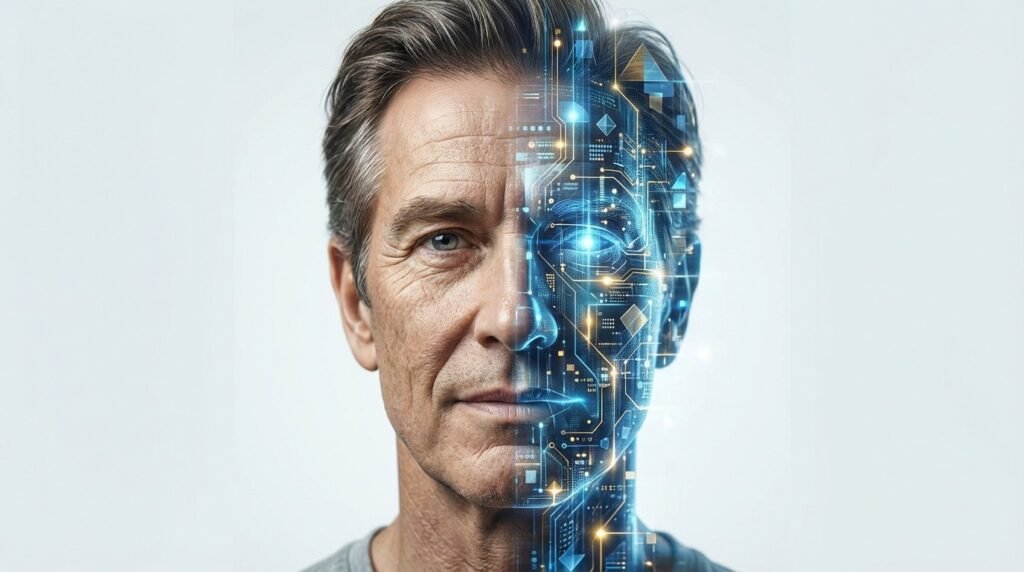
This evolution is radically transforming work and giving rise to the concept of hybrid AI. The role of the user is changing: we are moving from executor to “pilot.” This is the principle of the human in the loop. AI manages the “brute force” of information—massive data analysis, immediate visual recognition, and draft generation—while the professional becomes a “conductor.”
In this duo, generative AI provides the raw material (text, images, technical solutions), but it is humans who bring strategic nuance, empathy, and final validation.
To control this powerful engine, we need a steering wheel: this is where the art of communicating with the machine comes in.
The prompt: the language of communication between humans and machines
In order for generative AI to produce a result, it needs a gateway: this is called the prompt. If artificial intelligence is the engine of a race car, the prompt is the steering wheel. Without it, the machine has all the knowledge in the world, but it doesn’t know which direction to steer it in.
Why is the prompt changing the game?
Unlike a Google search, where you type in keywords to find existing information, the prompt is a creative instruction. You are not looking for a document; you are asking the AI to create something specific. The link between the user and the AI then becomes conversational.
This is where the magic lies: the prompt allows you to transfer your context, intentions, and nuances to the machine. The richer and more structured your invitation, the more accurately the AI can draw on its neural networks to provide you with a tailored response. It is this ongoing dialogue that defines hybrid AI: your vision drives the algorithm’s execution power.
The emergence of a new skill: leadership
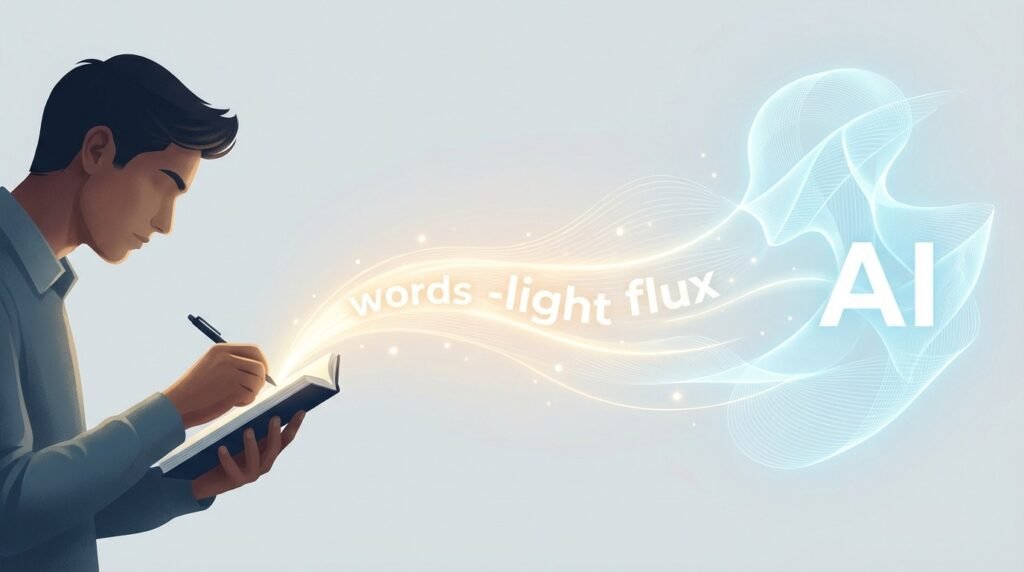
We are no longer talking about simply using software, but about “controlling” intelligence. Prompting has become the universal interface. Whether you want to generate complex computer code, an artistic image, or a market analysis, the tool is the same: natural language.
Mastering the prompt therefore means learning to translate your thoughts into clear instructions for artificial intelligence in order to extract maximum productivity from it.
Practical Guide to Prompting: Mastering the Art of Command
Prompt engineering has become a fundamental skill. A prompt is the instruction you give to AI. To optimize your productivity, here is the structure of a perfect prompt:
- The role: Give AI an identity. “Act as a business strategy expert.”
- The context: Explain the situation. “I am preparing a proposal for a client in the hotel industry.”
- The task: Be specific about the objective. “Write a five-point action plan.”
- Format: Define the format. “Use a persuasive tone and present the results in table form.”
Conclusion: AI as a lever for human potential
Artificial intelligence is no longer a futuristic promise: it is the tool that is already redefining the way we live and work. By mastering its mechanisms—from machine learning to generative and multimodal AI—you cease to be a mere spectator and become an informed pilot of your own technology.
A true personal ally, AI simplifies repetitive tasks, personalizes your leisure activities, and boosts your productivity. However, to ensure that this power remains at the service of humanity, vigilance is required: issues of bias and ethics are crucial challenges that we explore in detail in our dedicated cornerstone article.
Mastering AI means increasing your creative potential and organizational skills tenfold while remaining in control of your choices. That’s the real challenge: building a future where technology amplifies your talent without ever replacing it.
FAQ : L’essentiel sur l’IA en bref
What is AI and how does it work?
It is a computer system that mimics human thinking. Instead of following fixed orders, artificial intelligence analyzes data to identify patterns and predict the most logical action.
Does AI really understand what it says?
No. It has neither consciousness nor feelings. It simply calculates statistics: it predicts the most likely next word without grasping the deeper meaning.
How does AI help in everyday life?
It offers a major productivity boost. It automates repetitive tasks at the office (emails, reports) and personalizes services at home (music, GPS, voice assistants).
What are the risks to be aware of?
Be wary of hallucinations (errors asserted with confidence), biases (prejudices), and deepfakes. Always keep a critical mind and check your sources.
How can you protect your privacy?
Use GDPR-compliant tools, never share confidential data on free AI platforms, and prioritize local processing of your information.
AI vs. traditional software: what’s the difference?
Traditional software follows rules written by humans. Artificial intelligence (via machine learning) learns on its own from examples and creates its own solutions.
Turing and Dartmouth: why is this important?
In 1950, Alan Turing proved that a machine could imitate humans. The Dartmouth Conference then launched AI as a science in 1956.
Final word:
Artificial intelligence is no longer a promise for the future, but an immediate productivity lever. By mastering machine learning and prompting, you can transform technological complexity into a unique opportunity to increase your creativity and expertise tenfold.