
Preventing Burnout: How to Protect Your Brain from Exhaustion?
Key takeaways:
Burnout is the depletion of your biological resources in the face of chronic stress. As soon as cynicism or fatigue sets in, your brain sounds the alarm.
Identifying these signals allows you to regain control before you reach breaking point. By alternating between truly disconnecting and setting clear priorities, you can transform your mind into a lasting bulwark.
Exhaustion is not inevitable, but rather a warning sign from your body. By shifting from crisis management to conscious management of your resources, you protect your neurological capital.
Sustainable performance does not come from brute force, but from a balance between intensity and recovery. Take care of your balance today to remain in control of your ambitions tomorrow.
What will be your first small step toward restoring this balance today?
Understanding the mechanics of exhaustion: beyond simple fatigue
Burnout is not simply a temporary “slump”
It is a pathological response to stress. It is a state of physical or emotional exhaustion that also involves a sense of loss of personal identity.
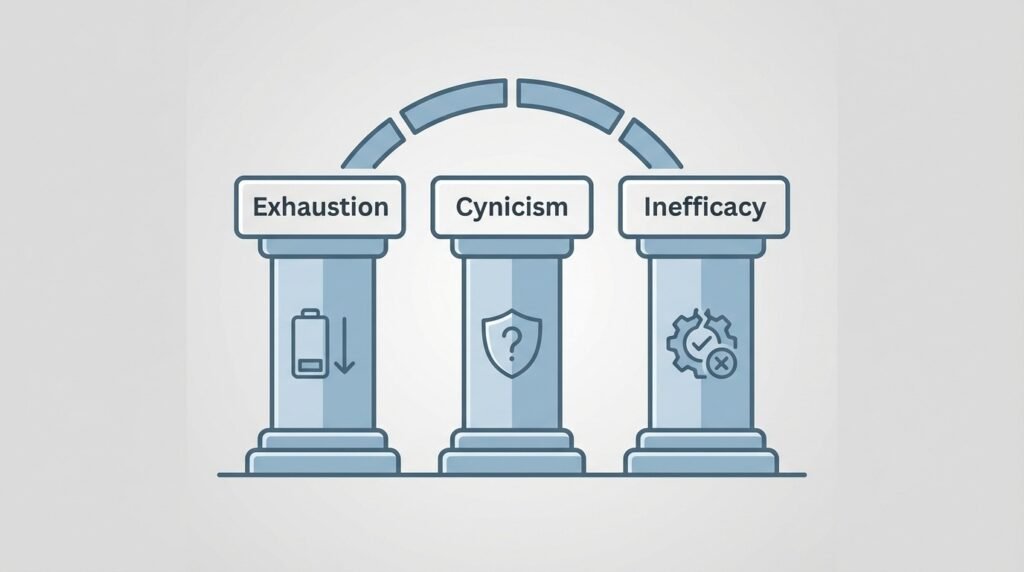
The 3-pillar model (Maslach Inventory)
For the scientific community, and in particular according to the work of researcher Christina Maslach at Stanford University, burnout manifests itself in a very specific triad:
- Emotional exhaustion: You feel drained, like a battery that no longer holds a charge.
- Example: You dread Mondays as early as Sunday afternoon, and even a 10-hour night’s sleep isn’t enough to make you feel “fresh.” A study by the Harvard Business Review indicates that 61% of employees feel exhausted by midday.
- Cynicism (or depersonalization): This is a cerebral defense mechanism. To stop suffering, your brain creates a “cold distance.”
- Example: You start treating your coworkers or clients like numbers or problems to be solved, losing all your usual empathy.
- Feeling of inefficiency: You feel like you’re swimming against the tide. It’s not that your skills are declining, but rather your self-efficacy.
- Example: A task that used to take you 15 minutes now takes an hour because your brain can no longer prioritize.
Chronic stress vs. burnout: when your “reset button” is broken
It is crucial not to confuse temporary stress with the downward spiral of burnout. Stress is, at its core, a biological ally: it is an adrenaline rush that helps your body adapt to a specific challenge. Once the project is completed or the exam is over, your body naturally returns to its state of equilibrium. This is called homeostasis.
Burnout, on the other hand, is a failure of this self-regulating system. Imagine a thermostat stuck on maximum: even when the room is boiling hot, it continues to heat up. Your body no longer knows how to calm down, even at night or on weekends.
This constant overheating has a real cost on your intellectual abilities. According to the American Psychological Association (APA), prolonged and unmanaged stress can reduce your cognitive productivity by 40% (Source: APA). You are no longer working, you are just “spinning your wheels.”
The most striking aspect remains the profound biological impact. A study published in the scientific journal The Lancet has shown that biological markers of stress, such as cortisol (the stress hormone), do not return to normal levels after a few days of rest (Source: The Lancet). This proves one thing: when it comes to burnout, vacations are no longer enough. Your brain doesn’t need a “vacation”; it needs real neurological repair to relearn how to function without being in a constant state of alert.
Beyond Burnout: Boreout and Brownout
While the pain felt is often the same, the source of the problem can vary. It is crucial to put the right words to your ailments in order to tailor your recovery strategy.
- Bore-out (exhaustion due to boredom): This is the paradox of “too little.” Your brain is a machine designed to solve problems. Without stimulation, it atrophies. A lack of challenges generates chronic stress that is as devastating as overload, because it is accompanied by paralyzing social shame.
- Brown-out (voltage drop): Here, it is not the amount of work that is the problem, but its absurdity. It is a crisis of meaning. According to a Deloitte survey, 77% of professionals have already felt this inner emptiness (Source: Deloitte). When effort seems pointless, your mental energy evaporates, leaving you in a state of total disconnection from your tasks.

Learned helplessness: the trap of the system
This feeling of “not being able to do it anymore” is not a flaw in your personality. It is a neurological mechanism called “Learned Helplessness.”
When your efforts are systematically hampered by a dysfunctional organization (absurd processes, lack of resources, toxic management), your brain eventually realizes that fighting is futile. This realization puts a sudden stop to the production of dopamine, the neurotransmitter responsible for motivation. You are not lacking in willpower; your brain has simply activated an “energy-saving” mode to protect you from an environment it considers beyond your control.
Beyond biology: triggers in the field
As we explored in our previous articles on the neurobiology of stress, you are now familiar with the chemical battle between glutamate and GABA and the fatigue of your glial cells. But understanding the internal mechanics is not enough: we now need to identify the external “arsonists.”
While biology explains how the brain becomes overwhelmed, environmental factors are the sparks that light the fuse. Identifying them is the first step toward defusing the process.
1. Work overload and gratitude debt
The first factor is often the most visible: the accumulation of tasks. However, research shows that workload alone is not enough to break an individual. The real poison is the imbalance between the effort expended and the reward obtained. If you complete a complex project to general indifference, only to receive a new list of tasks, your reward circuit shuts down. The cost of this overwork is well documented: a study by Stanford University has shown that beyond 50 hours of work per week, productivity drops so sharply that these extra hours become biologically useless. You are no longer productive, you are wearing yourself out.

2. The trap of perfectionism and hyper-investment
Perfectionism is not a sign of rigor, it is a cognitive vulnerability. In psychology, we distinguish between healthy excellence and dysfunctional perfectionism, that visceral fear of failure that drives constant vigilance. This is the case, for example, when you spend two hours formatting an internal email, exhausting your brain’s glucose reserves before you even get to the substantive issues. This trend is not isolated: the American Psychological Association (APA) points out that perfectionist tendencies have jumped 33% in thirty years, creating fertile ground for chronic anxiety.
3. Blurred boundaries and hyper-connectivity
The advent of smartphones has created a veritable “digital leash.” The danger lies not only in working in the evening, but in maintaining constant vigilance. Researchers at the University of Virginia have proven that simply waiting for a message after office hours is enough to keep cortisol at an alert level. When you scroll through your work messages just before bed, you not only block your melatonin, but you also prevent your brain from switching to “repair” mode. Your nervous system remains in fight mode, even under the covers.
4. Lack of autonomy and micromanagement
The need for autonomy is a pillar of human motivation. Not being able to decide how to work triggers low-intensity but constant stress, leading to learned helplessness. The impact on health is staggering: the Whitehall II study, a global benchmark, found that employees with little control over their tasks have a 50% higher risk of cardiovascular disease. Micromanagement is not just bad management practice, it is a major biological risk factor.

5. Social isolation and climate change
Finally, let’s not forget that we are social animals. Support from colleagues acts as a biological buffer: in groups, we produce oxytocin, a hormone capable of neutralizing the toxic effects of cortisol. Conversely, isolation or chronic tension leaves individuals alone to deal with their mental load. The quality of social relationships is the number one protective factor against premature burnout. Without mutual support, every difficulty weighs twice as heavily on your shoulders.

Your body is talking to you: decoding warning signs before the breakdown
Burnout never happens without warning. Before you completely shut down, your body sends a series of “error codes” that are vital to interpret. These symptoms are biological evidence that your nervous system is no longer able to regulate the load.
1. Emotional armor: when cynicism becomes a shield
The first sign is often a feeling of inner emptiness, an “emotional numbness” where your battery refuses to recharge. If you were once known for your empathy and now sigh whenever a colleague asks for your help, you are probably experiencing what researchers call depersonalization.
This is not a change in character, but a brutal defense mechanism: to conserve what little energy it has left, your brain shuts down.
2. Cognitive fog: synaptic fatigue in action
Are you starting to search for words, forget appointments, or reread the same sentence three times? This “brain fog” is a sign that your working memory is truly overwhelmed. Under chronic stress, the prefrontal cortex—your command center—can lose up to 20% of its processing capacity.
According to the American Psychological Association (APA), this drop in performance is usually accompanied by a 25% increase in errors due to inattention. You then spend more hours at the office to produce half as much, because your neurons are no longer processing information. It’s not a lack of willpower, it’s neural fatigue: your brain needs structural repair that only deep rest can provide.
3. Somatization: when the body screams what the mind ignores
When the mind refuses to slow down, the body takes over to shut down the machine. This often starts with “sabotaged” sleep: 80% of people in pre-burnout suffer from fragmented nights. Despite eight hours in bed, you wake up feeling like you’ve run a marathon. Cortisol, which remains too high, prevents you from entering REM sleep, which is essential for regulating your emotions.
The body eventually cries out in pain: neck tension, back pain, or digestive problems arise without any apparent medical cause. If you realize at the end of the day that your jaws are constantly clenched (bruxism), it means that your body is exhausting itself in vain anticipation, sounding the alarm before the final collapse.

Preventing Burnout: 5 Strategies to Protect Your Mental Health
Protecting your brain is not a matter of heroism or sheer resistance, but of strategic management. To restore your mental integrity, you must shift from being a passive recipient to becoming the architect of your own biological balance. Preventing burnout means moving from constant crisis management to conscious optimization of your resources: every micro-decision then becomes a lever for preserving your neurological capital in the long term.
1. Controlling your load: neural economy
Every decision, even the smallest, consumes brain glucose. Multitasking is the enemy of your performance: constantly switching between tasks can reduce your productivity by 40% and increase your error rate by 20%. This is known as the “cost of switching.”
Practice “batching.” Rather than responding to emails continuously, set aside two 30-minute slots per day. This will help you avoid exhausting cognitive restarts and relieve your prefrontal cortex.
2. Respecting your rhythms: the 90/15 method
Working against your internal clock is the fastest way to overload your circuits. Our attention works in natural cycles called ultradian rhythms.
- The strategy: After 90 minutes of intense concentration, force yourself to disconnect for 15 minutes. Pushing yourself beyond this time limit will cause stress rather than produce results. Identify your peaks of alertness for complex tasks and save administrative work for when your energy levels are low.

3. Brain nutrition: the fuel for resilience
Your brain consumes 20% of your energy. During periods of stress, it draws heavily on its reserves. According to a study published in Nature Reviews Neuroscience, omega-3s facilitate the fluidity of neuronal membranes, making your brain more “elastic” in the face of stress.
- Action: Prioritize healthy fats (nuts, small oily fish) and magnesium. Providing these materials allows for optimal repair of your synapses and limits cortisol-related brain inflammation.
4. Real recovery: beyond simple rest
Sleep is not enough if your day is a sensory marathon. Effective recovery requires a radical break to allow the parasympathetic nervous system to take over.
- The remedy of movement: 20 minutes of moderate exercise is enough to improve mood for the next 12 hours by “metabolizing” excess cortisol.
- Sensory silence: Give your auditory and visual circuits moments of total calm, without screens. This reduces attention saturation and allows your glial cells to clean up the metabolic waste that clogs your brain.

5. Setting boundaries: the right to disconnect
The danger lies not only in the actual work, but in the anxiety of anticipation. A study by the University of Virginia found that simply having to remain available keeps your cortisol levels sky-high, even if you don’t receive any messages.
- Immediate action: At a set time, put your work tools away out of sight. Removing the visual cue from your desk finally allows your brain to switch from “alert” mode to “repair” mode.

Action plan: 3 steps to restore your nervous balance
Here is your immediate protocol to stop the cycle of exhaustion and restart a deep recovery of your faculties.
1. Audit Phase: Identifying your energy “leaks”
Before correcting, observe. For 48 hours, act as an analyst of your own reactions.
- Action: Note on your phone every peak of irritability, confusion, or physical tension (clenched jaw, stiff neck).
- The goal: Reconnect your consciousness to your biological signals to identify stress triggers before they build up and get out of control.
2. Regulation Phase: Installing Neural “Micro-Brakes”
- The action: Apply the Sensory Silence technique. Three times a day, for 3 minutes, switch everything off: close your eyes, remove your headphones, and remain still. No music, no notifications.
- The goal: To create a metabolic break that allows your glial cells to clean up the waste accumulated by excessive concentration.
To counteract excess glutamate (the neurotransmitter responsible for excitation) that keeps your brain overheating, you need to manually stimulate your braking mechanisms.
3. Protection Phase: Keep your off-road excursions safe
Your nervous system cannot begin repairing itself if it remains in “operational standby” mode.
- The action: Establish a strict physical boundary. At a set time, turn off your work tools and put them away out of sight. If you work from home, mark the end of the day with a 5-minute walk or a change of clothes to signal the end of “survival” mode.
- The goal: To send a clear signal to your brain that the “threat” has passed, allowing the switch to the parasympathetic nervous system, which is essential for regeneration.
Don’t let overload decide your future. Exhaustion is not inevitable; it’s a signal inviting you to take back control of your biology. Starting tomorrow, choose just one step from this protocol—perhaps those three minutes of sensory silence—and watch your mental clarity return. Your brain is your most valuable asset: start protecting it now.
FAQ: Understanding burnout to better anticipate it
How does the WHO officially define burnout?
According to the World Health Organization (WHO)’s ICD-11 classification, burnout is not a disease, but a work-related syndrome resulting from chronic unmanaged stress. It is defined by three dimensions:
- Exhaustion: A feeling of total energy depletion.
- Cynicism: Mental withdrawal and negative feelings toward one’s job.
- Loss of efficiency: A drastic reduction in professional performance.
Please note: This definition excludes stress related to personal life and focuses solely on the professional sphere.
Burnout, boreout, brownout: how can you tell them apart?
Although their effects on health are similar, their origins differ:
- Burnout (Overload): The “overflow.” You crack under the weight of excessive investment and constant pressure.
- Bore-out (Underload): Exhaustion due to boredom. Lack of intellectual stimulation causes your motivation and self-esteem to decline.
- Brown-out (Loss of meaning): The crisis of absurdity. You feel drained because your tasks no longer have any value or logic in your eyes, causing a profound disengagement.
What happens chemically in my brain during overload?
The brain loses its regulatory abilities. Normally, a balance is maintained between glutamate (the accelerator that excites neurons) and GABA (the brake that calms the system). In cases of chronic overload, this balance is disrupted: the system remains “stuck” on the accelerator, generating permanent anxiety.
At the same time, astrocytes, the brain’s “garbage collectors,” are no longer able to clean up the metabolic waste produced by intense neuronal activity. This failure to “clean up” slows down the transmission of information, creating the famous brain fog.
How does mindfulness biologically affect stress?
Mindfulness is not simply relaxation, it is cognitive training. It reduces the reactivity of the amygdala, the center of fear and alertness. By bringing your attention back to the present, you break the cycle of anxious thoughts (rumination). This allows the nervous system to switch from “survival” mode to “restoration” mode, improving clarity and the ability to make strategic decisions without emotional overload.
The last word
Sustainable performance does not come from brute force, but from a balance between intensity and recovery. Take care of your balance today to remain in control of your ambitions tomorrow.
Find more articles on this topic HERE