
Emotions and the brain
How they drive your decisions and your mental energy ??
Key takeaways:
Emotions are the brain’s fundamental control system.
They dictate the perception and prioritization of information long before your logic.
Understanding how the brain processes emotions allows you to transform automatic reactions (like procrastination or impulsivity) into actionable insights.
Our emotions aren’t glitches, but biological mechanisms designed to protect our mental energy.
Do you feel like you’re fighting your emotions to try and keep your thoughts clear?
Actually, they’re not there to hold you back: they’re the true engine of your brain.
This article explains simply how your feelings influence your choices and energy levels.
You’ll discover how to use everyday digital tools to listen to what your body is trying to tell you, and thus regain control of your decisions.
Biological function: how the brain processes emotions
Since our emotions are useful, let’s delve into our biology to understand how they concretely guide our daily choices.
The role of emotions, the amygdala, and the thalamus
Neuroscientist Joseph LeDoux revolutionized our understanding of fear by demonstrating the existence of two processing pathways in our skull (see Joseph LeDoux’s work on survival circuits).
- The thalamus (the control tower) and the short pathway:
This is the “emergency circuit.” This fast track prioritizes immediate survival analysis over precision. Your brain would rather make you jump at a garden hose, mistaking it for a snake, than take the time to analyze and risk a fatal bite.
– - The cortex and the long pathway:
In parallel, information takes a slower path to the visual and prefrontal cortex to be rationally analyzed. It is this cortex that, a few milliseconds later, defuses the alert.
–
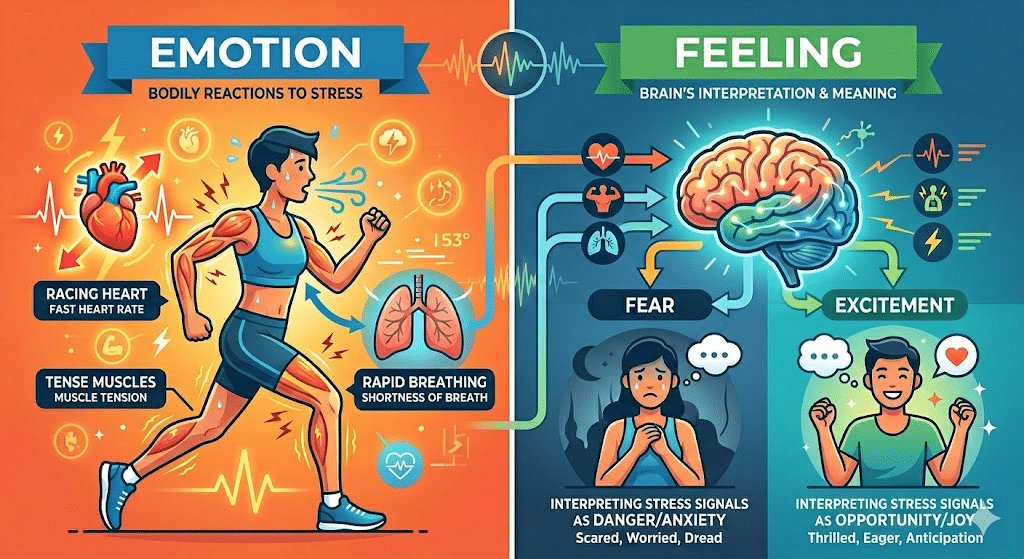
Distinction between bodily emotion and conscious feeling
Stop confusing your emotions and feelings: it’s a matter of chronology.
- Emotion is physical and automatic:
it’s a raw bodily response.
Faced with the unexpected, your heart rate accelerates, your neck tenses, your breathing catches.
It’s a biological survival reflex, measurable and impossible to prevent.
– - Feeling is the story you tell yourself:
It’s your cortex’s mental interpretation of that physical state.
A concrete example:
You go on stage to give a presentation. Your heart races (that’s the bodily emotion).
If your brain interprets this acceleration as a threat, you’ll create the feeling of “panic.”
But if it interprets it as a challenge, you create the feeling of “excitement.”
–
Understanding this changes everything: you can’t block your body’s reaction, but you have the power to choose the word you put on it.
Why the brain needs emotions to decide
For a long time, we believed that pure rationality was the pinnacle of human intelligence.
Neuroscience now proves precisely the opposite: without emotions, no decision is possible.
The role of emotions is not to cloud reason, but to make it operational.
The renowned neurologist Antonio Damasio brilliantly demonstrated that emotions act as “somatic markers”.
They assign a physical value (positive or negative, attractive or repulsive) to each available option, thus significantly reducing the range of possibilities.
Take the example of the patients studied by neurologist Antonio Damasio.
Following a brain injury, the connection between their reason and their emotions was severed.
Their IQ, memory, and logic remained completely intact, and yet they became incapable of making even the simplest everyday decisions.
Without emotion to guide their preferences, choosing a dish at a restaurant or arranging a date becomes an endless puzzle. The rational mind compares variables ad infinitum without being able to decide.
Ultimately: logic justifies the choice, but it is emotion that presses the button.

Emotions are not mistakes, but predictions.
This is a fundamental paradigm shift in the world of cognitive neuroscience.
Your brain doesn’t passively wait for events to happen before reacting. It is, above all, an anticipatory machine.
As demonstrated by researcher Lisa Feldman Barrett, our emotions are not hardwired reactions to the present; they are predictive constructs (see Barrett’s theory of constructed emotion).
Your brain uses your past experiences to predict what will happen and prepare your body accordingly.
This predictive model offers a fascinating and completely guilt-free framework for understanding many of our daily behaviors.
- Why you avoid certain tasks:
If a task seems vague or poorly defined, your brain predicts a high energy cost with a low reward (dopamine).
It then generates a feeling of physical aversion to protect your metabolic reserves.
– - Why you procrastinate:
It’s not a lack of willpower, discipline, or morale. When faced with a complex task, the amygdala perceives a threat to your immediate energy balance.
Procrastination is simply a short-term emotional regulation mechanism.
– - Why you react impulsively:
During a verbal conflict at the office or at home, your predictive brain doesn’t see a simple disagreement of ideas;
it anticipates a social threat of rejection, perceived biologically as a mortal danger.
The amygdala’s short circuit takes over, bypassing your prefrontal cortex to make you attack (anger) or flee (silence) before you’ve even had a chance to formulate a logical thought.
–
Why your emotions exhaust you (or energize you)
Since our emotions filter what we see and predict our efforts, they act as the true thermostat of our cognitive battery.
The link between brain and emotions is primarily a matter of managing our energy budget.
Invisible wear and tear: when your brain remains stuck in alert mode
Prolonged states of alertness drastically increase the mobilization of cerebral energy resources.
Researcher Bruce McEwen formalized this phenomenon as “allostatic load.” Maintaining a constant state of alert in the face of uncertainty (workplace restructuring, family tensions) overloads your brain.
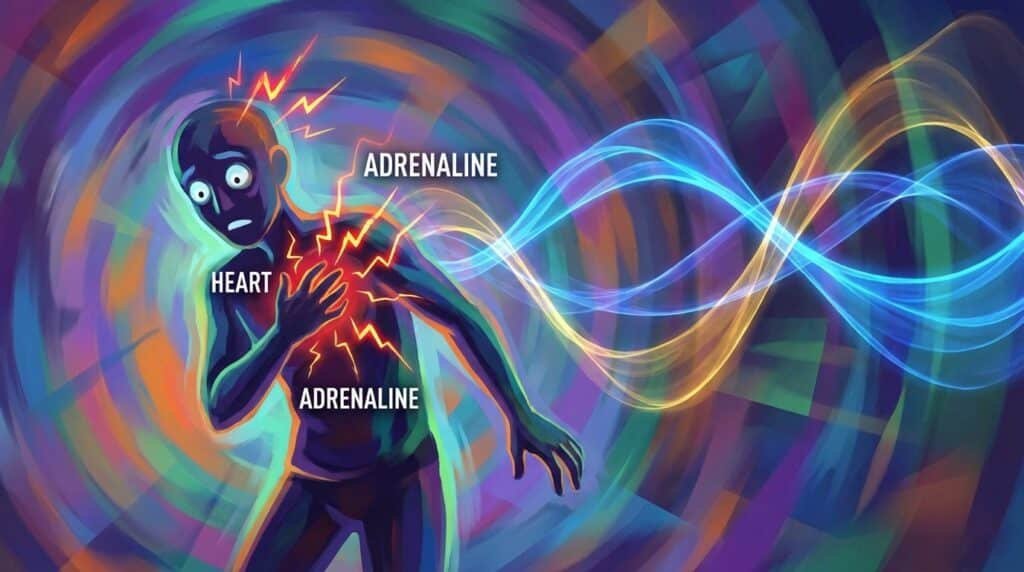
Your body becomes worn down by constantly producing cortisol and adrenaline for imaginary threats.
The fatigue you feel at the end of the day is fundamentally biological, even if you remain seated in front of a screen.
The release of resources
Conversely, curiosity, engagement, and a sense of mastery generate a dramatic energy boost.
When you feel safe and competent, your brain releases dopamine and norepinephrine, which facilitate synaptic transmission.
The feeling of effort diminishes. The mind becomes fluid, and decisions flow with a natural efficiency often referred to as “the flow state.”

Brain and emotions in the face of digital tools
Today, this prehistoric survival instinct clashes head-on with our hyper-connected daily lives.
Biologically, we are not programmed to absorb such an avalanche of demands without becoming exhausted.
Responsiveness to notifications
Every sound alert, every vibration from your smartphone can be interpreted by your limbic system as a signal of absolute priority.
Your brain maintains a continuous micro-alert that fragments your concentration.
The uncertainty surrounding each notification (Is it my boss? A family emergency? Just an advertisement?) creates anticipatory tension that constantly pulls on your sympathetic nervous system (the fight-or-flight response).
Technology as a mirror of the internal state
Rather than being controlled by technology, use it to your advantage.
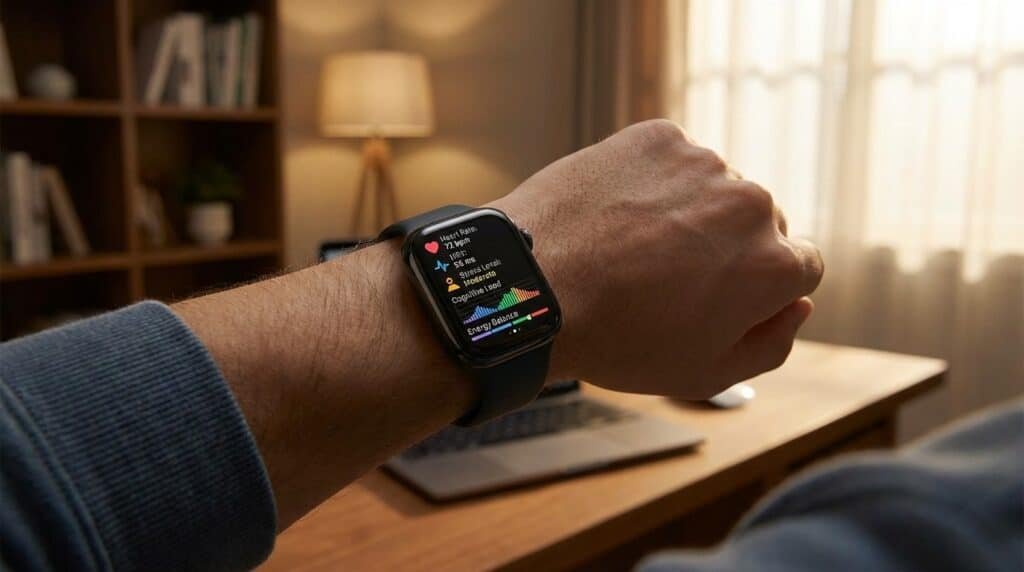
Today, most smartwatches measure your Heart Rate Variability (HRV). Behind this technical term lies a powerful tool:
it’s a true window into your biology, showing you in real time the state of fatigue and recovery of your nervous system.
(See studies on Heart Rate Variability and emotional regulation)
These modern tools make your body’s sensations of stress and recovery visible even before your conscious mind is aware of them.
They transform your watch into a true cognitive dashboard, allowing you to know objectively when to push yourself and when to give your system a recovery phase.
Strategies for clarity in your daily life
True mastery doesn’t consist of switching off your emotions—which would be biologically impossible and disastrous for your decision-making—but of applying systemic strategies to transform those reactions into data.
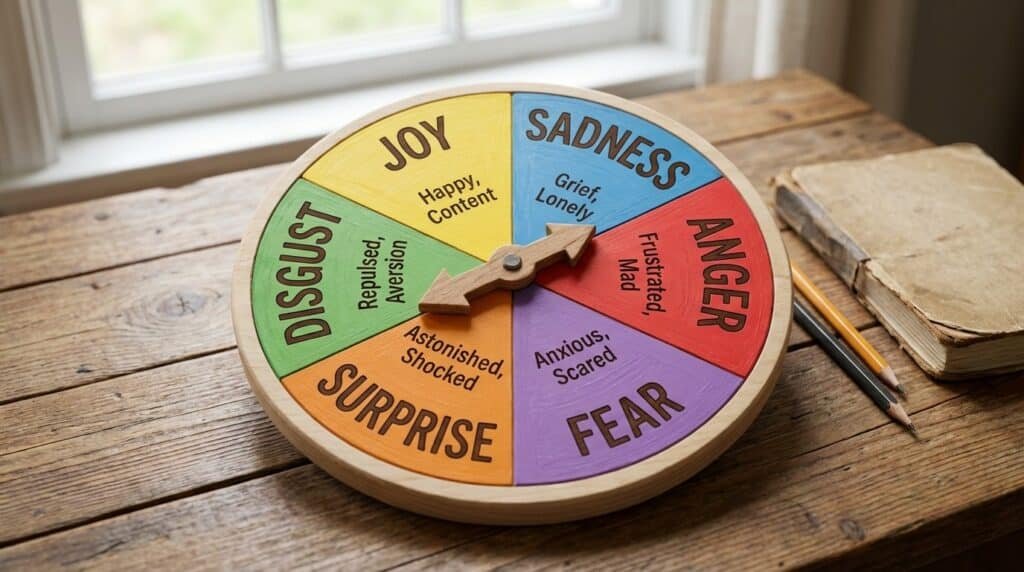
- Emotional labeling:
Put a name to your emotion. Science has proven it:
simply saying to yourself, “Right now, I feel anxious,” activates your rational cortex and instantly calms
the storm in your brain.
Naming is already a form of regulation. (See the study on emotion labeling.)
– - Shift from judgment to observation:
Don’t say, “I’m lazy for procrastinating on this.”
Say, “My brain predicts this task will exhaust me because it lacks clarity.”
This semantic detachment transforms the inner turmoil and guilt into a simple biological
fact to be resolved pragmatically (for example, by breaking the task down into clearer sub-steps).
– - Use your emotions as a compass:
Repeated boredom isn’t a character trait or laziness.
It’s simply a signal that your current environment no longer stimulates your brain enough.
Similarly, frustration isn’t an admission of weakness:
it’s a concrete indication that your work method is stuck and that you need to try a different approach.
–
Bridging the gap between your brain and your feelings allows you to transform stress or dips in motivation into genuine strategic insights.
Knowing that your biology is constantly anticipating the world around you has a liberating effect:
it proves that it’s pointless to fight against your human nature by trying to become a purely logical machine.
This emotionless rationality is an illusion that drains your energy.
By agreeing to collaborate with your body, you finally use your emotions for what they are:
powerful allies to direct your energy where it truly matters and make informed choices.
Conclusion: Take back control of your biology
Your emotions are neither weaknesses nor design flaws:
they are your body’s most sophisticated control system.
By understanding that they act as biological predictors to protect your mental energy, you can finally lay down your arms. There is no longer a war to wage against yourself.
The goal isn’t to become an insensitive, rational machine—we’ve seen that this is neurologically impossible and counterproductive—but to make these signals your allies.
By listening to your body, using your technological tools, and consciously arranging your environment, you stop being subjected to pressure.
You transform automatic reactions into strategic choices.
Starting tomorrow, when faced with a surge of anxiety or frustration, don’t try to suppress it.
Simply ask yourself this question: “What drop in energy or what obstacle is my brain anticipating for me?“
FAQ: Your questions, our answers
Why is it impossible to remain purely logical under stress?
When under pressure, your brain prioritizes survival: the fast-acting circuitry of the amygdala bypasses the slower-paced thinking of your prefrontal cortex.
This isn’t a lack of control on your part, but a natural biological reflex to prepare you for action.
–
Is procrastination really an emotional problem?
Yes. When faced with an unclear task, your brain anticipates a massive expenditure of energy and triggers
an aversion to protect your reserves.
Procrastination is an emotional defense mechanism against uncertainty, not a lack of willpower.
–
Without physical exertion?
Maintaining a state of alertness or anxiety consumes a huge amount of glucose and metabolic resources.
This invisible tension physically exhausts your nervous system, which explains why a stressful day in front of a screen drains your energy.
–
How can my smartwatch help me manage my emotions?
By measuring your Heart Rate Variability (HRV), it acts as an objective dashboard for your nervous system.
It makes your internal tension level visible, giving you the factual permission to slow down before you reach exhaustion.
–
What’s the quickest way to calm an intense emotional reaction?
Simply name what you’re feeling (e.g., “I’m feeling frustrated”).
This technique, called “affective labeling,” instantly reactivates your prefrontal cortex (the logic center) and mechanically reduces the alert in your emotional brain.
–
The final word
Accept your emotions as allies, not enemies. Listen to them, understand them, and transform each signal into a strategic choice to direct your energy and decisions.