
Sleep and the brain: the invisible maintenance of your mental performance
Why is the quality of your sleep crucial for your brain?
Key takeaways:
Much more than just rest, sleep is an essential biological maintenance process.
It allows toxins to be eliminated and learning to be consolidated into long-term memory.
Without this cycle, cognitive performance drops dramatically: after 17 hours of continuous wakefulness, your decision-making clarity declines to the same extent as a slight blood alcohol level.
Lack of sleep deprives your brain of its ability to repair itself, which directly impairs your mental clarity and decision-making.
More than just a break, nighttime is a vital time to “clean” the mind and stabilize your emotions.
We’ll see how to turn this rest time into a performance driver for your waking hours.
Sleep is not rest: it is intense regenerative work.
After exploring the physical structure of the brain in our previous articles, it’s time to understand that this machine never really shuts down, especially when you close your eyes.
Neural maintenance and repair of structures
Nighttime is not a shutdown but a change of regime. The brain takes advantage of your sleep to launch structural repair projects. This is when your cell membranes finally rebuild themselves.
During the day, your brain naturally wears out from being used. Nighttime is the only time when it can completely recharge.
It is a true repair phase that deeply strengthens your brain.
Without this period of rest, wear and tear sets in and eventually becomes permanent.
Example: Imagine a road that is very busy during the day; nighttime is the only time when workers can fill in potholes to prevent the road from collapsing.
This maintenance ensures the longevity of our faculties.
The brain prioritizes these tasks as soon as external stimuli disappear. It is an absolute priority for your health.
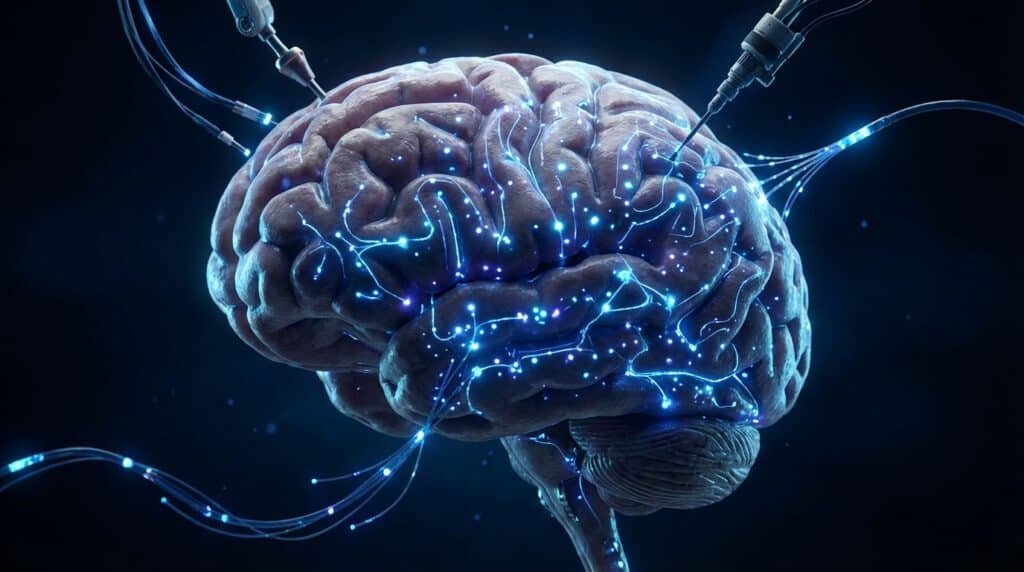
Reorganizing connections: selective sorting
The brain must adjust the connections between neurons to remain effective despite the constant influx of new data. This is the moment when your neural circuits are recalibrated.
During the night, your brain sorts through your networks: it strengthens important connections and erases unnecessary details. This nightly cleanup prevents saturation and ensures that your mind is alert when you wake up.
Energy balance and recharging the mind
Restoring your chemical resources is just as vital. The brain consumes a lot of energy during the day, and nighttime is used to replenish these energy reserves.
The gradual overall slowdown allows the body to direct all its energy toward this internal reconstruction. It is a true phase of biological logistics: while your physical functions calm down, your brain takes the opportunity to replenish its reserves and stabilize its chemical environment. This stage determines your future effectiveness.
This neural maintenance determines your future effectiveness.
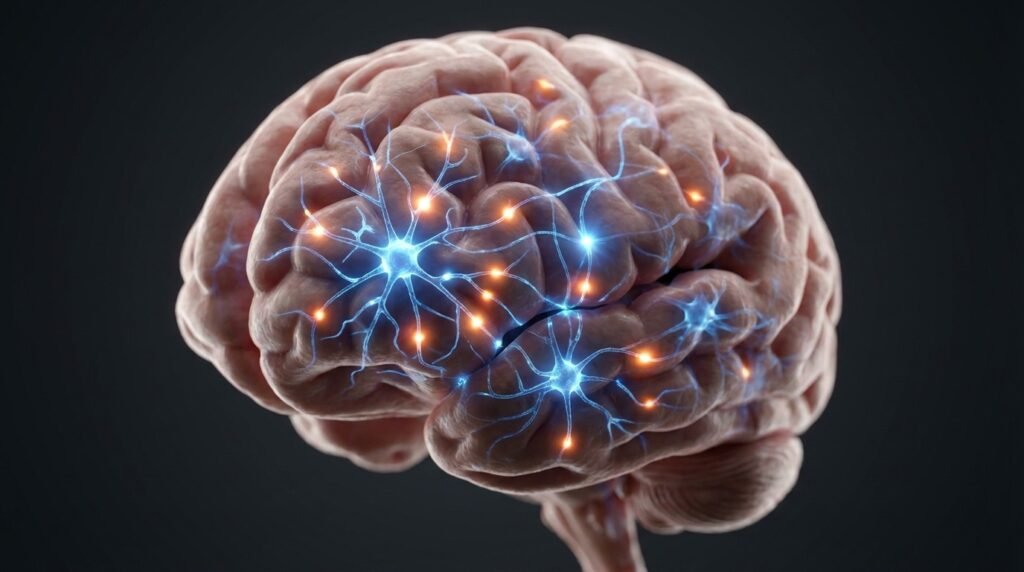
Brain detoxification: the big nighttime clean-up
Biological maintenance goes beyond simple repair and includes deep cleaning of brain tissue.
Waste disposal and prevention of decline
During the day, your brain naturally produces waste as it functions. One of these wastes is a protein called beta-amyloid, which gradually accumulates in your tissues. Its regular removal during the night is crucial to prevent your neurons from becoming “clogged up.”
If these toxins are not flushed out every night, they eventually clump together between your nerve cells, like tartar that hardens on a tooth. These deposits, called “plaques,” act as physical obstacles: they eventually suffocate neurons and block the flow of electrical messages.
Without this nightly cleansing, these plaques become permanently lodged, creating fertile ground for cognitive decline. Fortunately, your brain has an automatic cleansing system—the glymphatic system—but it only activates at full capacity when you are in deep sleep.
Science validates this absolute necessity. A study on the link between sleep and Alzheimer’s supports the importance of eliminating these waste products to protect your memory in the long term.
Activation of the glymphatic system: the nighttime pump
The activity of this internal “cleaning service” intensifies considerably once night falls. Its efficiency increases ten to twenty times during rest.
A powerful flow then passes through all of your brain tissue to flush it out.
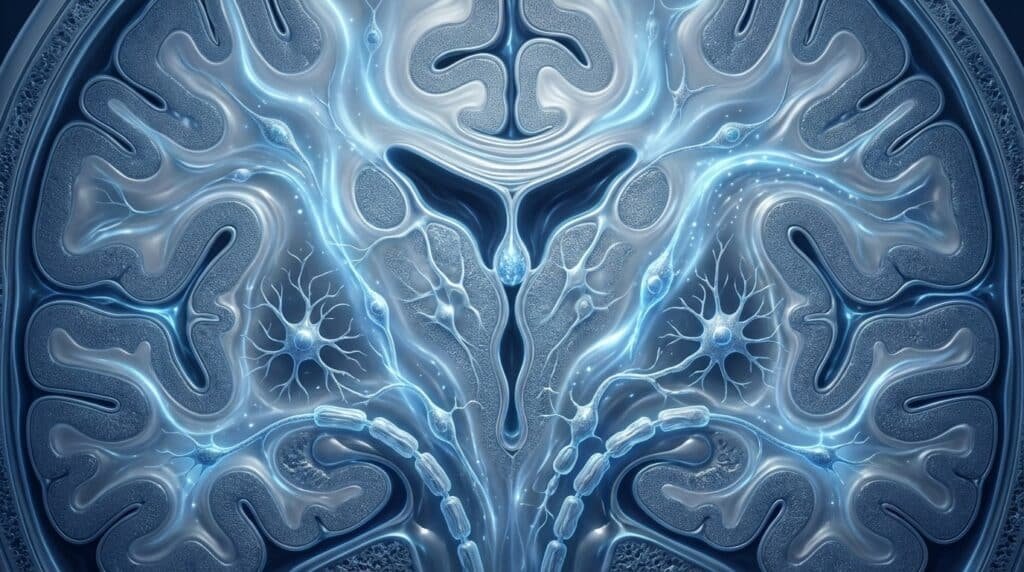
However, this process requires calm and continuous sleep. Any sudden awakening instantly interrupts this biological “pump”: the cleansing process remains incomplete, and your mental efficiency drops the very next day.
Example: It’s like running a dishwasher cycle: if you open it halfway through, the water stops and your dishes remain dirty. It’s the same for the brain; it needs a complete cycle to be “clean” when you wake up.
Cycle engineering: the maintenance program
To be effective, your brain follows a specific program divided into 90-minute cycles.
Light Sleep (N1 & N2): This is the gateway to your night. Your heart rate slows down and your brain begins to disconnect. It prepares the ground for the deep phases and begins an initial sorting of information.
Deep Sleep (N3): This is when the glymphatic system is working at full capacity. It is the most restorative stage. Without it, you wake up feeling mentally foggy. This is the most important phase for strategic clarity.
Rapid Eye Movement (REM) Sleep: Here, brain activity explodes: it is the time for dreams and for consolidating learning. It stabilizes your emotions and creates new connections between ideas. It is the engine of your creativity.
| Phase | Nom | Strategic Role | Approximate duration. |
| N1 | Falling asleep | Transition and floating vigilance. | 5% |
| N2 | Light Sleep | Initial sorting and metabolic regulation. | 50% |
| N3 | Deep Sleep | Heavy maintenance: glymphatic detox, physical repair. | 20% |
| REM | Paradoxically | Innovation: problem solving, emotional management. | 25% |

Memory: transforming information into lasting knowledge
Cleaning up your brain is a crucial step, but sleep also serves to sort through the chaos of your days to extract meaning from them.
Consolidation of achievements and strategic sorting
Every day, your brain processes thousands of pieces of information. Without drastic sorting, the system would become overwhelmed in less than 48 hours. Sleep performs this essential selective sorting: it decides what is “active” (useful) and what is “archived” (useless).
During the night, your circuits are reinforced by invisible internal repetition. According to the CNRS, the brain can “replay” a sequence learned during the day up to 20 times faster than in reality.
Example: If you are learning a new software program or a foreign language, it is between the 6th and 8th hour of sleep that the neural connections related to this learning truly solidify.
Transfer to permanent storage
To manage your memories, the brain uses the hippocampus as a transit area (a limited, short-term memory) before transferring the information to the cortex for long-term storage.
This transfer frees up space for the next day. Without this movement, your learning capacity drops by nearly 40%. The brain then performs three operations:
- Archiving: Record the key points of a strategic meeting.
- Delete: Delete the parking space number from the previous day.
- Indexing: Create links so that information can be accessed extremely quickly when making decisions.
REM sleep: your internal innovation laboratory
REM sleep is a fascinating phase: while your body is completely still, your brain enters a state of intense activity. It’s not just a phase of dreaming; it’s the moment when you become more skilled and creative.
Invisible training
This phase is the secret to technical mastery.
Whether you are an athlete, a musician, or learning a new professional skill, your brain uses this time to “rehearse” your movements in secret. During these cycles, it replays your motor sequences at an accelerated speed to refine your precision. This is how you gain fluidity without even lifting a finger.
The engine of creativity
REM sleep is also the realm of innovation. By breaking down the barriers of conventional logic, it allows your mind to connect ideas that seemed unrelated. It is a veritable incubator for solutions.
According to a study published in the journal PNAS, going through REM sleep could increase the brain’s ability to link ideas together to solve complex problems by 250%.
The classic example: It’s that famous “brilliant idea” that pops into your head when you wake up. Your brain has spent part of the night testing out new combinations to offer you the solution on a plate when morning comes.

The challenge of the last cycle
It is crucial to note that REM sleep predominates mainly at the end of the night. If you shorten your night by an hour or two, you are not just losing sleep, you are sacrificing a large part of your creative potential and your ability to solve problems. Missing these last cycles means depriving yourself of a major strategic advantage for the day ahead.
Sleep and emotions: recalibrating the system
Beyond memory, sleep acts as a real regulator for your mood. It is during the night that your brain “digests” the tensions and frustrations of the day.
Calming the alarm center: relieving stress
During the day, your brain accumulates stress that activates your “alarm center” (the part that manages fear and anxiety). Sleep allows this area to calm down permanently. This process reduces the emotional charge of your memories: you remember what happened, but the annoyance or pain fades away. Without this cleansing, each stress would add to the previous one endlessly.
Sleep allows you to put events into perspective: that’s why a problem that seems huge in the evening often appears much simpler the next morning.
Restoring control to reason
Nighttime restores balance to your mind: it gives control back to your “reflective brain,” the area that manages wisdom and restraint. A full night’s sleep restores your ability to remain calm and not react impulsively.
Without rest, irritation takes over. By regaining this clarity, you avoid “knee-jerk” reactions that are often regretted later. This is the foundation of your mental strength in the face of everyday challenges.
A natural shield against anxiety
Everyone has noticed it: lack of sleep causes irritability to skyrocket. The slightest little worry then becomes an insurmountable mountain.
Sleep acts as a natural chemical balm. During the night, it causes the stress hormones that have been saturating your body all day to drop. By stabilizing your mood, a good night’s sleep becomes a natural shield against anxiety. It gives you the serenity and confidence you need to face each day with complete assurance.
Understanding the biology of sleep is one thing, but integrating it into your daily life is another. In a world that often values hyperactivity, science proves the opposite: rest is the foundation of your personal and strategic capital.
Nutrition and inhibitors: sabotaging the system
For nighttime maintenance to be effective, your brain must receive the right chemical signals at the right time.
Introducing certain substances into your body not only alters your health, it also sends contradictory information that interferes with your performance and degrades your biological “code.”
Caffeine: a decoy for your sensors
Contrary to popular belief, caffeine does not provide any real energy. Its action is purely mechanical: it lodges itself in the adenosine receptors, the molecule that measures your need for sleep.
By “blocking” these sensors, it prevents your brain from triggering its maintenance at the right time.
It’s like putting tape over your car’s fuel gauge: the warning light disappears, but the tank continues to empty.
You simply mask your fatigue without eliminating it: the engine continues to run out of fuel silently, and the backlash will be all the more brutal once the effects of caffeine wear off.

Alcohol: a sedative, not a sleeping pill
Alcohol is often mistaken for a sleep aid, when in fact it is an anesthetic. While it may help you “knock yourself out” faster, it destroys the very structure of your night’s sleep. By fragmenting your cycles, it almost completely eliminates REM sleep, the phase during which your creativity and emotional balance are at play. You wake up with a system that has been forcibly “shut down,” but whose data has not been archived and whose emotions have not been recalibrated.
Blue light: the signal for work interrupted
The light from your screens simulates daylight, sending a signal of full activity to your visual sensors. This signal instantly blocks the secretion of melatonin, the hormone that triggers the cleaning process. By looking at your smartphone late at night, you prevent the drainage system from opening. The brain then remains in “standby” mode instead of switching to “heavy maintenance” mode, leaving the metabolic waste from the day to stagnate in your tissues.

Rebooting and performance
When your alertness drops, whether at work or in your personal life, the solution is not to find a stimulant, but to truly reboot. There are two tools for restarting the system:
- The Power Nap (20 min): This is the “Clear Cache.” This short nap format purges your RAM and restores immediate attention without creating fog when you wake up. Ideal for staying alert between tasks.
- The full nap (90 min):« The full nap (90 min): This is “heavy maintenance.” By completing a full cycle, it allows for deep cleaning and memory consolidation. It’s a radical investment to save the day after a short night.Maintenance Lourde ». By completing an entire cycle, it provides deep cleaning and memory consolidation. It’s the ultimate investment to save your day after a short night’s sleep.
- Micro-sleep: Be careful with emergency stops. Those few seconds when you lose focus despite yourself indicate that your brain is forcing you to stop to avoid overheating. Your decision-making ability is then completely impaired.

Performance et leadership
Sleep is your strategic asset. A well-rested brain promotes clear analysis and long-term vision. Conversely, fatigue erodes self-control and patience, damaging the social climate and the quality of relationships. Rest is not a waste of time; it is the essential condition for a rich, lucid, and productive life.
Conclusion
Sleep is not simply the absence of activity, but the secret engine of your lucidity and resilience. By understanding that every night is a critical maintenance session, you no longer see rest as a waste of time, but as a strategic investment. Mastering your cycles, using the reboot wisely, and protecting your system from chemical pollutants are the keys to sustainable performance.
True performance is not built by adding hours of activity, but by protecting hours of strategic inactivity.
FAQ: Better understanding for better sleep
Why is sleep vital for my brain?
Sleep is not just a break, it is an active maintenance phase. While you sleep, your brain repairs its cells, organizes the information it has received, and recharges its batteries. It is this process that allows you to be efficient and clear-headed the next morning.
How does sleep help with learning and memory?
At night, your brain sorts through everything: it erases unnecessary details and engraves important information into your long-term memory. This “tidying up” frees up space for new learning the next day. Without this cycle, your ability to learn and make decisions drops dramatically.
What is this “cleansing” of the brain that people are talking about?During the night, your brain activates a high-performance cleaning system. It uses a purifying fluid to remove toxins that have accumulated during the day (such as beta-amyloid protein). It is this nightly clean-up that prevents your neurons from becoming clogged and protects your long-term health.
Why are we more irritable when we lack sleep?
Sleep acts like an emotional feeling. It calms your “alarm center” (stress) and gives control back to your “reflective brain” (wisdom). Without rest, you lose your ability to take a step back, your emotions take over, and the smallest worry becomes a mountain.
What are the real risks of not getting enough sleep?
After 17 hours of wakefulness, your brain functions as if you had a slight blood alcohol level. Your attention span decreases, you become more impulsive, and your judgment becomes clouded. Lack of sleep puts you in “degraded” mode, which directly impairs your performance and safety.
The last word
Your brain is your most valuable asset, so don’t let it become clogged with neglect. Make sleep your strategic ally: sleep precisely to conquer with clarity.