
Cybersecurity and AI:
How can you protect your sensitive data without losing control?
Key takeaway:
Faced with the automation of threats, cybersecurity must shift from “total control” to high surveillance.
Modern protection no longer seeks absolute security through technical lockdowns, but relies on the clarity of mind of the defender.
The challenge is to delegate mass sorting to machines in order to free up the mental capacity of humans, who are the only ones capable of arbitrating complex threats in the face of the digital deluge.
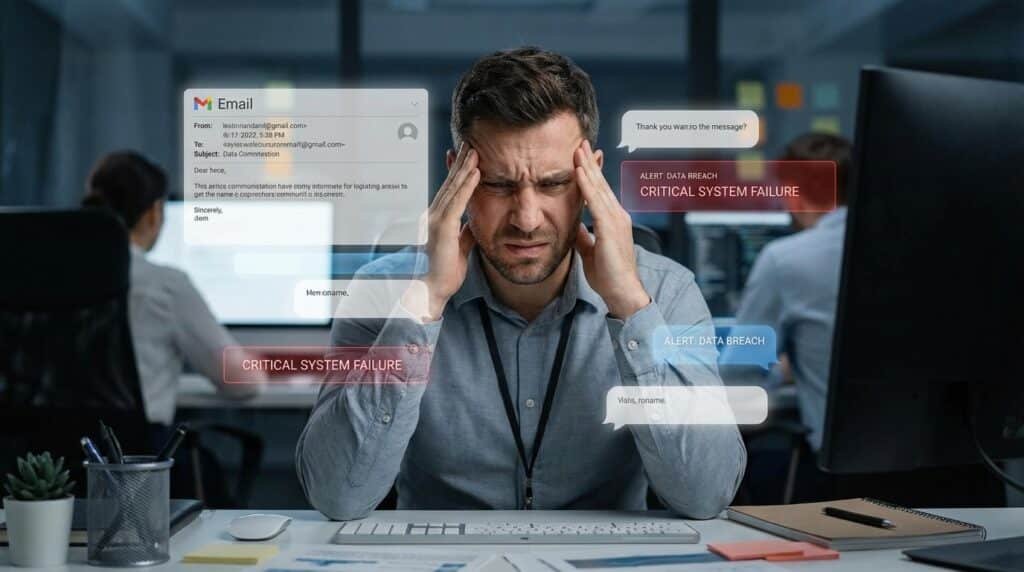
The paradox of modern security is striking: the more tools we pile on, the more we generate deafening digital noise—that cacophony of notifications and alerts that overwhelms the brain like ten televisions blaring in the same room.
This chaos of attention has become an ally of hackers:
they take advantage of our cognitive fatigue to slip invisible threats into the midst of information overload, turning every moment of distraction into a major security breach.
? Short on time ? Get the audio breakdown.
Listen to the podcast episode now.
Facing digital predators:
AI as a survival filter for humans
For decades, cybersecurity was all about walls:
we built ever higher firewalls.
But today, the nature of cyber threats has changed:
we have moved on from the era of static viruses to the era of autonomous agents.
Unlike traditional software that simply executes fixed code, these intelligent programs act like digital predators.
They prowl your network 24/7, silently observing your work habits and testing thousands of potential vulnerabilities, adapting to your defenses in real time without any human intervention.
Faced with this invisible threat, humans alone are overwhelmed by the volume.
The IBM Security study (Cost of a Data Breach Report 2025)
shows that companies integrating AI identify breaches 100 days faster than others,
saving an average of $2.1 million per incident.
But the gain is not only financial:
it directly affects the decision-making capacity of teams.
By acting as a first-line filter, AI protects the analyst’s prefrontal cortex—the area of the brain responsible for complex decisions.
It prevents human error, caused by exhaustion, from becoming the main gateway into your system.
AI does not replace the command center; it cleans it up so that the manager can see clearly again.

New cyber threats: from illusion to impersonation
Generative AI has radically transformed phishing.
Today’s hackers no longer send generic emails riddled with spelling mistakes.
They use algorithms to analyze your public profile, your LinkedIn posts,
and even your company’s tone to create hyper-personalized messages.
These decoys mimic your employees so perfectly that they bypass our natural mechanisms of mistrust.
However, the most destabilizing technological leap forward is deepfake technology.
This technology now makes it possible to clone a manager’s voice or simulate their face
in a videoconference with absolute fidelity.
This is no longer fiction, but a story that could happen in 2025:
Imagine an employee receiving a video call from their “Chief Financial Officer” on Teams.
The face, speech patterns, and voice are perfect.
The “director” demands an immediate transfer for a secret and urgent acquisition.
In this moment of pressure, the brain, saturated by ambient digital noise, tends to obey authority rather than analyze the anomaly.
In the end, millions evaporate into thin air.

This is where technology touches on the human aspect.
To counter these illusions, we must establish the doctrine of Cognitive Zero Trust,
embodied by Double Check (or double verification).
Unlike traditional IT Zero Trust, which verifies machines, Cognitive Zero Trust recognizes that our senses can be deceived.
It imposes double verification protocols: any critical action (transfer, password change, server access) must be confirmed by a second independent means of communication
(a verification phone call or a secure SMS code).
We no longer just verify the interface, we verify human intent.
Less noise, more protection:
Why AI must free up human attention
In the world of computing, a “denial of service” attack is one that overwhelms a server to cause it to crash.
Today, hackers are doing the same thing to your brain: it’s called cerebral denial of service.
By drowning you in a flood of notifications, alerts, and urgent emails, they wear down your attention span.
An exhausted brain eventually lets its guard down: that’s when you click on the wrong link without thinking.
This is where AI changes everything.
It shouldn’t be just another tool that shouts louder than the rest, but rather a smart “noise-canceling” headset.
Its role is to sort through all the noise and present you with only the truly critical signals.
By cleaning up this chaos, AI restores your ability to make good decisions.
Because while machines are unbeatable at calculating quickly, only humans
have the judgment necessary to make big decisions.
For example, shutting down a factory’s network in the middle of production is a serious decision:
AI detects the anomaly, but you decide whether the shutdown is worthwhile based on
the actual situation of the company.
AI manages the volume, you manage the responsibility.
Sovereignty and ethics:
The legal framework as a strategic shield
In 2026, cybersecurity can no longer be separated from digital sovereignty.
With the full implementation of the EU AI Act and the NIS 2 Directive,
executives are now responsible for the transparency and security of the AI systems they use.
Using “black box” AI hosted outside Europe exposes companies to legal risks and silent data exfiltration.

The phenomenon of Shadow AI—the uncontrolled use of public AI by employees—is a major flaw.
By copying source code or confidential contracts into free AI to save time,
your employees are “feeding” external models with your trade secrets.
A responsible leadership strategy therefore consists of deploying private,
sovereign AI (on-premise or sovereign cloud) .
This is a fundamental cybersecurity measure: securing the internal information highway
while ensuring that AI remains a performance tool, not an unwitting spy.
Compliance then becomes a lever of trust for your customers and partners.
Finally, ongoing dialogue between lawyers and technicians is essential to navigate
this complex regulatory landscape with confidence.
Measuring success: The new KPIs for fluidity
For executives, the success of cybersecurity should no longer be measured by the number of attacks blocked.
This figure is impressive, but it hides a dangerous reality: the exhaustion of your experts.
True performance now lies in reducing cognitive friction—that is, reducing the unnecessary mental effort imposed on your teams.
In cybersecurity, human resilience is not infinite:
an exhausted employee is an employee who, one day, will fail to spot a critical alert amid the noise.
Protecting your business means first and foremost protecting your experts’ ability to remain alert without burning out.
| Strategic KPI | Measurement method | Impact sur l’entreprise |
| Filtered false positive rate | Percentage of unnecessary alerts blocked by AI before reaching humans. | Drastic reduction in techno-stress and staff turnover. |
| Speed of resolution | Average time for a human to validate a complex alert. | Ultra-fast response to real threats. |
| Deepfake alert index | Results of audio/video attack simulation tests. | Organizational immunity against impersonation. |
| Digital silence ratio | Volume of notifications deleted or intelligently grouped. | Protecting the team’s capacity for innovation. |
| Cognitive Restoration Index | Respect for experts’ disconnection and rest times. | Sustainability of expertise and reduced risk of error. |
The power of less:
When fewer tools mean greater security
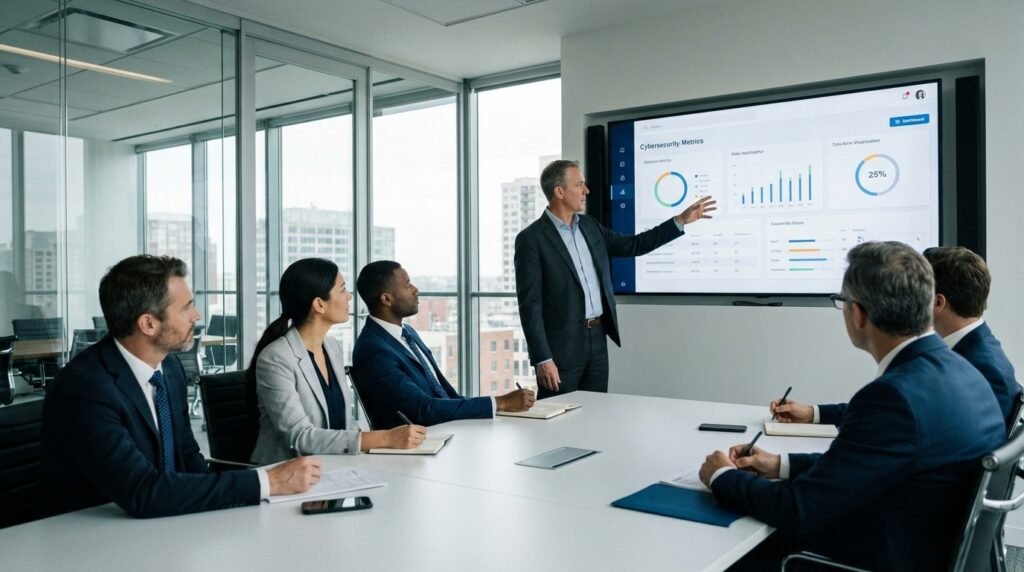
Let’s take the example of a financial consulting firm that, in 2024-25, saw its analysts overwhelmed by an average of 150 security alerts per day.
The error rate was increasing and two key experts were suffering from burnout.
At the end of 2025, they adopted a technology subtraction strategy:
removing three redundant monitoring tools in favor of sovereign AI filtering.
The result was immediate.
The volume of daily alerts requiring human intervention fell from 150 to 12.
Analysts thus regained four hours of “deep work” per day.
Paradoxically, even though they were using fewer tools, their actual level
of security skyrocketed: no longer exhausted, they detected a sophisticated intrusion
attempt in less than 10 minutes, where it had previously taken them several hours.
This study demonstrates that security is not a question of technological muscle, but of mental clarity.

Orchestrating defense:
People at the heart of the augmented system
The resilience of your business no longer depends on the power of your software, but on your ability to orchestrate seamless collaboration between artificial intelligence and human judgment.
The division of roles: machine execution vs. human decision-making
For this alliance to work, the dividing line must be clear.
AI excels at mass execution: it processes thousands of suspicious emails and continuously
scans your networks without ever tiring.
This is its area of expertise.
On the other hand, strategic decisions—such as blocking a key account or shutting down
a critical server—must remain the prerogative of human supervisors.
In times of crisis, this organizational clarity is your best weapon:
when everyone knows their role, weaknesses disappear.
Cultivating discernment in the face of synthetic content
In a world saturated with AI-generated content, human attention becomes your most valuable firewall.
Training your teams to detect deepfakes is no longer an option, it is a vital priority. It involves retraining the eye and ear to spot micro-anomalies (unusual voice tones, frozen facial expressions) that give the machine away.
This digital hygiene is based on simple but rigorous habits:
- The second channel reflex: Always validate a sensitive instruction using a different means of communication (the famous “double check”).
- Neutralizing urgency: Learn to identify unjustified urgency, the main lever of manipulation.
- The culture of reporting: Turn every employee into a vigilant sensor rather than a potential victim.
Towards open governance
Modern security signals the end of technical silos.
To protect your assets, cybersecurity experts and data scientists must now work hand in hand.
This synergy makes it possible to audit AI models before they are deployed and to continuously monitor their biases or deviations.
As IBM points out in this report, this convergence between technology and governance is the only viable path forward.
Algorithm transparency is not just a constraint; it is the pillar that strengthens internal trust and overall security.
Action plan:
The emergency checklist for managers
To move from reflection to immediate protection, here are the five pillars of your new governance:
- Shadow AI Audit:
Instantly identify which consumer AI tools your employees are using behind your back. Offer a secure internal alternative to stop data leaks.
– - Sensory vulnerability test:
Don’t settle for technical intrusion tests.
Organize a “voice cloning” or hyper-personalized phishing simulation to assess
the psychological resilience of your financial services.
– - Implementation of double checking:
Decree that no transaction or critical access change can be validated
via a single medium (email or chat).
The confirmation phone call must once again become the security standard.
– - Simplification of the workstation:
Apply the 3U rule (Useful, Usable, Used) to your security tools.
Anything that generates noise without adding value should be removed.
– - Sanctuarization of rest:
Cybersecurity is a marathon.
Make sure your experts get real downtime.
A rested brain is your best firewall.
–
Conclusion:
Towards sustainable and clear-headed performance
Tomorrow’s technological innovation will not overwhelm minds, it will liberate them.
By adopting a strategy of digital sobriety applied to cybersecurity, you can finally align your tools with the real limitations and needs of your teams.
Faced with the automation of threats, your strongest defense no longer lies in stacking
expensive software, but in the clarity of your governance.
The challenge is no longer to lock everything down, but to keep a human being available and lucid at the center of strategic decisions.
Be the leaders who simplify the world to unleash resilience.
FAQ : Pour approfondir la réflexion
Why will AI never be able to completely replace cyber experts?
AI excels at pattern recognition and mathematical logic, but it lacks contextual intuition.
It can detect that behavior is “abnormal,” but only humans can determine whether this anomaly is an attack or simply an exceptional situation related to a merger or acquisition or an unforeseen crisis.
AI makes suggestions, humans make decisions.
How does cognitive fatigue actually affect a company’s ROI?
A fatigued team makes costly mistakes: misconfiguration, ignored alerts, slow response to incidents.
The cost of a breach (2.1 million on average) is often the price to pay for neglecting the cognitive health of its defenders.
Isn’t there a risk that “Cognitive Zero Trust” will slow down processes?
It’s a necessary trade-off.
Admittedly, confirming an order via a second channel takes an extra 60 seconds.
But those 60 seconds are your insurance against fraud that could paralyze the company for weeks.
That’s the price of clarity in a world of digital illusions.
Final word:
By using AI as a filter against saturation, you finally stop being at the mercy of technology
and become the clear-headed supervisor of your own performance once again.
Sustainable cybersecurity is no longer measured by the height of your walls,
but by the quality of attention you are able to maintain.