
Technological innovation in business:
How can you overcome mental overload and regain your efficiency?
Key takeaways:
Technological success no longer depends on accumulating tools, but on reducing cognitive friction—the invisible mental effort generated by interfaces, notifications, and unnecessary decisions that drain attention without creating value. Faced with attention saturation, performance now requires a strategy of subtraction:
AI must serve as a filter to eliminate complexity and restore human decision-making capacity.
The current paradox is striking: according to the Microsoft Work Trend Index report, 68% of employees say they don’t have enough uninterrupted concentration time during the day. Our productivity tools often generate more mental load than actual performance. This article analyzes how to realign technology with human limitations to move from forced innovation to fluid innovation.
The trap of technological accumulation: the hidden cost of “always more”lation technologique
For decades, innovation in business has been synonymous with addition. Every new piece of software was seen as progress. However, this digital inflation has created a massive “attention debt.”
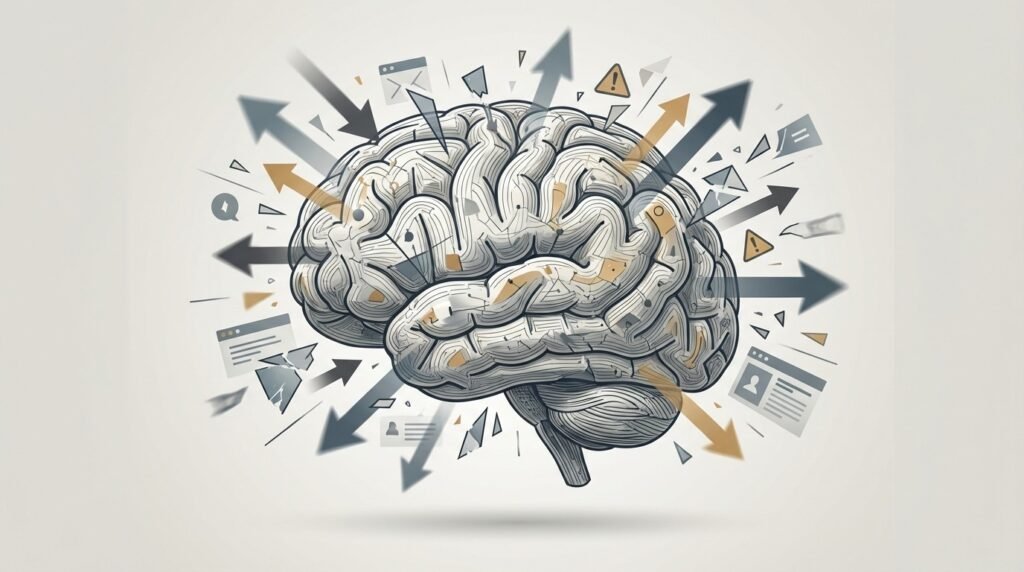
Attention fragmentation and the cost of context switching
Excessive demands constantly disrupt your workflow. A well-known study by the University of California highlights that it takes an average of 23 minutes and 15 seconds to fully refocus on a task after being interrupted.
In practice, this means that an employee who is interrupted five times in the morning can lose more than an hour of actual work capacity, without ever feeling like they have “stopped” working.
The brain does not multitask; it switches contexts at a high energy cost. This phenomenon, called “context switching,” exhausts your cognitive resources before you even get to the substance of the matter.
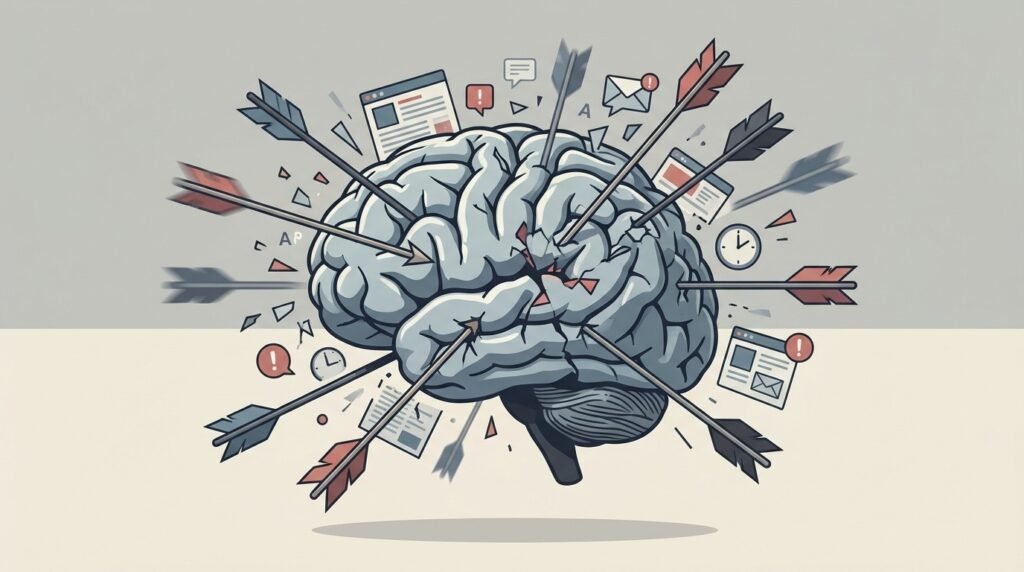
Every notification is a signal that the brain must analyze: Is it urgent? Is it important? This constant evaluation, even if brief, consumes glucose and glutamate, the fuels of our thinking.
Simplicity as a strategic competitive advantage
To break this deadlock, innovation must no longer be an accumulation, but a major clean-up. Simplicity has become the ultimate competitive advantage. In a market saturated with information, the most agile company is not the one with the most tools, but the one with the most streamlined processes. The fewer technical bottlenecks there are, the more responsive the company is.
True performance now lies in the ability to streamline systems to unleash creative energies.
AI as a filter: restoring clarity in decision-making
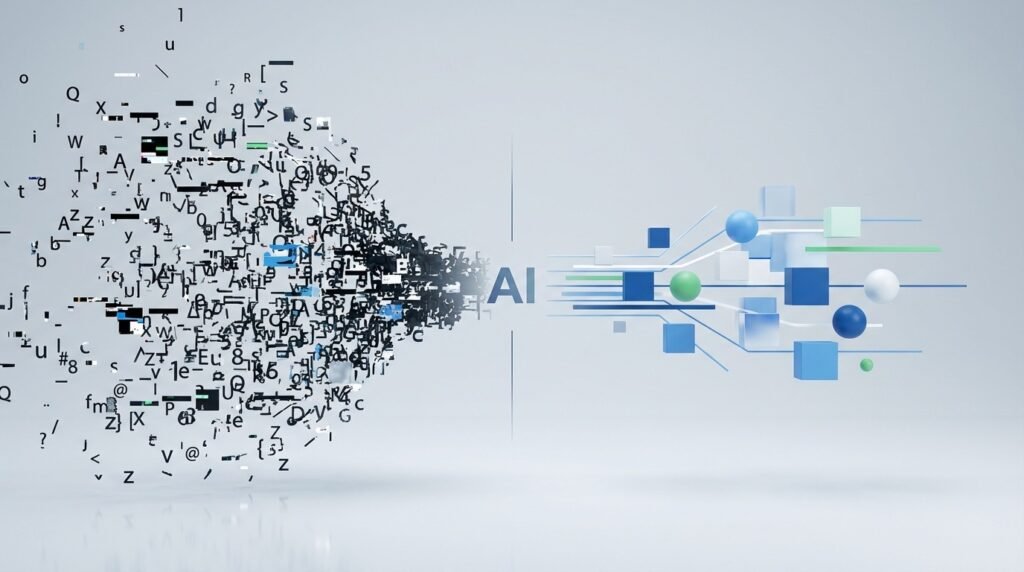
In this new era, AI should not be just another tool, but a means of simplifying everyday work. Its role is to process vast amounts of information and return only what really matters.
Automatic sorting of decision flows
Administrative “noise” is the biggest time thief. AI can now automatically sort decision-making emails. The algorithm isolates urgent approval requests and critical alerts, relegating secondary discussions to later review. Imagine a manager receiving 200 emails a day: without a filter, they spend two hours sorting through them. With an AI filter, they spend 15 minutes making decisions. This is a direct recovery of intellectual capital.
In practical terms, this allows a manager to approve only three structural decisions per day, rather than spreading their attention across thirty minor decisions with no strategic impact.
The daily project summary: from chaos to vision
The fragmentation of information between Teams, Slack, and ERP systems creates an exhausting coordination burden. AI can be used to generate a daily project summary. This document summarizes the key decisions made the previous day and any identified bottlenecks. Instead of starting the day in “search mode,” employees start in “action mode.” They no longer search for information; they arbitrate it.
The drastic reduction in unnecessary alerts
According to a Deloitte analysis of Human Capital trends, digital saturation is one of the primary factors contributing to disengagement. AI is now learning to identify the degree of real urgency. On a production line or in an emergency department, only alerts requiring immediate human intervention are transmitted. This digital silence is not an absence of activity, it is a renewed quality of concentration.
Case studies: Innovation through fluidity in practice
Industry Sector: Predictive Maintenance and Vigilance
In an automotive factory, the proliferation of sensors on machines generated thousands of alerts per day. Overwhelmed technicians ended up ignoring some critical signals. By implementing an AI layer acting as a supervisor, the company reduced alerts by 80%. The AI only transmitted “weak signals” indicating an imminent breakdown. The result: a 15% reduction in machine downtime and a noticeable improvement in the morale of the maintenance teams.
Services Sector: The End of Information Overload in Consulting Firms
A large consulting firm tested “Technological Subtraction.” After auditing their tools, they eliminated three redundant reporting software programs and replaced them with a single voice and text synthesis interface. The consultants reported a gain of four hours per week of deep work.
Managing innovation: becoming a flow and attention regulator
The modern manager is the conductor of their team’s mental availability. Their mission is to filter out interruptions in order to preserve their employees’ ability to concentrate.
The 3U rule: a survival audit for your tools
Before introducing any new tool, the manager must subject the project to the 3U rule:
- Useful: Does the tool solve a specific problem? If it’s just a “trendy” gadget, it should be discarded.
- Usability: Is the interface easy to learn? If training takes three days, the tool is too complex for our already overloaded brains.
- Used: Does the tool fit into the existing workflow? Adding a new tab is often one step too far toward saturation.
Sanctify “Deep Work” and neural priority
Based on McKinsey’s work on automation and skills, it is clear that human added value is shifting towards solving complex problems. Managers must therefore establish periods of “digital silence.” During these periods, no notifications are allowed. This is vital protection for the prefrontal cortex, allowing it to reach levels of reflection that AI cannot yet simulate.
Some companies have introduced mornings without meetings or internal notifications. As a result, teams report not only better quality work, but also a noticeable reduction in fatigue at the end of the day.

Change management: respecting biological rhythms
The failure of many digital transformations stems from overlooking the time factor. The human brain needs time to create new neural networks and automate the use of a tool.
Avoiding “Techno-stress”
The sudden deployment of technologies creates natural resistance linked to fears of obsolescence or overload. To be successful, innovation must be incremental. It is better to have a small, smooth improvement that is adopted by everyone than a technological revolution that is rejected by the collective. Humans must feel like supervisors of the machine, not its slaves.
Digital transmission and mentoring
AI should be used to capture the expertise of specialists. By documenting complex interventions, it structures a living knowledge base. It is a new form of mentorship where machines help humans pass on their most valuable asset: their experience.
Measuring success: The new KPIs for fluidity
A decision-maker must stop managing solely by costs and start managing by reducing friction.
| Strategic KPI | Measurement method | Impact on the company |
| Perceived friction index | Post-task survey: “Did the tool help or hinder?” | Reduction in turnover and techno-stress. |
| Uninterrupted focus time | Calendar analysis: 90-minute blocks without requests. | Massive increase in the quality of innovation. |
| Decision rate by summary | Percentage of cases arbitrated using a high-fidelity AI summary. | Acceleration of strategic decision-making. |
| Digital silence ratio | Volume of alerts deleted or intelligently grouped together. | Reduction in error rate and mental fatigue. |
| Digital serenity index | Qualitative feedback on the feeling of mastery of the tools. | Social climate and sustainable commitment. |

The ethics of attention: a leadership responsibility
Innovating in a sober manner is no longer a technical option; it is a fundamental ethical commitment. In a knowledge economy, attention is not an inexhaustible resource; it is a common good within the company that managers have a duty to protect. Responsible leadership today must incorporate the cognitive health of its teams as a performance indicator in its own right, on a par with financial profitability.
Technology as a silent supporter in the face of captology
It is crucial to understand that we are evolving in a digital environment saturated with captology mechanisms.
What is captology? It is the art of designing tools (apps, software) to deliberately “capture” our attention. It uses psychological triggers such as red notifications or sound alerts to force us to interrupt our work and keep us connected for as long as possible.
Rejecting a tool that is too intrusive, even if it performs well on paper, then becomes a strong managerial act: that of protecting attention rather than maximizing visible activity.
A responsible company must exercise critical oversight of its tools: technology should no longer be a source of constant distraction, but rather a silent support. A successful tool is one that knows how to fade into the background once the task is accomplished, allowing employees to return to a state of deep concentration without being distracted by artificial stimuli.
Towards sustainable performance and a return to relationships
The true purpose of AI is not to produce more data, but to protect your attention span. By freeing the brain from repetitive tasks and information chaos, AI paradoxically restores the prestige of emotional intelligence.
This time “freed up” by machines is a valuable asset that must be reinvested in something that no line of code can ever replace: individual coaching, active listening, conflict resolution, and collective creativity. This is where the productivity of the future lies: performance that no longer relies on the exhaustion of mental resources, but on the quality of human connection and the power of commitment.

Conclusion
Tomorrow’s technological innovation will not overwhelm minds, it will liberate them. By adopting a strategy of digital sobriety, you align your tools with the real needs of your teams.
The future belongs to organizations that will make technology a discreet ally, capable of eliminating friction to make room for human intelligence. Be the leaders who simplify the world of work to unleash creativity.
FAQ: For further reflection
Why does technological innovation often fail?
Failure occurs when technology adds complexity instead of reducing it. If the tool requires more energy to manage than it saves, it is naturally rejected.
What is the real impact of overload on decision-making?
Saturation of the prefrontal cortex leads to “decision paralysis.” The more options and raw data we have, the less able we are to make relevant decisions.
How can AI become a mental health partner?
By acting as a filter (reducing emails, alerts, data synthesis), it lowers stress levels and prevents burnout linked to information overload.
The last word
Tomorrow’s innovation will not lie in the frantic accumulation of new features, but in a strategy of radical subtraction.
The ultimate goal? To restore your clarity of mind.
By using AI as an intelligent filter against saturation, you can finally stop being overwhelmed by technology and once again become the clear-headed supervisor of your own performance.