
Attention and concentration:
The brain’s active filter
Key takeaways:
Attention is a limited metabolic resource, governed by constant filtering by the brain.
Each switch between two tasks generates an “interruption cost” that depletes your resources.
Mastering your concentration means reducing these interruptions to maintain your efficiency and mental clarity.
If you struggle to master the attention-concentration duo in a saturated environment, it’s because your filtering system instinctively prioritizes urgency and novelty. Here, we break down this biological mechanism to explain how your mind sorts information and why it gives in so easily to distraction.
You will learn how to build a solid focus architecture to transform this limited resource into strategic capital.
Attention and concentration: how the brain filters useful information
Once we understand that our brain is a complex biological machine, we must tackle its most sought-after function: its ability to sort out what really matters.
The myth of multitasking and the price of cognitive switching
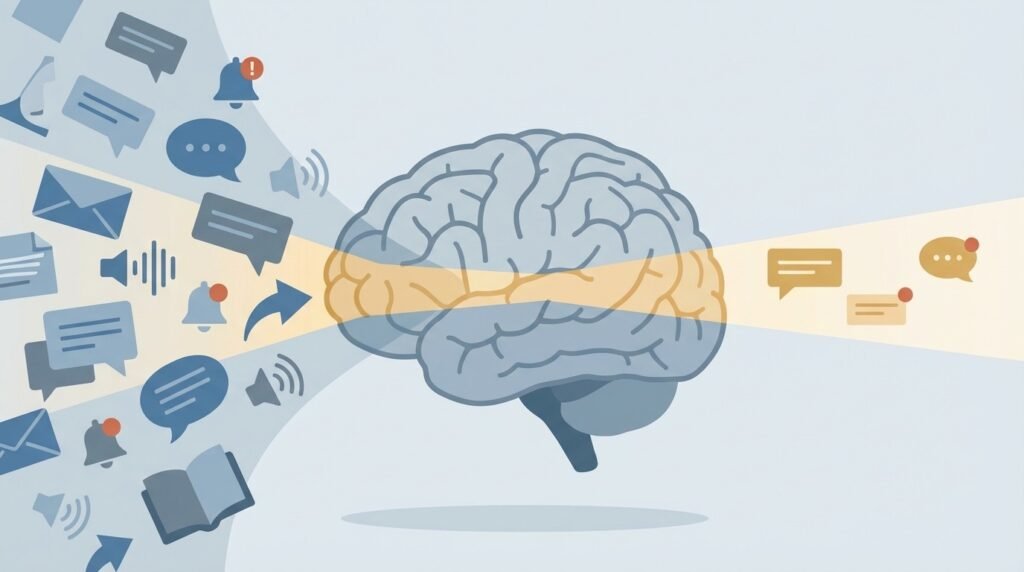
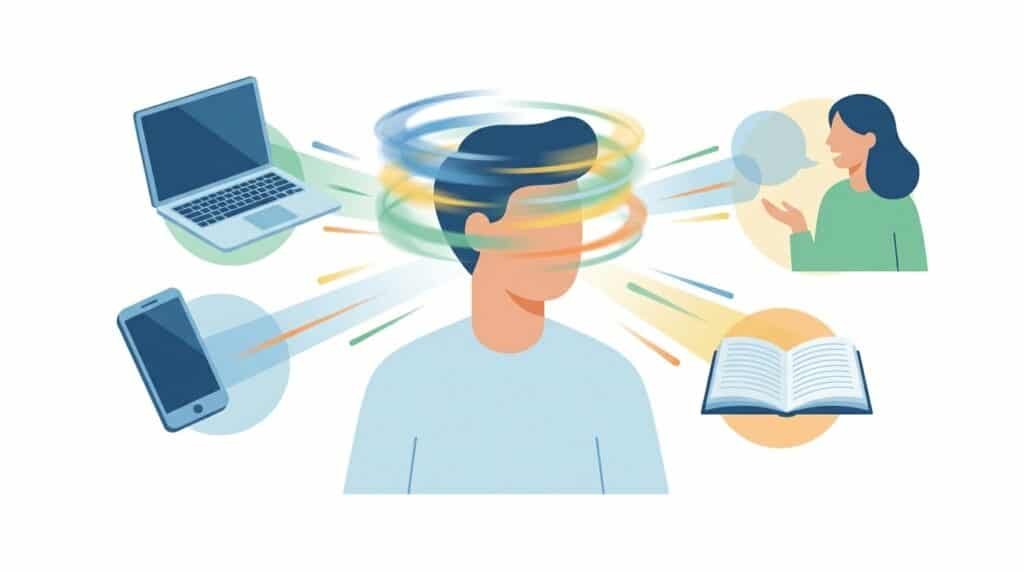
Your brain cannot effectively process two complex tasks simultaneously. This is a strict biological limitation of your control center: it simply switches very quickly from one to the other, creating a simple optical illusion.
Every change in activity forces your neurons to reload a whole new context. This invisible mechanism sabotages your actual efficiency. For example, if you are drafting a contract and glance at a WhatsApp group notification, your brain has to “close” the legal file and “open” the social file, then do the reverse.
This switching cost drains considerable mental energy. Your brain processes everything in series: choosing a point of focus means temporarily giving up everything else.
The duel between your focus and your radar
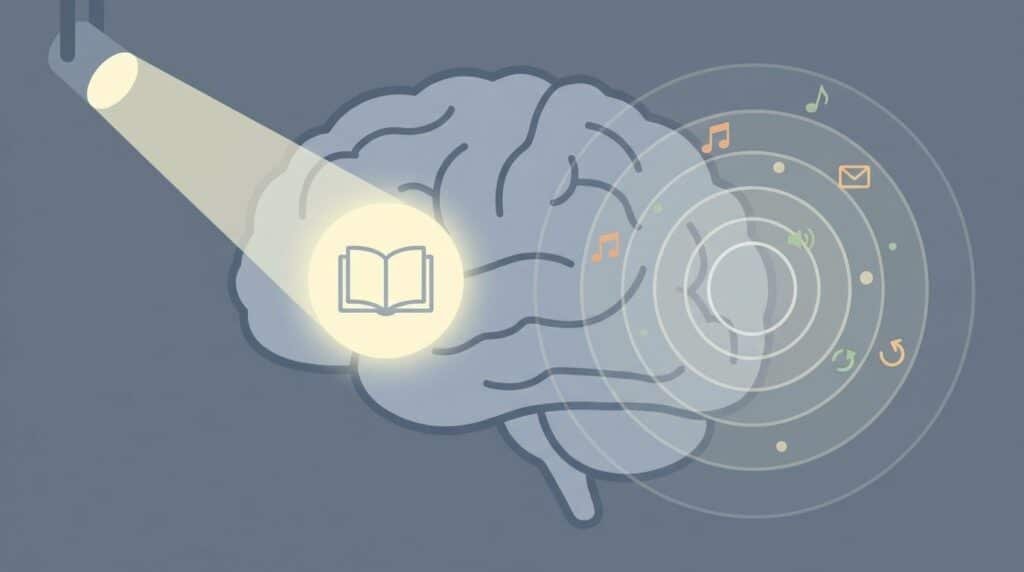
To understand how you process information, imagine that your brain uses two tools:
- The Spotlight (Your Focus): You control it. When you decide to read a report or respond to a customer, you shine the spotlight on that task. Everything else around you (the noise of your coworkers, the weather) remains in the dark.
- Radar (Your importance detector): This runs automatically in the background. It scans the environment to identify anything that “jumps out” (salience). Its role is to alert you if something new or urgent happens.
Why are you losing track?
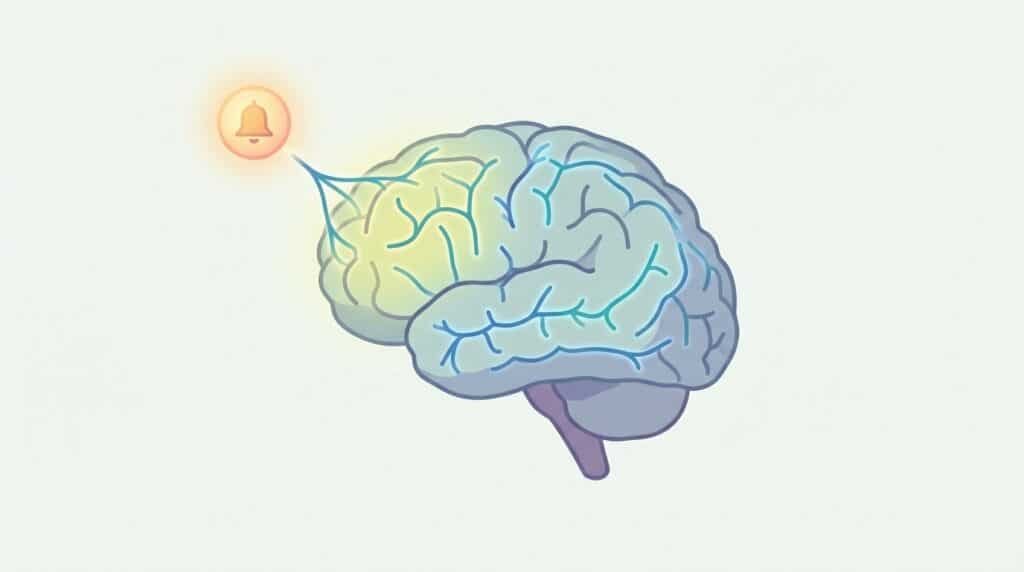
The problem is that your Radar is very sensitive. As soon as a notification appears on your smartphone or a sound signal rings, your Radar considers it a top priority.
It then triggers a signal that forces your Projector to leave your work and shine its light on the screen. You did not “choose” to be distracted: your Radar diverted the light from your Projector. This explains why, after looking at a simple text message, you find it so difficult to get back into your reading: your Projector has to make a physical effort to redirect itself.
Protection against overheating
Fortunately, this system can also protect you. When you are “immersed” in a task, your brain shuts down everything else. This is attentional blindness: you can be so focused on your screen that you don’t even hear someone calling you. Your brain “erases” the outside world to prevent your thermal engine from overheating.
The novelty bias, or why the brain prefers exploration to focus
The quest for instant gratification: a legacy of survival
Dopamine increases when a new signal is perceived as potentially relevant or rewarding. It activates a mechanism of anticipation rather than a simple reflex of pleasure.
It’s an ancient survival instinct that allowed your ancestors to instantly detect an opportunity (a ripe fruit) or danger (a predator). Your brain is biologically programmed to scan the horizon.
This reward circuitry draws you to whatever immediately grabs your attention and promises quick gratification, making it harder to focus on demanding tasks. Distraction is, at its core, an adaptive bias that helped us stay alive in the savannah. Today, this mechanism is exploited by digital interfaces to trap you in endless loops of browsing.
Your brain gives top priority to four types of stimuli:
- The latest news (a new post, breaking news).
- The immediate reward (a “like,” a positive message).
- The threat (a critical email, a controversy).
- Urgency (a red dot, an audible notification).
Hyper-reactivity in response to constant “scan mode”
Your alert system has turned into exhausting digital vigilance. You are now in a state of “permanent scanning,” the inevitable price of hyper-connectivity. In this context, it is common to confuse constant availability with real efficiency. However, responding to every request in real time destroys your depth of thought and is a productive illusion that ultimately exhausts you.
The impact on your performance is scientifically documented. A famous study on Brain Drain (Journal of the Association for Consumer Research) shows that simply having your smartphone within sight reduces your cognitive abilities, as part of your brain is exhausted from maintaining unconscious vigilance towards the device.
In short, your inattention is not a lack of willpower, but the result of a modern environment that overwhelms your archaic instincts.
The fragmented presence: the invisible cost to your privacy
Attention is not just a performance driver, it is also the glue that holds your relationships together. When you engage in “phubbing” (the act of checking your phone while ignoring the person you are talking to), you instantly break the emotional connection with your loved ones. This gesture, often perceived as harmless, signals to those around you that an algorithm is more important than their presence.
In your private life, inattention acts as a memory eraser. Since your brain cannot memorize what it has not actively filtered, a life spent switching between your screens and your loved ones becomes a succession of blurred moments.
For example, if you play with your children while checking your notifications, you are not recharging your batteries: you are maintaining divided attention, which generates nervous fatigue without any emotional benefit.
Regaining control of your focus means, above all, deciding on the quality of the memories you build.

Concentration: tension against your survival instincts
Why your brain is drawn to exploration rather than focus
The conflict you feel between your work and the urge to check your phone is a biological duel. Your brain operates according to a fundamental principle called exploration/exploitation trade-off.
- Exploration involves scanning the horizon in search of new information or potential opportunities. This reflex, once vital in the savannah for detecting threats or resources, is now overexploited by digital tools.
- Exploitation, on the other hand, involves delving deeper into a task already underway to extract maximum value from it. This is where your ability to produce quality work comes into play.
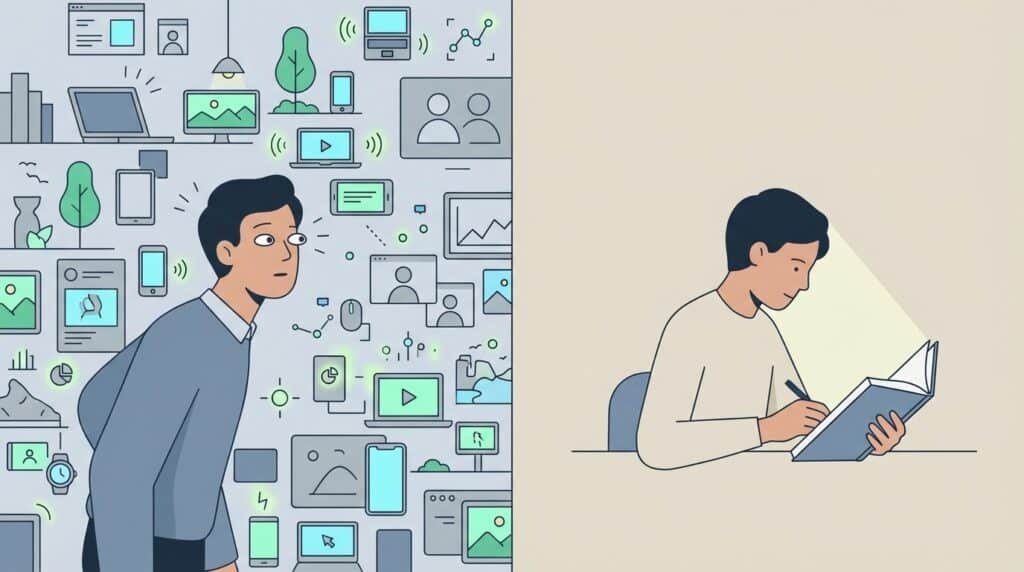
In a stable environment, your brain naturally favors exploitation. But in a world saturated with signals—notifications, alerts, continuous feeds—every “novelty” signal activates your reward circuitry and forces your mind to switch to exploration. This is not a lack of willpower on your part, but an automatic response from your alert system. This constant imbalance weakens your ability to maintain sustained focus and keeps you in an exhausting “scan mode.”
The hidden cost of constant availability
People often confuse being available with being effective. However, hyper-responsiveness fragments your mental clarity. Responding to every request instantly keeps you in a state of superficial alertness that exhausts your nervous resources.
The impact is immediate: lasting fatigue sets in, not because of the difficulty of your tasks, but because of the proliferation of unnecessary micro-decisions (opening an email, judging its urgency, deciding whether or not to reply). To preserve your mental clarity, you need to shift from reactive attention (responding to alerts) to proactive attention (choosing when to connect).
Attention as strategic capital
Attention should no longer be seen as an individual skill, but as a strategic asset to be managed sparingly. In a world of infinite information, your ability to ignore noise becomes your most valuable asset. Protecting your mental space is not a retreat, it is a necessary condition for maintaining your capacity for action and long-term vision, both in your professional and personal life.
Delegate sorting: AI working for your peace of mind
Since your attention is a finite resource, your goal is no longer to read everything, but to decide based on the essentials. Today, artificial intelligence must become your primary attention filter. By delegating the summarization of your long discussion threads or the sorting of your emails to it, you preserve your attention resources for high value-added tasks.
Using AI as an “external memory” frees your mind from the stress of forgetting. When you jot down an idea or delegate a summary to a machine, you declutter your consciousness.
This human-machine collaboration allows you to shift from being a “passive receiver” of information to a strategic pilot. Your added value no longer lies in your ability to absorb massive amounts of data, but in your ability to remain clear-headed enough to make the right decisions.
Attention in the workplace:
Transforming fragile capital into collective leverage
Breaking free from the culture of urgency to protect your cognitive time
Your collective attention is a scarce resource that cannot be wasted in digital chaos. The culture of immediate response keeps your teams in a state of constant stress, a counterproductive reflex that overwhelms your ability to think clearly.
It is now crucial to differentiate between artificial urgency (the noise of notifications) and substantive priority (the useful signal).
The current work design too often encourages distraction. To reverse this trend, you need to identify the obstacles to added value:
- The proliferation of communication channels (emails, chats, video calls) that fragments your thinking.
- Meetings without a clear hierarchy that consume your energy without producing any decisions.
- La culture du “répondre vite” qui sacrifie la qualité de la réponse sur l’autel de la réactivité.
Establish focus rituals for shared sovereignty
Setting aside dedicated time slots is essential for your performance. You need to establish a contract of trust: during these cycles, no one should be disturbed. These collective disconnect rituals are not moments of inactivity, but periods of attentional sovereignty where everyone respects each other’s mental load.
Mastering this dynamic does not require fighting your instincts, but rather rigorously filtering incoming signals. By reducing digital noise, you restore mental clarity for yourself and your employees. Attention is the decisive strategic asset of tomorrow: organizations that know how to protect it will be the only ones capable of sustainable innovation.

Strengthen your focus: calm training
Attention behaves like a muscle: if you have accustomed it to constant channel surfing, it will atrophy. To reverse this trend, you need to retrain your attention.
Start by practicing “progressive focus”: set yourself 15 minutes of work or reading without any screens in sight, then increase this time by 5 minutes each day.

Another powerful lever is to reclaim moments of boredom. When waiting in line or riding public transportation, resist the urge to pull out your smartphone.
These moments of downtime allow your brain to activate its “default mode,” which promotes creativity and complex problem solving in the background.
By relearning how to do nothing, you strengthen your ability to resist impulses and restore your mental sovereignty.

Conclusion: Take back control of your mind
Your attention is the most valuable resource you have. To meet the challenges of the future, the difference will no longer be made by your access to information, but by your ability to filter out the noise and focus on what matters most. Every moment of protected focus is a victory over fatigue and stress.
By preserving your metabolic energy and protecting your moments of calm, you do much more than just become more efficient: you regain your freedom of thought. Don’t let algorithms control your day anymore. Become the sole architect of your mental clarity and serenity once again.
FAQ: Mastering your attention span
Why is multitasking a costly myth?
Your brain does not process two complex tasks at once: it quickly switches from one to the other. This constant “zapping” consumes a massive amount of energy and generates a switching cost that reduces your efficiency. By fragmenting your attention, you increase errors and stress.
What is the role of your “control tower” (frontoparietal networks)?
These networks direct your focus. They act as an intelligent filter: they identify priority information and focus your attention on it, while blocking out ambient noise. It is thanks to them that you can stay focused on a specific voice in a noisy room.
Why is your brain drawn to distraction?
It’s a survival trait. Your brain is programmed to scan the environment for novelty or threats. Notifications hijack this mechanism by releasing dopamine, prompting you to prefer superficial exploration over deep work.
What is the real impact of your smartphone on your mind?
Its mere presence reduces your abilities. Even when turned off, your smartphone causes a brain drain: part of your mental resources are unconsciously depleted by “ignoring” the device in order to stay focused on your task.
Why is concentrating physically tiring?
Your brain mobilizes significant resources to curb your distracting instincts. This high energy expenditure explains why a day of intense thinking tires you as much as physical exertion.
The last word
Your attention is the ultimate filter of your experience:
What you choose to ignore defines your freedom. By protecting your focus from artificial urgency, you regain control of your energy and serenity. Don’t let algorithms shape your mind anymore; become the architect of your own clarity once again.