
AI and decision support: Transforming business strategy through data
In an increasingly volatile economic environment, the ability to make fast, informed decisions has become the ultimate competitive advantage. While intuition has long guided leaders, the time has now come for data-driven management (data-driven). Artificial intelligence (AI) is no longer just a technological promise, but an operational engine capable of transforming corporate governance.
But beyond the surrounding marketing talk, how does AI really help with strategic decision-making? And above all, how can we avoid the pitfalls of blind dependence on algorithms? Analysis for decision-makers who want to take things to the next level.
Artificial intelligence at the service of decision precision
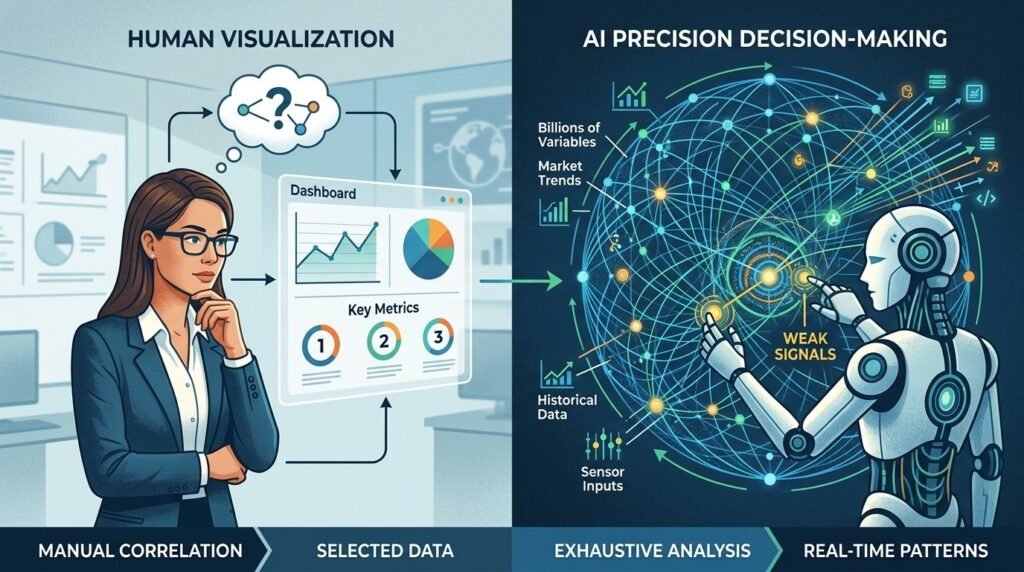
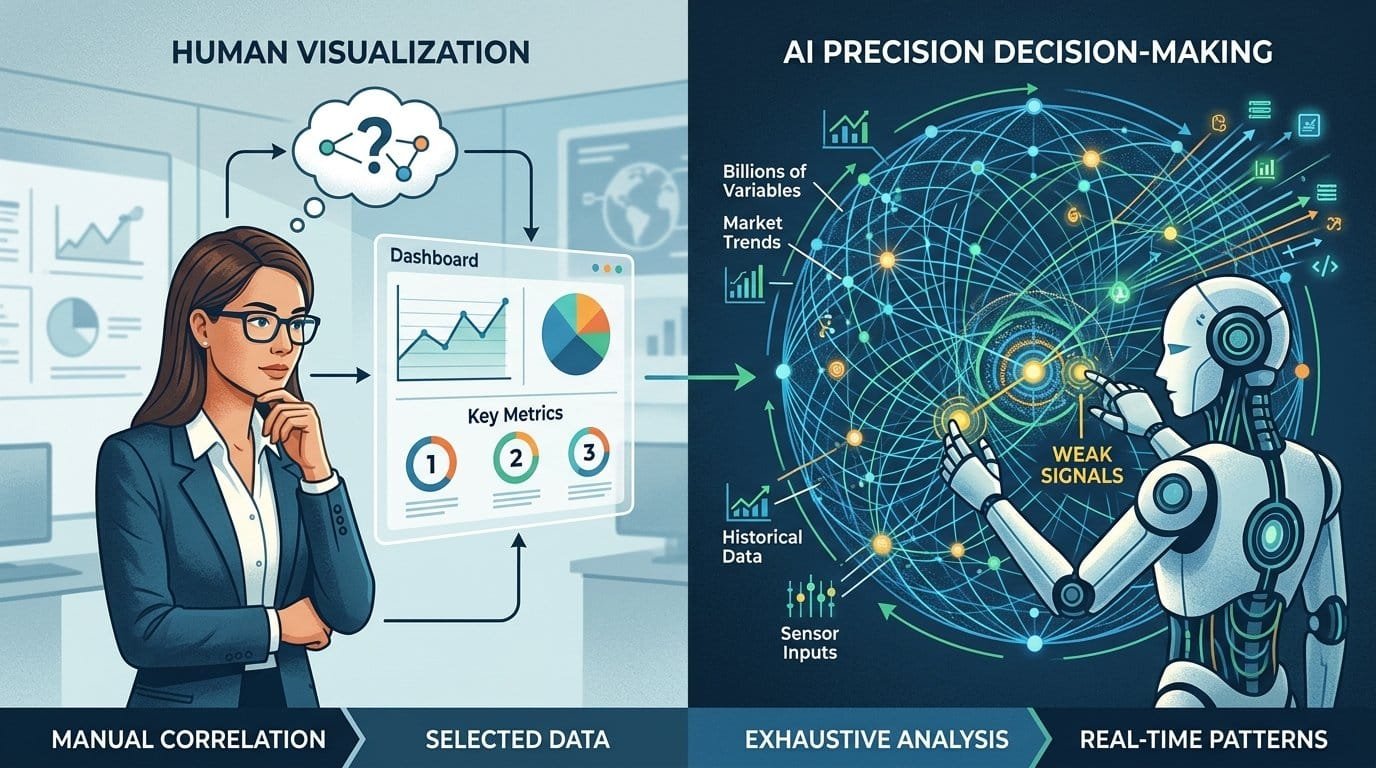
The fundamental value of AI in decision-making lies in its ability to process massive volumes of data — both internal and external — with a level of completeness beyond human reach. Where a human analyzes samples, AI correlates billions of variables in real time to reveal weak signals that are often imperceptible.

Decision optimization: the performance levers
Integrating AI and Machine Learning models delivers concrete benefits in planning cycles:
- Predictive anticipation: AI does not merely analyze the past; it models future scenarios. By anticipating changes in the Belgian market, disruptions in the supply chain, or shifts in consumer behavior, the company gains a head start.
- Neutralizing cognitive biases: Leaders are subject to biases (confirmation, anchoring, overconfidence). AI, by relying strictly on datasets, offers a cool, factual perspective, serving as a counterweight to sometimes misleading intuitions.
- Simulation of complex scenarios (“What-if”) : Testing the impact of a pricing strategy or a structural change in a virtual environment before deploying it in the real world makes it possible to drastically reduce operational risks.
Staying in control: limits and points of vigilance
While AI is a catalyst for power, it also has blind spots. No tool, however high-performing, can replace the responsibility of a leader. A robust business strategy cannot rely solely on algorithmic probabilities.

The challenge of explainability (the “black box” effect)
A major risk concerns the opacity of certain deep learning models. If the algorithm recommends a decision without allowing its logical path to be audited, it becomes difficult to justify strategic choices, especially in highly regulated sectors (finance, insurance, healthcare). Transparency toward stakeholders requires AI to be “explainable”.
Limits not to ignore
To ensure lasting adoption, decision-makers must keep these real constraints in mind:
- Data quality (GIGO – Garbage In, Garbage Out) : An AI is only as relevant as the data that feeds it. Fragmented, outdated, or poorly structured data will inevitably lead to mistaken, even dangerous, decisions.
- Inability to face black swans : AI excels at repeating and optimizing known models. However, it is less equipped to handle unprecedented and disruptive events. Human judgment remains the only one capable of interpreting unpredictable geopolitical or social contexts.
Toward a hybrid approach: the decision-maker as a “curator”
AI-based decision support does not mean replacing human intelligence. On the contrary, it redefines the role of the decision-maker, who becomes a “decision curator”. Leadership does not lose its power; it shifts its focus from gathering information to strategic orchestration.
The three pillars of successful integration
To transform your organization, a structured approach is essential:
- Team acculturation: Technology is nothing without people. Training your managers to read the insights generated by AI is crucial to avoid resistance to change.
- Data governance: Before implementing AI, it is imperative to streamline your data architecture. Clean, accessible data is the foundation of any AI ready strategy.
- Human-in-the-loop: Systematize a human validation step for any critical decision (major investment, market change). AI proposes, humans decide.
Conclusion: adapt to dominate
AI is not a substitute for leadership, but a power multiplier. By combining the machine’s computational capability with the finesse, ethics, and long-term vision of the leader, Belgian companies gain agility and relevance. The future belongs to organizations that can combine algorithmic power with human decision-making wisdom: that is where tomorrow’s true strategic advantage lies.
FAQ: Frequently asked questions for decision-makers
How can I start an AI project for decision-making without major risk?
Start with “low risk, high value” pilot projects (e.g., stock optimization, customer sentiment analysis) to prove ROI before a large-scale rollout.
Can AI replace a strategy consultant?
No, AI provides data and scenarios, but it does not have the contextual and relational understanding essential to lead complex organizational change.
What are the minimum technical requirements?
A data centralization setup (Data Lake or Data Warehouse) and data governance capability that can ensure security and compliance (especially with regard to the GDPR).
Is AI reserved for large companies?
Absolutely not. With the rise of accessible AI tools and cloud solutions, Belgian SMEs can now access predictive analytics capabilities once reserved for large multinationals.