Stress and the Brain: Understanding to Take Better Action
Key takeaway: Much more than just an emotion, chronic stress physically reshapes the brain’s architecture by atrophying memory areas. However, this biological erosion is not fatal: thanks to the brain’s remarkable neuroplasticity, adopting targeted strategies can reverse this structural damage and fully restore neural connections.
Do you feel like your mind is overwhelmed by pressure and never gets a chance to rest? This reaction signals intense cerebral stress activation, a complex biological process that floods your circuits with cortisol and reprograms your neurons. Here, you will discover how to master this neuroscientific mechanism to preserve your cognitive functions and transform this raw energy into resilience.
Stress and the brain: understanding your biological response to stress
Many people mistakenly believe that stress is just an unpleasant emotion, when in fact it is a sophisticated biological mechanism controlled by your brain.
Distinction between stressor and state of tension
Hans Selye laid the foundations for this concept in 1936. He defined stress as a nonspecific response of the body to any demand made on it.
It is crucial to distinguish between the spark and the fire: the stressor is the external agent, while stress is the chemical storm that rages inside you after your brain has assessed the threat. This distinction is key.
Your body is constantly seeking its vital internal balance. When it is disrupted by external factors, it fights to stay on course. What we call “brain stress” is precisely this intense effort of biological adaptation to restore stability.
Acute stress as a lever for immediate survival
Acute stress as a lever for immediate survival
In the event of danger, our body instantly switches to survival mode: energy is massively redirected to where it is vital. Blood leaves the digestive system and flows to the muscles, while the heart speeds up to oxygenate the body in a flash. The true conductor of this mobilization is our brain, which controls these physiological reactions to provide us with temporary armor, essential in an emergency.
The shift to chronic stress
The breaking point occurs when the pressure never subsides. The system races on without pause. Adaptation, which is supposed to protect you, then becomes a permanent internal assault.
Your resources eventually become completely depleted in the face of this demand. Regulatory mechanisms become overwhelmed, and it is no longer a question of survival, but of profound exhaustion. The body pays a heavy price for this uninterrupted tension.
This leads to guaranteed physiological overload. The cardiovascular and immune systems become dangerously exhausted. This is fertile ground for modern diseases linked to our hectic lifestyle.
The areas of the brain that control your reaction to danger
Can you feel that inner chaos? To understand this biological storm, you need to lift the hood of your machine, where three specific regions are vying for control.
The amygdala or emotional alarm center
The amygdala scans your environment without pause. It spots potential threats long before your conscious mind gets involved. It is a biological sentinel that never sleeps.
If it is overstimulated, this area goes into overdrive and becomes hypersensitive. The slightest harmless noise then becomes a signal of immediate danger. You end up living in a state of constant, exhausting alertness.
This is where raw fear arises. It bypasses all logical thinking to force you to act. Your body reacts instantly, without asking for your opinion.
The hippocampus as regulator and archivist of stress
Fortunately, the hippocampus is there to calm things down. It acts as a necessary brake on the amygdala’s overreaction. Its role is to put events into perspective.
He coldly analyzes whether the danger is present or past. He is the meticulous archivist who classifies your memories. He contextualizes the alert to avoid unnecessary panic.
Unfortunately, this structure remains very fragile in the face of cortisol floods. Excessive stress can literally atrophy its neurons. This is the true Achilles heel of your emotional regulation.
The control tower: your last line of defense against chaos
The prefrontal cortex acts as your brain’s control tower. It manages logic and higher executive functions. It is responsible for tempering the irrational impulses of the amygdala.
Thanks to its action, you don’t punch your boss during a tense meeting. It keeps you civilized despite internal pressure. It’s your rational shield against savagery.
But under extreme stress, she completely loses control. Emotions suddenly take the wheel. Any sensible thinking suddenly becomes impossible.
Stress : comment notre corps donne l’alerte ?
But these areas of the brain do not work alone; they use chemical messengers to dictate their orders to the rest of the body.
The command center: a precision chemical relay
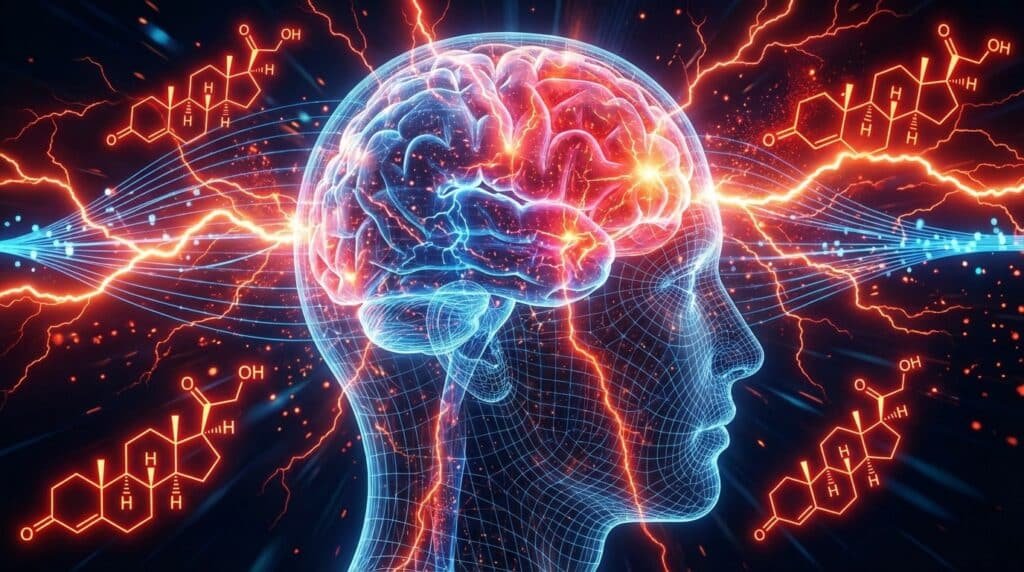
The brain does not work alone; it uses chemical “messengers” to dictate its commands. This is known as the HPA axis (Hypothalamus-Pituitary-Adrenal).
The brain does not work alone; it uses chemical “messengers” to dictate its commands. This is known as the HPA axis (Hypothalamus-Pituitary-Adrenal).
The pituitary gland, a small gland nearby, picks up this signal and immediately releases ACTH into the bloodstream. This hormone travels at high speed to the adrenal glands (located above the kidneys) to tell them to take action.
Adrenaline and noradrenaline for instant action
The adrenal glands trigger an immediate release of these powerful chemical stimulants. Adrenaline acts like your body’s turbocharger, boosting your abilities. It prepares you for physical action in a matter of milliseconds.
The physical effects on your body are massive and instantaneous. Your heart rate skyrockets to pump blood to your muscles. Your brain’s alertness reaches its maximum level to analyze the threat. You become a high-performance survival machine.
These substances also engrave stressful events in your mind. It is an emotional memory mechanism to avoid future threats. You never forget a mortal danger you have encountered in the past.
Cortisol and prolonged energy management
Cortisol releases large amounts of glucose stored in your body. It prioritizes feeding the brain so that it remains alert and sharp. This is the fuel needed to manage the current crisis.
Normally, cortisol eventually tells the brain to stop the alert. This feedback mechanism acts like the thermostat of the nervous system. It must cut off the signal once the danger has passed.
If the signal does not turn off, cortisol becomes toxic. Tissues wear out prematurely and your mind eventually becomes completely foggy. Continued exposure leads to the depletion of vital resources. This is the insidious trap of modern stress.
Brain overload: the toxic cocktail of chronic stress
When this chemistry goes haywire, the damage is no longer just psychological; it becomes cellular and inflammatory.
The broken shield: when the brain becomes inflamed
The biological impact of stress on the brain is as devastating as it is invisible. Under normal circumstances, an ultra-selective protective barrier—the blood-brain barrier—filters every substance, allowing only what is necessary to pass through. But under chronic pressure, this shield becomes porous and lets toxic intruders in.
This is the starting point for neuroinflammation: pro-inflammatory molecules infiltrate the nervous tissue without any filter, creating a state of constant biological irritation. Your brain then literally finds itself “on fire,” trapped in an immune response that never stops.
This loss of protection is a recurring threat to your brain health. Deprived of its natural armor, each neuron finds itself exposed to external aggressions and toxins circulating in the blood. Its very survival is compromised, as it no longer has the purified environment essential to its functioning. This is no longer just a feeling of mental fatigue; it is a real weakening of the architecture of your mind, paving the way for a decline in your cognitive abilities.
The snowball effect: when stress becomes poisonous
Let’s talk about the toxicity of glutamate. Stress releases too much of this excitatory neurotransmitter. Your neurons are overstimulated to the point of total exhaustion.
Dendrites, the small branches that allow cells to communicate with each other, undergo rapid deterioration. The connections between your neurons visibly shrink. Brain communication becomes much less fluid on a daily basis. This leads to a loss of mental agility, which translates into slower thinking and less fluid communication.
Research confirms that cortisol impairs cellular metabolism. This atrophy reduces your cognitive abilities. It is a real biological wear-and-tear mechanism.
The unrestrained brain: the broken balance between calm and excitement
A real chemical imbalance sets in within your neurons. In this biological chaos, neural excitation takes over from inhibition, a mechanism that is essential for allowing your mind to calm down. The result is frustrating: your brain simply forgets how to calm itself down.
You feel like you’re constantly plugged into 220 volts. Rest becomes an abstract and unattainable concept.
You then slip into one of the most cruel symptoms of chronic stress: a state of intense fatigue, but a total inability to disconnect. Your system remains on high alert for no reason, consuming your last reserves of energy without ever giving you the respite you need to recover.
How stress sabotages your brain: the invisible effects
This biological erosion ultimately has a direct impact on your productivity and mental clarity on a daily basis.
When stress “nibbles” away at your memory
Chronic stress acts like an acid that physically erodes the volume of your hippocampus. Brain scans are conclusive: this area visibly shrinks under the continuous assault of cortisol. It is a concrete and measurable loss of gray matter.
Do you forget familiar names or miss important appointments? It’s not just simple forgetfulness; it’s a failure to store new information. It’s an invisible but very real disability that undermines your effectiveness.
The scientific evidence is clear. Stress reduces brain volume and impairs memory, even in people who appear to be in good health.
The locked brain: when stress paralyzes your decisions
Under pressure, your brain locks into rigid behaviors. You repeat the same technical or managerial mistakes, unable to change your strategy. You literally lose the ability to innovate when faced with the unexpected.
Impulsivity skyrockets. We rush toward the easy solution because the brain seeks immediate relief from its discomfort. Long-term strategic decisions suffer greatly as a result.
This distorts your judgment. Biological pressure distorts your perception of the actual risk. Paradoxically, you then become either excessively cautious or dangerously reckless.
Brain overload: the trap of notifications and screen overload
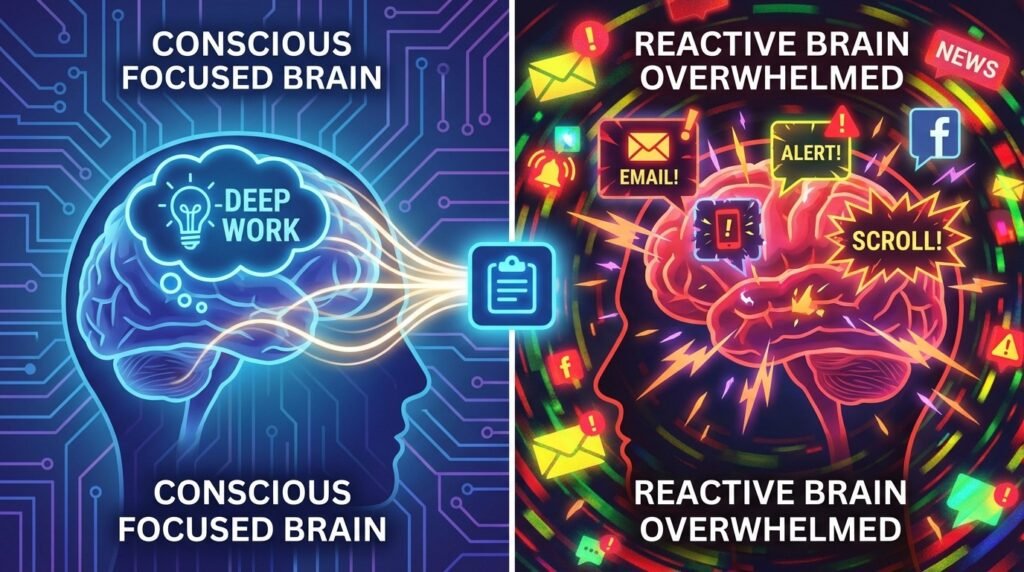
In our hyper-connected world, every notification acts as a micro-stressor that violently assaults your nervous system. It’s not just a simple distraction: it’s a real fragmentation of your attention that opens up constantly. In addition to an email or smartphone alert, you prevent your mind from entering a state of deep concentration. It’s a silent war of attrition against your ability to concentrate, where each interruption nibbles away at your precious mental energy.
Despite its extraordinary capabilities, the human brain is not designed to handle this constant flow of information. This overload directly impacts the prefrontal cortex, the area of the brain responsible for complex decision-making and reasoning. By falling into the trap of multitasking, you cause a drastic drop in your actual productivity: you work more, but with less efficiency. This mental fatigue then sets in insidiously, as your attentional resources are depleted without ever being able to regenerate. Digital stress ends up transforming your daily life into a state of permanent fog, where performance gives way to a feeling of total overwhelm.

Stress: why do we end up “exploding” over nothing?
Beyond logic, it is our ability to feel and manage our emotions that finds itself held hostage.
The overheated amygdala: when the center of fear takes power
Under constant pressure, the amygdala—your brain’s danger sentinel—doesn’t just activate, it physically grows larger. Neural connections in this fear center multiply rapidly. Your brain then specializes in being on constant alert.
This growth leads to increased sensitivity to the immediate environment. Everything becomes potentially dangerous to your overworked nervous system. You jump at the slightest thing or sudden noise. This is the concrete biological basis of chronic anxiety.
A vicious cycle then sets in permanently. The more stressed you are, the more your amygdala grows in size. The more it grows, the more you perceive stress everywhere.
The divorce between emotion and reason
This intensification of fear is accompanied by a worrying breakdown in communication: the weakening of neural connections isolates your prefrontal cortex. Imagine a cable connecting reason to emotion gradually fraying under tension until it breaks. Logic is no longer able to temper raw emotion.
You feel completely unable to rationalize the current situation. You know it’s irrational, but you still tremble physically. Your emotional autopilot has taken over your thinking. Your brain can no longer slow down.
Reactions become completely disproportionate to events. We explode with anger over the smallest everyday trifles. Irritability becomes a default character trait.
From real alertness to generalized anxiety
It is crucial to understand the biological difference between stress and anxiety. Stress is a healthy response to a real and identifiable threat; it is a precise survival mechanism. Anxiety, on the other hand, is fear without any immediate cause, a true “pathology of negative anticipation.”
However, the neurobiological markers differ between these two distinct states. The circuits involved are not identical here. Anxiety takes hold in much broader neural networks. It is a true pathology of negative anticipation.
The transformation of acute stress into a chronic condition is key. Constant repetition eventually creates anxiety disorder. Your brain literally ends up learning anxiety.

Reversing stress: the art of brain self-healing
Fortunately, nothing is set in stone: our brain has an amazing ability to repair itself.
De-programming stress: how to “rewire” your brain
Despite the damage caused by daily stress, it has a fascinating ability called neuroplasticity, a kind of biological superpower that allows it to remodel and repair itself.
Imagine that your neural pathways are like a garden: if stress acts like a devastating drought, neuroplasticity is the rain that allows new shoots to sprout. By activating these recovery mechanisms, you enable your neurons to create new connections and strengthen those that have been weakened, thereby physically reversing the effects of atrophy and mental fatigue.
This biological mechanism does not happen overnight. It is a slow process, but it is entirely achievable. By consciously changing your environment and habits, you send a clear signal to your neurons: it is time to dismantle the networks of anxiety and rebuild those of resilience.
Science confirms this remarkable adaptability. A major study proves that plasticity is a key mechanism in resilience to trauma. The brain reconfigures itself to heal. This is biological proof of your ability to bounce back.
Why sleep is the best remedy for stress
Nighttime is when your chemical balance is restored. Cortisol levels must drop dramatically to calm the body. This is the essential recovery window for the nervous system.
Your brain actively removes metabolic waste. The glymphatic system cleanses toxins accumulated during wakefulness. Without this rest, neuroinflammation progresses dangerously. It’s like a biological nighttime shower.
Sleep repairs the damage caused by stress on memory. It meticulously sorts and archives the information received. This behind-the-scenes work consolidates your memories for the long term.
Artificial intelligence: a new lease of life for your mind
Using artificial intelligence to unburden your mind is no longer an option, but an essential survival strategy. By entrusting the heaviest part of your cognitive load to intelligent tools, you finally allow your brain to take a break.
This is the very principle of augmented cognition: delegating the organization, synthesis, or sorting of data to drastically reduce the mental noise that pollutes your daily life. By freeing up this precious space, you regain the creativity and clarity of analysis that stress had robbed you of.
However, for this system to be effective, technology must never become an additional stressor. Its role is to become a discreet and efficient assistant once again, capable of filtering out urgent matters to limit your daily exhaustion. The ultimate goal is to transform your digital environment into a shield against overload, so that your human intelligence can focus on what truly brings value and meaning.
Three concrete ways to strengthen your brain
To move from theory to practice, here are three concrete ways to strengthen your brain in the face of adversity.
- Calming the inner storm: the power of breath and silence
Mindfulness isn’t just about escaping from everyday life or treating yourself to a simple break; it brings about a real physical transformation in your brain. Medical imaging has now proven that regular meditation practice actually reduces the size of the amygdala, the center of fear that tends to become enlarged under the effect of stress. This is no longer just a promise of well-being, but a tangible structural change: by training your mind to be calm, you physically defuse your internal alert system to regain lasting serenity and better mental health.
In addition, cardiac coherence acts as an immediate biological switch by activating the vagus nerve, the true highway of calm within your nervous system. By adopting rhythmic, deep breathing, you send an instant biological safety signal to your brain. This message is so powerful that it forces the HHS axis (the stress control center) to stop its frantic activity and rest. In just a few minutes, your body’s chemistry changes: stress hormone production drops, giving way to deep recovery. You no longer endure the storm; you learn to calm it from within.
This mechanism has been validated by science. The CNRS (French National Center for Scientific Research) confirms that meditation has a direct effect on stress and optimizes emotional regulation on a daily basis.
- Move to heal: how physical exercise heals your brain
Physical activity doesn’t just build muscle; above all, it is one of the most powerful tools for regenerating your brain. When you exercise, your body triggers a massive production of BDNF. This protein acts like a “biological fertilizer”: it promotes the creation of new neurons and strengthens existing connections. It’s not just a question of physical fitness; it’s an active neuroplasticity strategy that allows your mind to remain malleable, alert, and capable of learning, regardless of your age.
Beyond this rebuilding process, exercise acts as a chemical purification plant. It allows you to directly “burn off” excess stress hormones, such as cortisol, that accumulate during stressful days. If you feel lighter and calmer after a session, it’s because your internal chemistry has shifted into a state of recovery. This natural therapy is a powerful bulwark against anxiety that erodes your faculties.
By exercising regularly, you also protect your hippocampus from atrophy. This area, which is particularly vulnerable to everyday wear and tear, remains large and efficient, ensuring a strong and effective memory. In short, exercise is undoubtedly the best investment you can make to build the ultimate defense against premature cognitive decline.
- The anti-stress diet: nourishing your brain’s protective shield
What you put on your plate directly dictates your ability to withstand pressure. Omega-3s, for example, are not just fats: they ensure the fluidity of your neuron membranes, enabling fast and efficient nerve communication. A brain that is well nourished with these good fats becomes a fortress capable of withstanding shocks without slowing down. Conversely, a deficiency in essential fatty acids weakens your circuits and makes you much more vulnerable to mental exhaustion.
But protection doesn’t stop there. The constant dialogue between your gut and your brain is one of the major pillars of your balance. Your microbiota acts as a true hormonal regulator capable of directly influencing your cortisol levels. By taking care of your gut flora, you are acting on the very source of stress. To complete this shield, foods rich in help your nervous system stay calm, while antioxidant polyphenols extinguish the brain inflammation caused by chronic stress. By eating strategically, you’re not just nourishing yourself: you’re maintaining the complex machine that manages your mental health on a daily basis.
The Pasteur Institute has demonstrated that the microbiota contributes to brain function and regulates your mood. It’s your second brain speaking.
Understanding the neurobiological mechanics of stress is the first step toward overcoming it. While chronic exposure erodes your cognitive abilities, your brain retains a tremendous capacity for resilience. By activating the right physiological levers, you can reverse the tide and transform this biological vulnerability into a lasting adaptive strength.
From survival to resilience: your brain has the final say
Understanding the neurobiological mechanics of stress is much more than just a science lesson: it’s the first step toward breaking your chains. While chronic stress may have eroded your cognitive abilities and fatigued your system for a time, keep in mind that your brain is not a passive victim. It has an absolutely phenomenal capacity for resilience and is just waiting for a clear signal from you to begin rebuilding itself.
By activating the right physiological levers—from targeted nutrition to neuroplasticity through movement and rest—you can reverse the tide. You don’t just erase the damage; you transform what was once a biological vulnerability into a true adaptive strength. Stress then ceases to be a poison and becomes the catalyst for a profound transformation, allowing you to build a stronger, clearer, and more resilient mind that is better equipped to face tomorrow’s challenges.
FAQ
How does stress actually change the way your brain works?
Under the effect of stress, your brain switches from a reflective mode to a survival mode. The amygdala, the center of fear, takes control and “short-circuits” the prefrontal cortex, which is responsible for logic and reasoning. This explains why, in situations of intense tension, it becomes difficult to make rational decisions or control your impulses, as energy is redirected toward immediate vigilance.
What hormones are released by the body in stressful situations?
The stress response orchestrates a precise hormonal cascade via the hypothalamic-pituitary-adrenal (HPA) axis. First, adrenaline and noradrenaline are released for immediate action (increased heart rate, heightened alertness). Then cortisol takes over to supply glucose to the brain and maintain the energy needed for resistance. It is this chemical cocktail that prepares your body for the “fight or flight” response.
Can chronic stress physically damage the brain?
Yes, prolonged exposure to cortisol can become neurotoxic. Chronic stress leads to negative neuroplasticity: it causes atrophy of the hippocampus (the memory center) and a loss of neural connections in the prefrontal cortex. At the same time, it tends to enlarge the amygdala, thereby reinforcing the circuits of fear and anxiety, which creates a vicious cycle of hypervigilance.
How can you limit the negative impact of stress on your memory?
To protect the hippocampus, a key structure in memory that is highly sensitive to cortisol, it is crucial to reduce allostatic load. Sleep is your best ally, as it helps eliminate metabolic toxins and consolidate memories. In addition, reducing cognitive overload (such as digital multitasking) and practicing emotional regulation exercises helps lower cortisol levels, thereby preserving your learning abilities.
Can your brain recover its faculties after prolonged stress?
Fortunately, thanks to neuroplasticity, the effects of stress are not inevitable. Your brain has a tremendous capacity for resilience and can reform neural connections. Practices such as physical activity (which stimulates the production of BDNF, a neural growth factor) and meditation can reverse hippocampal atrophy and restore optimal cognitive functioning.