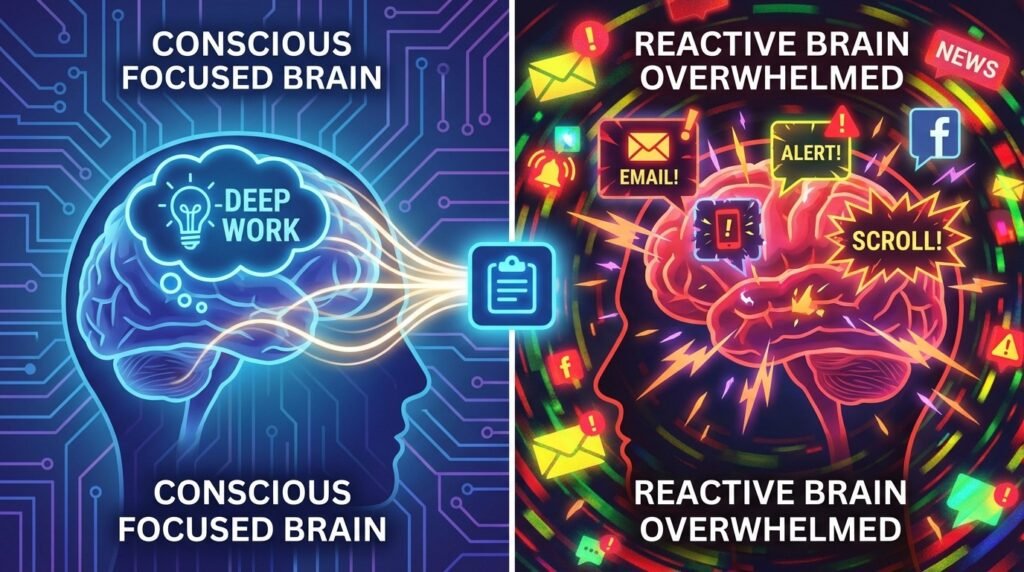

How can you protect your focus in a fast-paced digital world?
Your phone vibrates.
A notification, an email, a “like”… and in an instant, your concentration vanishes.
This seemingly harmless action triggers a biological reaction that drains
your energy long before the end of the day.
At BrainTech.life, we consider your digital attention to be your most valuable asset.
In this age of hyper-connectivity, learning how to protect it has become
a key factor in achieving both performance and peace of mind.
The Biology of Digital Attention: Why Do We Give In?
To regain control of your concentration, it’s essential to understand how our brains respond to stimuli. It’s not a matter of willpower, but of pure neurological function.
The reward circuit and the role of dopamine
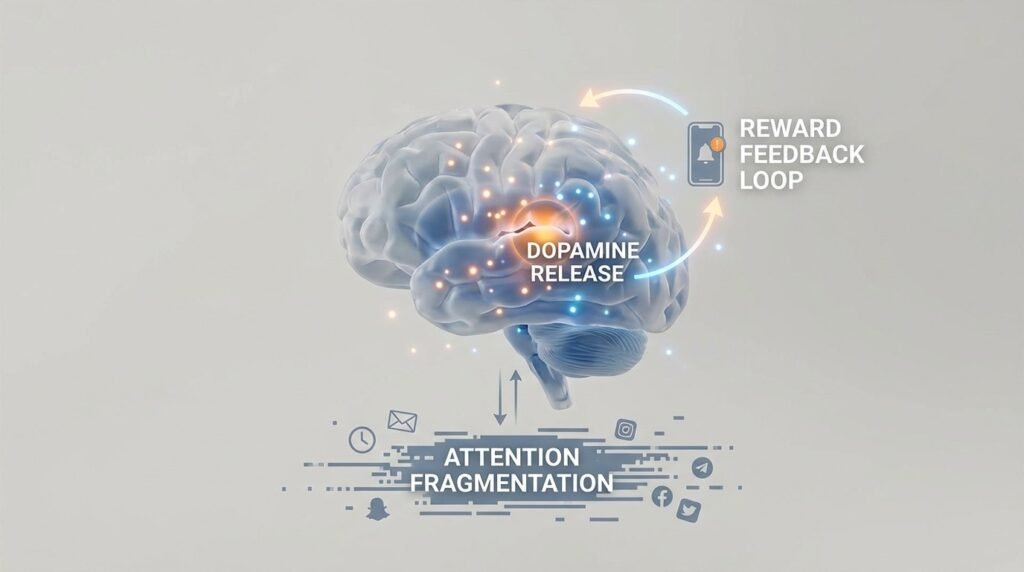
Every notification taps into an age-old mechanism: the reward system.
With every alert, the brain releases a surge of dopamine.
Contrary to popular belief, dopamine isn’t the “pleasure hormone”—it’s the “anticipation hormone.”
It drives us to check our screens “just in case,”
creating a compulsive habit that disrupts our natural train of thought.
Automatic attention vs. voluntary attention:
The battle between the two types of attention
We have two distinct systems: automatic (reflexive) attention, which responds to sounds and lights,
and voluntary (conscious) attention, which is necessary for deep work.
The challenge today is that digital distractions constantly trigger the reflexive mode, preventing your focus from settling on complex tasks.
The Hidden Cost of Distractions on Your Concentration
It is often believed that switching quickly from one task to another is a sign of efficiency.
However, neuroscience is clear: “multitasking” is a cognitive myth that undermines your productivity.
The 23-minute rule: the enemy of deep concentration
A well-known study shows that after a single interruption, it takes an average of 23 minutes to return to a state of deep concentration.
If you check your messages every ten minutes, you’re constantly operating in a state of “attention residue,” never fully tapping into your potential.
Task-switching and cognitive exhaustion
The brain does not process two complex tasks at the same time; it switches back and forth between them.
This “task-switching” consumes a huge amount of glucose in the brain.
The consequences are immediate: early mental fatigue, an increase in errors, and a feeling of “brain fog.”
Set up your workspace to improve your focus
Since willpower is a finite resource, the most reliable solution is to adjust
your environment to minimize temptations at the source.
Protecting the digital space
- Radical decluttering:
Turn off 90% of your notifications.
Keep only what’s personal and urgent. - “Grayscale” mode:
Switch your screen to grayscale.
Without those bright, “dopamine-inducing” colors, your icons instantly lose their appeal.
Why does it work?
“The brain is biologically programmed to be drawn to bright colors (signs of nutrients or danger in nature).
By removing them, you make your phone visually boring.” - AI as a bulwark:
Use AI to sort and summarize your news feeds or automate your routines.
Delegating this mental load frees up space for strategic thinking.
Create a sacred space
Your brain associates places with certain behaviors.
To improve your concentration, put your smartphone away:
just seeing it—even when it’s turned off—takes up some of your mental bandwidth.
A minimalist office immediately calms the nervous system and helps you focus.

Sharpening Your Focus: The Practice of Deep Work
Attention is a skill that can be developed, just like a muscle.
Deep Work involves immersing yourself completely in a task without any distractions.
Set aside blocks of time for deep work
Organize your day into periods of intense focus.
For beginners, the Pomodoro Technique (25 minutes of focused work) is ideal.
Developed by Francesco Cirillo in the late 1980s, this technique uses a timer to divide your work into strict time intervals, known as “pomodoros.”
The standard protocol:
- Focus (25 min): Choose a single task and devote 100% of your attention to it. No emails, no phone calls.
- Short break (5 min): Take a complete break. Stretch, drink some water, but avoid scrolling.
- Repeat this 4 times.
- Long break (15–30 min): After 4 cycles, give your brain a chance to truly recharge.
For strategic projects, aim for 90-minute blocks.
The key is to shield these time slots from any outside interruptions.
The BrainTech.life Rule: The 20-20-20 Rule
To give your brain and eyes a break during periods of intense focus, follow this simple routine:
Every 20 minutes, look at an object 20 feet (about 6 meters) away for 20 seconds.
This action breaks the “cognitive fixation” and resets your visual system, instantly reducing accumulated fatigue.
Reading exercises to improve concentration
Reading a physical book for 20 minutes every day remains one of the best ways to train your ability to focus.
It’s the perfect antidote to short-form videos that erode your ability to maintain focus over the long term.

Common mistakes to avoid
Even with the best intentions, certain habits can undermine your efforts to concentrate:
- Digital “mindless scrolling” first thing in the morning:
Checking your phone as soon as you get out of bed floods your brain with dopamine
before your conscious attention has even kicked in. - Believing that music with lyrics helps:
The brain uses some of its energy to process language.
Opt for white noise or instrumental music instead. - Skip the breaks:
Concentration works in cycles.
Working for four hours straight without a break drastically reduces the quality of your final decisions.
FAQ :
Your questions about concentration and digital attention
Is multitasking really an effective way to save time?
No.
The brain does not process two complex tasks simultaneously;
instead, it switches back and forth between them (task-switching).
This increases stress and reduces overall productivity by 40%.
Why is it so hard to resist notifications?
They trigger our automatic (reflexive) attention and create a dopamine-driven anticipation.
Modern interfaces exploit this biological need for novelty.
How can I tell if I’m experiencing cognitive overload?
Common signs include irritability, difficulty making simple decisions, eye strain, and the feeling that you have “too many tabs open” in your head.
Can AI really help you focus?
Yes, as long as you use it to delegate repetitive tasks.
By automating the sorting of information, AI frees up your energy for deep work.

Conclusion :
Regain control of your mind
Regaining control of your attention allows you to work more efficiently, learn faster, and drastically reduce your stress.
By adapting your environment and sharpening your focus, you can turn technology into a source of personal power.
Your challenge for today:
Turn on “Do Not Disturb” mode for the next 60 minutes of work
and keep your phone out of sight.
Notice how the light begins to shine.
At BrainTech.life, we help you make your brain your greatest ally.