
What are the most effective ways to improve concentration?
Practical techniques for staying focused longer
Does your attention span start to fade after just 40 seconds of dealing
with constant notifications and exhausting multitasking?
Contrary to popular belief, concentration isn’t a fixed trait:
it’s a muscle that can be trained.
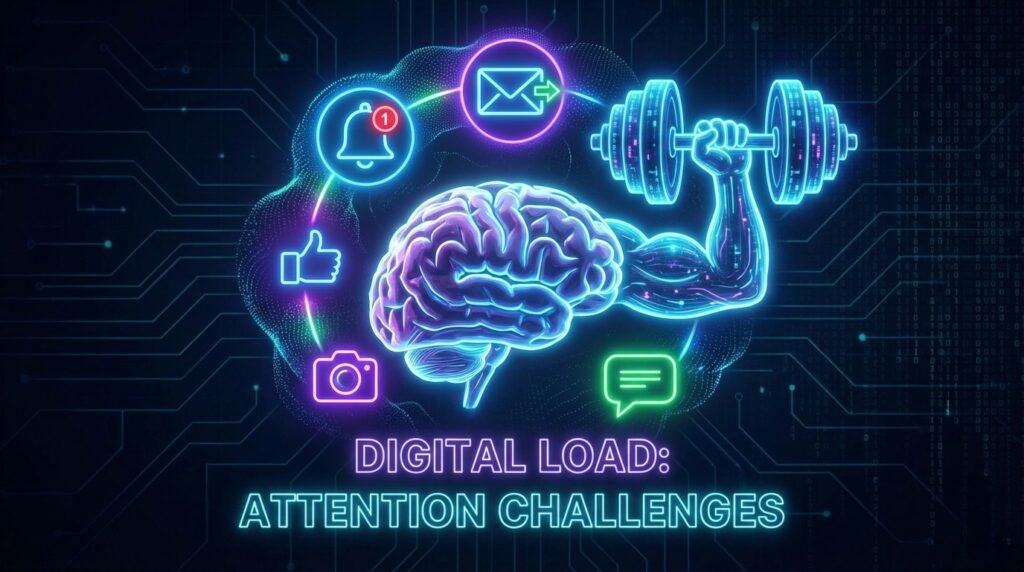
In this article, you’ll discover practical, proven techniques to improve your concentration,
stay focused longer, and work more efficiently—whether you’re at the office, at home, or even on the go.
Mechanisms of Attention:
Why Has Focus Become a Challenge?
Before you start building up your willpower, it’s time to take a closer look at the biological mechanisms that govern our ability to stay focused.
Distinguishing between sustained, selective, and alternating attention
Attention is not a monolithic entity. It can be broken down into three functions:
- Sustained attention: The ability to maintain focus on a task for an extended period of time.
- Selective attention: The ability to choose what to focus on while ignoring distractions (the “filter”).
- Task-switching: The ability to switch effectively from one task to another without losing one’s train of thought.
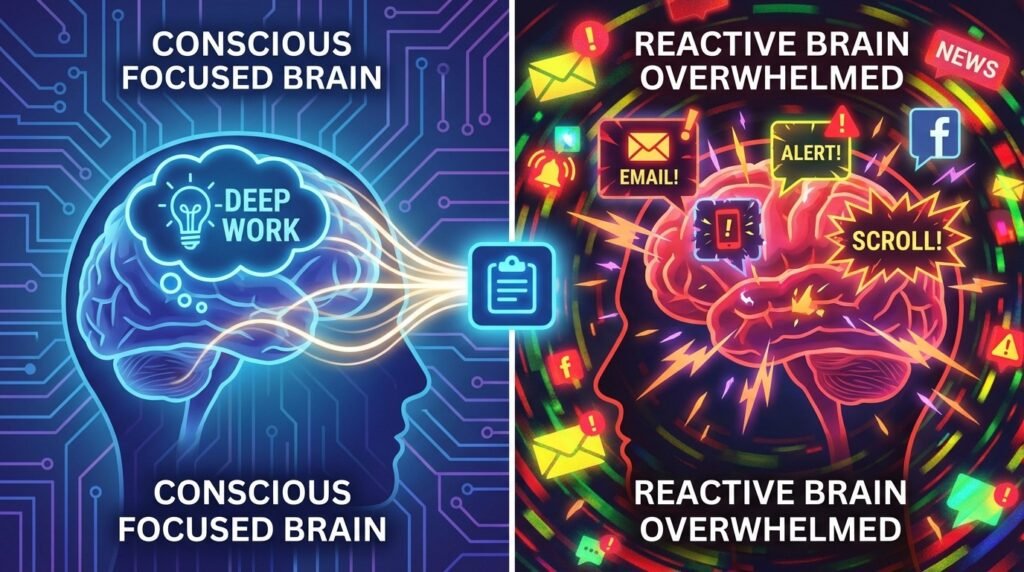
The struggle between proactive focus and reactive mode
Directed focus requires a conscious and deliberate effort on your part.
In contrast, reactive attention responds automatically to stimuli (a flash on the screen, a noise).
Your brain naturally favors the ease of the reactive mode.
Strengthening your willpower is therefore the only way to sustain conscious cognitive effort.
The True Cost of Multitasking and Attention Fragmentation
Multitasking is a myth.
The brain does not process two complex tasks at the same time; it simply switches back and forth between them.
Every time you switch tasks, it leaves a residual trace of attention: part of your mind remains focused on the previous task, overwhelming your working memory and slowing down information processing overall.
A survey by Sciforma also highlights the fact that it is impossible to stay focused for more than 12 minutes without a break in a typical work environment.
Time Management Strategies for Sustained Focus
Understanding the theory is a good start, but excellence comes from proven structuring methods.
Pacing Your Work with the Pomodoro Technique
The Pomodoro Technique (created by Francesco Cirillo) uses time pressure to boost concentration while preventing mental fatigue:
- Focus session (25 min): Focus exclusively on a single task.
- Actual break (5 min): Complete disconnection (no screen).
- Cycle: After 4 sets, take a 15- to 20-minute break.
Use apps like Pomofocus or TomatoTimer to time your sessions.
Respect the circadian rhythms
The body operates in 90-minute energy cycles.
Learn to identify your natural peaks in alertness (often in the morning) so you can schedule your most complex tasks during those times.
Scheduling your sessions according to your chronotype is the easiest way to double your productivity without any extra effort.
BrainTech.life Tip: After four 25-minute sessions, take a longer break of 15–20 minutes.
Deep Work: Creating a Sanctuary for Your Focus
Inspired by Cal Newport, Deep Work involves immersing yourself completely in a demanding task without any distractions.
- Turn off 90% of your notifications.
- Use website blockers (such as Forest or Freedom) to secure your digital space.
- AI at your service: Let AI handle the logistics so you can save your mental energy for the real work.
Organize and Prioritize (Eisenhower Matrix)
Don’t let your brain take the easy way out by defaulting to “reactive” mode.
* Categorize your tasks as Urgent vs. Important.
* Break down your complex projects into small steps to avoid cognitive overload.
* Schedule your sessions for when you have the most energy (morning, afternoon, etc.).eilleure énergie (matin, après-midi…).
Mental Fitness: Training Your Brain for Calmness and Precision
Attention isn’t a gift; it’s a skill that can be strengthened through practice.
To improve your focus, you need to train your brain to resist distractions and process information quickly.
- Mindfulness meditation:
Don’t think of this as a mystical practice, but rather as training in redirecting your attention.
By practicing just 10 minutes a day, you strengthen your prefrontal cortex.
The goal is simple: notice when your mind wanders and consciously bring it back to the present moment.
It’s the ultimate antidote to digital distraction. - Cognitive challenges:
Take your brain out of its comfort zone.
Puzzles, memory exercises, and brain-training apps (such as Lumosity or Peak) stimulate neural plasticity.
These games aren’t just for fun:
They challenge your brain to form new connections, thereby improving your processing
speed and resistance to mental fatigue.
The BrainTech.life reflex:
Mix things up.
A brain that is accustomed to a single type of exercise eventually stops developing.
Alternate between meditation for calmness and logic games for mental alertness.
Lifestyle habits that boost concentration
Your lifestyle determines your brain function.
Without a healthy body, no time-management technique will work wonders.
Sleep and Hydration: Cleansing the Brain
Sleep is vital:
At night, your brain activates its glymphatic system to flush out toxins and consolidate what you’ve learned.
When it comes to hydration, keep in mind that a drop of just 2% in your body’s water content can impair your cognitive function and cause “brain fog.”
Drink water regularly to maintain optimal nerve function.
Diet and Blood Sugar: Avoiding a Crash
The brain uses a lot of energy, but it hates sudden changes.
- Prioritize:
Omega-3s (fatty fish, nuts), protein, leafy greens, and berries
to help stabilize mood and support neural function. - Avoid :
Fast-acting sugars that cause a spike in insulin followed by a sudden crash,
leaving you irritable and unable to concentrate.

Tools and Environment:
Create a sanctuary for focus
Putting up a barrier against digital distractions
The environment always wins out over willpower. Automate your silence:
- Turn off 90% of notifications on your smartphone and computer.
- Use website blockers (such as Forest or Freedom) to secure your work environment.
- Set aside a dedicated physical space for deep work. Your brain will associate that space with automatic focus.
The Brain Dump
Keep a notebook handy.
As soon as a distracting thought pops into your head (“Buy bread,” “Reply to X”), write it down immediately.
This allows you to set it aside from your working memory and stay focused
on the task at hand without worrying about forgetting it.
AI and “Deep Flow”
Let AI handle complex planning so you can conserve your mental energy.
Use white noise or alpha frequency generators to block out
distracting noises and help you quickly enter a state of flow.
FAQ :
Your questions about concentration
Why is it so hard to stay focused these days?
Your attention is being captured by interfaces designed to trigger dopamine release.
Over the past 20 years, the average attention span has dropped from 2 minutes and 30 seconds to just 40 seconds.
Does music really help?
Yes, if it’s instrumental or “white noise.”
Lyrics engage the language centers of your brain, which reduces the energy available for your main task.
Is it possible to stay focused all day long?
No
Concentration works in waves (ultradian cycles).
Aim for 3 to 4 hours of intense focus each day; the rest of the time should be devoted to lighter tasks.
Conclusion
Improving your concentration requires a combination of practical techniques, healthy lifestyle habits, and self-reflection.
The methods presented—the Pomodoro Technique, blocking out distractions, meditation, task organization, and creating an optimal environment—have all been proven effective for staying focused longer.
Start by choosing one or two and gradually incorporate them into your routine.
If you do this consistently, you’ll soon notice an increase in your productivity and mental clarity.