
Mental rumination:
How to reprogram your brain to stop negative thoughts?
Have you ever felt like your mind doesn’t have an “off” switch?
That the same catastrophic scenarios, regrets, or worries about the future keep looping, undermining your concentration during the day and your sleep at night?
This phenomenon, mental rumination, is far from being just a personality trait. It is a neurological process that puts your body and mind into a state of chronic stress. Understanding the underlying mechanisms of this cognitive “overheating” is the first step toward regaining control.
Here is how, by relying on brain plasticity, you can reprogram your brain to get out of the dead end.
Understanding rumination: when the brain runs in circles
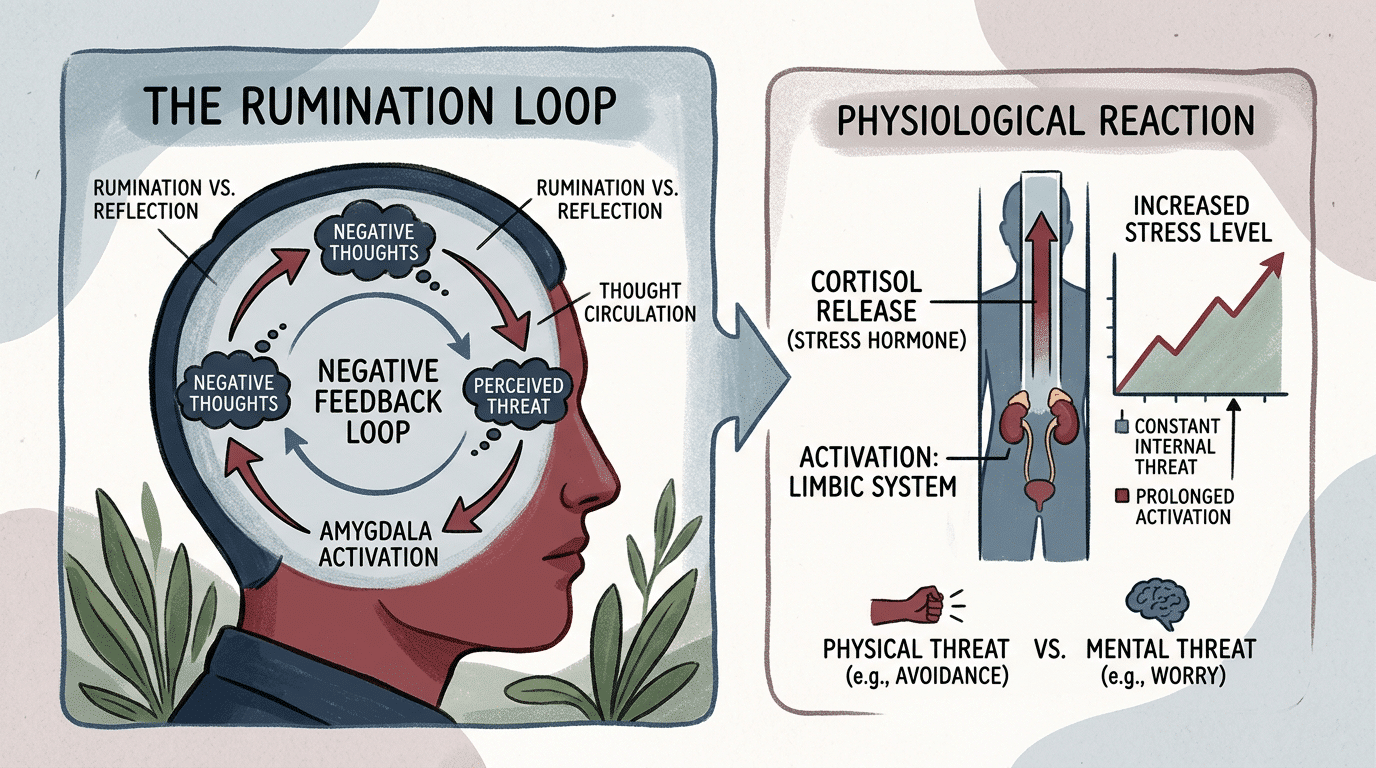
Mental rumination is not simply deep thinking. It is a negative feedback loop. When you keep replaying a thought, your brain interprets it as an immediate threat.
The limbic system, especially the amygdala (our danger-detection center), becomes activated and triggers the release of cortisol, the stress hormone. Unlike a real physical threat — such as avoiding a skidding car — rumination is an endless virtual loop. Your nervous system is kept in a state of maximum alert with no outlet, which drains your cognitive resources.
By repeating these patterns, you strengthen specific neural connections linked to anxiety.
The brain, in the interest of saving energy, automates this pathway (“the path of least resistance”): by neurological habit, you become an expert in pessimism.
Why does your mind try to “overthink”?
The human brain is designed for survival, not happiness.
By constantly scanning for potential problems, it thinks it is “protecting” you. This mechanism, called anxious anticipation, becomes pathological when it turns into sterile rumination: instead of solving a problem, you only analyze the possible consequences without ever taking action.
The visible consequences on your cognitive abilities
Prolonged rumination does not stay “in your head”; it physically alters your performance:
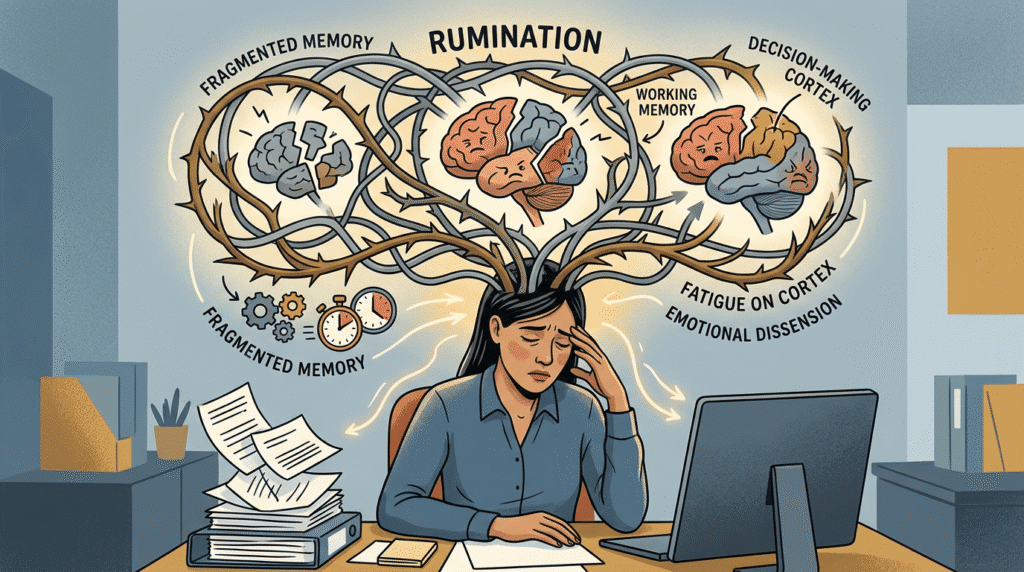
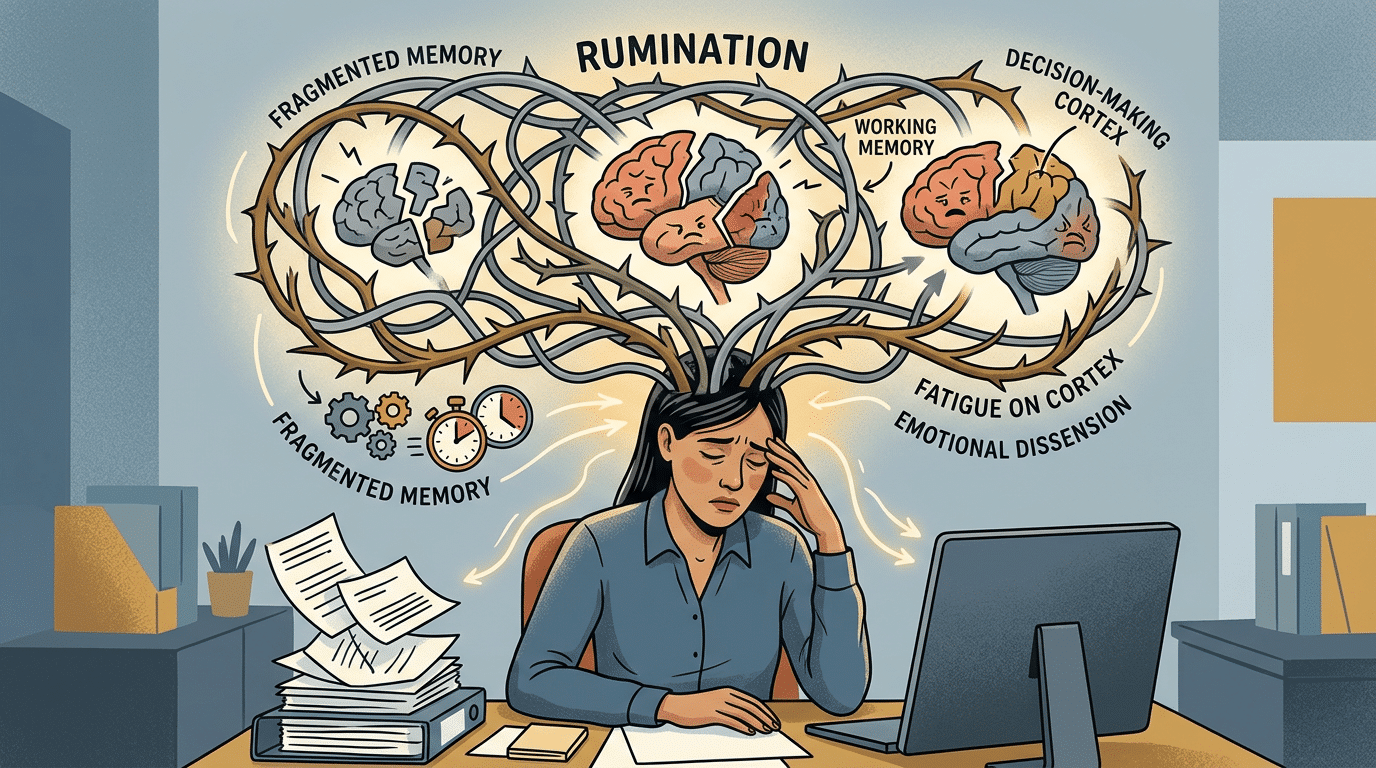
- Fragmentation of working memory: Stress occupies valuable mental bandwidth, making concentration difficult.
- Decision fatigue: The constant process of threat assessment exhausts the prefrontal cortex, making every everyday decision feel heavier.
- Emotional imbalance: The dialogue between the prefrontal cortex (the seat of reason) and the amygdala is disrupted, reducing your ability to regulate your emotions.
Neuroscientific strategies to stop intrusive thoughts
To break this cycle, there is no point fighting the thought — that is like trying not to think about a pink elephant. Instead, you need to act on the neurological network to force the brain to switch into another mode of operation.
1. “Grounding” (sensory anchoring)
The default mode network (the “daydreaming” or rumination mode) is deactivated as soon as you engage your senses.
The 5-4-3-2-1 method is an effective emergency technique:
- Identify 5 objects you can see.
- 4 things you can touch.
- 3 sounds you can hear.
- 2 smells you can detect.
- 1 thing you can taste (or a positive emotion).
This forces an immediate cognitive release toward the prefrontal cortex.
2. The “Brain Dump” (cognitive unloading)
Rumination thrives in the abstract. By writing down your thoughts, you materialize them. The brain, seeing the information “stored” outside itself, no longer needs to maintain the constant recall loop. It is a simple method that instantly frees up mental load.
3. Meditation to shape your brain
Neuroscience research is clear: regular mindfulness practice changes the density of gray matter. By training yourself to observe your thoughts without reacting to them, you weaken the connections between the amygdala and the conscious brain. Over time, the ability to “detach” from rumination becomes a neurological reflex rather than an exhausting conscious effort.
FAQ: Better understanding and managing rumination
Is rumination a symptom of depression?
If rumination is a central pillar of anxiety and depressive rumination, it is also common during periods of intense stress. If it affects your daily life over time, it is recommended that you consult a mental health professional.
How long does it take to change my thinking habits?
Thanks to neuroplasticity, the first changes can be observed quickly with daily mindfulness exercises (even 10 minutes a day). However, consolidating these new “neural pathways” requires repetition over several weeks.
Is it possible to stop negative thoughts completely?
The goal is not to eliminate negative thinking — which is biologically impossible — but to change your relationship with it. The idea is to move from “I am my thoughts” to “I observe my thoughts,” which reduces their emotional impact on your nervous system.
Want to go further? Don’t let your thoughts run your life anymore. The next time the cycle starts, choose an immediate physical action: stand up, walk, or change your environment. Break the loop through movement.