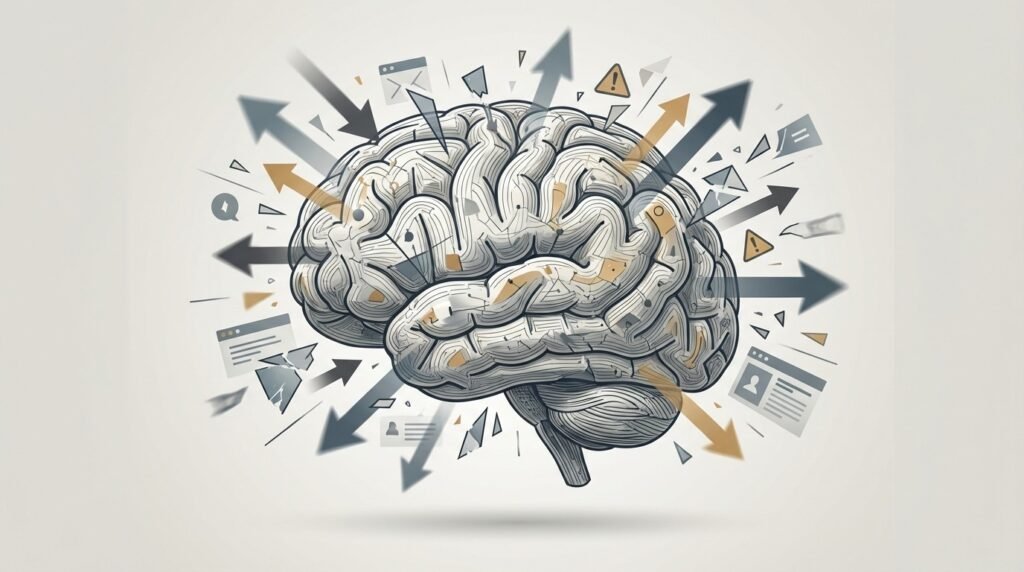

Digital mental load: when your brain sounds the alarm
In an ultra-connected professional and personal environment, technology, although essential, has become a major source of cognitive friction.
The continuous flow of demands — emails, instant messaging, app alerts — has transformed the way we work and live. This digital omnipresence generates what experts call digital mental load.
When the brain is constantly stimulated by technological inputs, it loses its ability to filter what matters, leading to lasting mental overload. How can you recognize the symptoms of this invisible fatigue and, above all, regain control of your attention?
This article explores how to navigate the era of hyper-connectivity without sacrificing your cognitive abilities.
What is digital mental load?
Digital mental load is not just about the number of hours spent in front of a screen.
It is the cognitive cost generated by managing your tools and information flows. Every notification, every switch between two windows (the famous multi-tasking), and every quick decision about an email consumes precious brain energy.
In neuroscience, this is called a switching cost: every time you move from task A to activity B (checking your messages), your brain needs an adjustment period to refocus. Multiplied dozens of times throughout the day, these interruptions fragment your “working memory,” preventing access to deep work (deep work), that state necessary for creativity and high-quality productivity.

Mental overload at work: warning signs
Digital fatigue is not an abstract concept.
It shows up through clinical and behavioral signs that are increasingly common in office environments:
- The inability to maintain focus: You feel an irresistible urge to check your notifications after only a few minutes of working on a complex task.
- The feeling of constant urgency: The illusion that a message sent now requires an immediate reply, creating unnecessary stress.
- Decision fatigue: By the end of the day, making simple decisions becomes difficult because your brain has used up its energy reserves on trivial digital details.
- Increased irritability: Difficulty tolerating unexpected events or outside demands, often linked to sensory overload.
- Cognitive scattering: An increase in typos, forgotten files, or difficulty prioritizing your real tasks in the face of digital “noise.”

The addiction mechanism: why is it so hard to stop?
Our brain is wired to be drawn to novelty.
Every notification stimulates the reward circuit through a release of dopamine. This feedback loop creates a behavioral addiction: we do not check our phone to process information, but to soothe the anxiety triggered by the idea of “missing out” (FOMO – Fear of Missing Out).
Over time, this vicious cycle weakens our prefrontal cortex, the area responsible for self-regulation, planning, and complex thinking. By outsourcing our attention to notifications, we become passive receivers instead of proactive actors in our day.
How to free your mental space: actionable strategies
The goal is not to eliminate technology, but to move from imposed use to chosen use.
Here are three pillars for lightening your mental load:
1. Adopt asynchronous communication
Nothing requires an answer within seconds, except in rare cases. Clearly communicate your availability windows to your colleagues.
Turn off “push” alerts from your messaging apps (Slack, Teams, WhatsApp) and set fixed time slots to handle your messages.
This way, you work in time blocks, which are much more efficient.
2. Sort through your digital “pollution”
Apply the principle of sparseness: every notification that does not directly contribute to your priority goals is a parasite.
Turn off all non-essential alerts on your smartphone and computer.
Clean up your virtual desk: fewer icons on screen means fewer visual demands on your attention.
3. Make cognitive silence a ritual
The brain needs “downtime” to consolidate information and regenerate its resources. These moments must be fully disconnected.
Practice “emptiness”: walk without headphones, have lunch without checking your emails, or dedicate the first hours of your morning to deep work, with no digital interference at all.
FAQ: Better understanding to act better
Can digital mental load lead to burnout?
Yes. Prolonged cognitive overload prevents nervous system recovery. If warning signs (fatigue, irritation, disengagement) are not taken into account, this can indeed contribute to severe professional burnout.
Is multi-tasking a solution?
On the contrary. The human brain is not designed for multi-tasking, but for switch-tasking. Moving quickly from one task to another temporarily lowers your IQ and drastically increases the time needed to complete a mission.
How long does it take to regain control?
Brain plasticity makes it possible to change habits quickly. By following a digital detox (such as turning off non-critical notifications) for 7 days, users often report a significant drop in their anxiety and fatigue levels.
Technology should be a lever serving your ambitions, not a wall that keeps you from thinking. By becoming aware of your cognitive limits again, you are doing more than working better: you are protecting your most precious asset, your attention.